






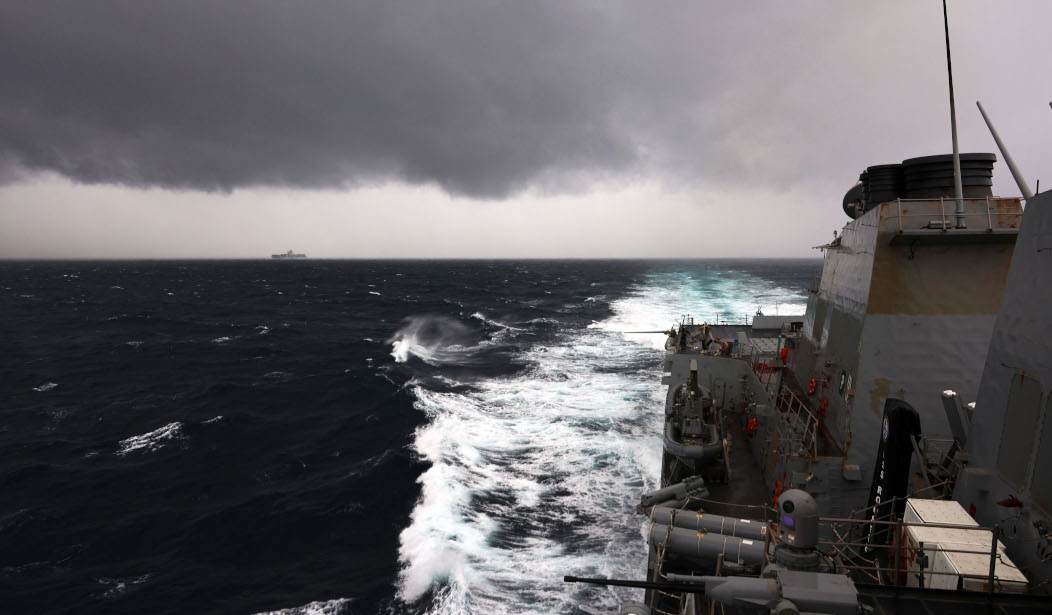
The Trump administration is demanding that Iran say, out loud and in public, that the Strait of Hormuz is open and that its forces will stop firing on commercial ships, and it wants that admission by Saturday.
That demand, relayed to Tehran both directly and through regional mediators, comes from three U.S. officials who briefed reporters Friday, as first reported by Axios. Iran has already broken one commitment on shipping. The administration wants proof it can be trusted to keep a much bigger one on its nuclear program.
Admin Says There Won’t Be a “Good Outcome” Without It
U.S. officials were blunt about what happens if Iran does not deliver the public statement they’re looking for. One official told Axios the administration expects Iran to say that every channel in the strait is open and toll-free, and to at least implicitly admit it made a mistake. A second official put it more directly: if that isn’t Tehran’s position by Saturday, “it is not gonna be a great day for them.”
Read More: 'Locked and Loaded': Trump Says 1,000 Missiles Will Drop on Iran If They Keep Trying to Kill Him
Iran’s account of how the talks got here differs sharply from Washington’s. A U.S. official claimed Iranian representatives reached out after this week’s skirmishes and acknowledged the attacks were an error. Baghaei denied on Friday that Iran had requested any negotiations with the U.S., saying Tehran only agreed to a request from Qatari mediators to discuss the matter.
Iran’s top negotiator, Mohammad Bagher Ghalibaf, made clear Tehran isn’t taking the American demands at face value. Ghalibaf said this week that Iran remains “distrustful of the Americans,” according to CNN, and reiterated that Tehran will continue to defend itself.
A Three-Week-Old Deal Already on Life Support
The dispute is once again centered on the increasingly fragile memorandum of understanding that Iran and the United States signed last month, an agreement meant to formalize an end to hostilities and set up 60 days of negotiations over Iran’s nuclear program. Within weeks, Iranian forces were firing on commercial vessels in and around the strait again, according to U.S. officials, triggering exchanges of fire that pushed the fragile truce toward collapse.
President Trump has already declared the ceasefire over once this week, even as he agreed to keep talking. U.S. officials now argue that if Iran cannot honor a commitment as basic as not shooting at cargo ships, it raises real doubts about whether Tehran can be counted on to follow through on a far more complicated nuclear agreement.
Oman Becomes the Venue for a Make-or-Break Meeting
Iranian Foreign Minister Abbas Araghchi traveled to Muscat on Saturday to meet his Omani counterpart, Sayyid Badr al-Busaidi, a trip Iranian state media framed as a continuation of talks that have been underway for a month or two, according to Arab News. Oman has positioned itself as a key broker throughout the crisis. It had already opened a southern shipping channel near its own coast before the MOU was even signed, a move U.S. officials say infuriated Iranian negotiators who saw it as weakening their leverage.
Read More: Iran Shuts Down the Strait of Hormuz Again, Says the U.S. Breached the Islamabad Deal
Iranian negotiators privately told their American counterparts that hardline elements within the regime opened fire on ships specifically to claw back that leverage, Axios reported, citing three U.S. officials. Publicly, Iranian officials, including Islamic Revolutionary Guard Corps commanders, have taken the opposite line, insisting Tehran must retain control over navigation through the strait.
Iran’s Foreign Ministry spokesperson, Esmail Baghaei, said the Oman visit would focus on maritime security and that Tehran has been resolute in meeting its obligations under the agreement. Iran’s ambassador to the United Nations has staked out an even harder position, according to List25, telling the U.N. that Iran alone gets to decide what happens with the waterway, a claim at odds with the strait’s long-standing status as an international shipping route.
Editor's Note: For decades, former presidents have been all talk and no action. Now, Donald Trump is eliminating the threat from Iran once and for all.
Help us report the truth about the Trump administration's decisive actions to keep Americans safe and bring peace to the world. Join RedState VIP and use promo code FIGHT to get 60% off your VIP membership.
Join the Conversation
VIP members get the ability to comment on articles.