
An interesting debate is occurring across America, and it’s not your usual conservative vs. liberal argument. While our ever-exploding technological capabilities can be used to make us safer, the expanding surveillance operations raise serious questions of privacy and whether the government needs to know every little thing about us and where we are every second of every day.
What’s causing all the sudden headlines? It’s partly because Flock Safety’s network of artificial intelligence-powered cameras has now crossed a milestone: 100,000 units have been deployed across the United States, and they can track your every move with automatic license plate readers (ALPRs).
It might seem like a simple issue: “Don’t tread on me, man, stop surveilling me, and get lost; I’m doing nothing wrong.” But the technology has sometimes averted tragedy, as I wrote about in April:
North Carolina Man Arrested in Florida Over Alleged Festival Shooting Plot
— Breaking911 (@Breaking911) April 23, 2026
A North Carolina man accused of plotting a mass shooting at a New Orleans festival was arrested in Destin, Florida, after authorities used the Flock camera system to locate him, according to the Okaloosa… pic.twitter.com/ie782nhf1h
North Carolina Man Arrested in Florida Over Alleged Festival Shooting Plot
A North Carolina man accused of plotting a mass shooting at a New Orleans festival was arrested in Destin, Florida, after authorities used the Flock camera system to locate him, according to the Okaloosa County Sheriff’s Office.
Christopher Gillum is facing extradition to Louisiana after deputies say they recovered a handgun and about 200 rounds of ammunition from his hotel room, where he was allegedly planning the attack.
And yet, there have also been some major missteps, including this near-disaster on Thursday:
🚨 FLOCK ERROR = GUNS DRAWN
— Jason Bassler (@JasonBassler1) August 8, 2026
Police shut down I-94, boxed in a silver SUV, and held two people at gun point after Flock cameras flagged the car as “connected to a homicide.”
Except it wasn’t.
The alert was outdated.
Authorities forgot to remove it.
Trust the algorithm.™ pic.twitter.com/stzXSeyL1w
RedState’s Teri Christoph has been providing excellent coverage of the issue:
Flock Cameras Just Got Even Creepier
Flock Cameras Are Turning America's Roads Into a Surveillance Dragnet (VIP)
As Teri wrote, these things capture a whole lot of information:
Flock Safety builds a "vehicle fingerprint" that captures things like your car's make, model, and color, and also unique car features such as dents, roof racks, and even bumper stickers; it also stores information like your car's location, date, and time. All of this information then becomes searchable data points for police ... and others.
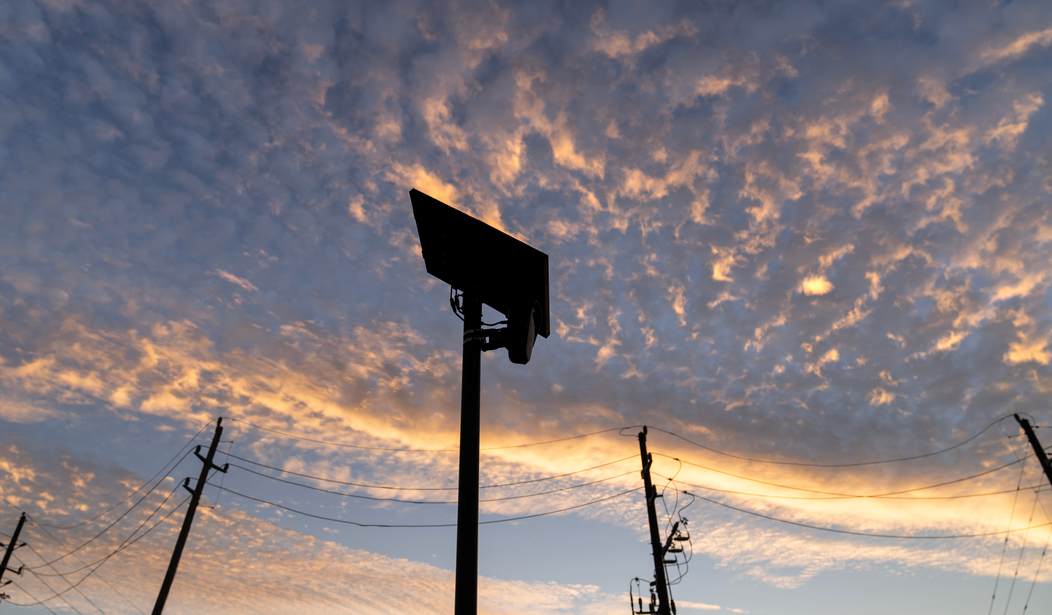
I vividly remember my first encounter with what I assume was a Flock system (or something similar) — it was at the height of COVID, and when I went to the grocery store, there was suddenly this tall, gangly, dystopian-looking structure with a flashing blue light in the parking lot. Nobody could tell us what it was. The overlords were spying on our pandemic guidance fealty, I figured. Par for the course for California. Soon they started appearing in parking lots at numerous locations. All these places already had surveillance cameras, so what was different about these ones?
Presumably, they are much more powerful than your Ring doorbell, and they sized up who you were and what you thought in an instant. If the Democratic Socialists of America get their hands on that information, a whole lot of us are going to be in dire straits.
Now, many Americans say they’ve seen enough.
Communities across the U.S. are cutting ties with Flock Safety, one of the country’s leading producers of license plate readers and other surveillance systems, over concerns around mass surveillance and data privacy — and fears over how data could be used in immigration crackdowns.
Residents have swarmed city council meetings in states where Flock cameras have cropped up to urge elected officials to cancel contracts or deactivate Flock cameras — arguing that the technology could be used to track people traveling to places of worship, medical care centers, political protests and other sensitive locations.
Often it’s not just the programming that can cause problems; it's the people who have access to it.
Six former Savannah Police Department employees are under criminal investigation after being fired for allegedly misusing surveillance cameras made by Flock. https://t.co/E5soS6KzA2 pic.twitter.com/cYdSn04eTP
— ABC News (@ABC) August 9, 2026
That doesn’t mean, however, that we shouldn’t ask questions about the system itself. You see, many local law enforcement agencies thought they were approving a local crime-fighting network, but they failed to realize that the internet’s so-called “cloud” changes the game:
What many cities didn't fully grasp when they signed up — sometimes after a free trial, sometimes after a pitch about solving car thefts — is that the system was never purely local. By default, many contracts enabled the national lookup feature, which allows law enforcement agencies anywhere in the country to query the data a specific city collected. The more cities joined, the more useful and the more expansive the shared network became.
The blowback against the widespread use of Flock initially came from leftists, who worried that the cameras would be used to track illegal aliens (God forbid). But many libertarians and conservatives have now also raised the alarm — when is giving up our liberties too high a price to pay for increased safety?
I myself have mixed feelings, because the tech has arguably stopped horrific crimes and has helped nab vicious criminals. It is undeniable, however, that some have used it for their own nefarious purposes.
I operate under the assumption that everything I do on the internet is monitored, and that every move I make when out and about is seen and recorded. Pause for a moment the next time you’re outside your grocery store or at your local mall. Notice just how many cameras are subtly attached to walls, ceilings, columns — basically, everywhere. And don’t even think about all the smart devices in our lives that are uploading every detail about you to the webosphere.
But I don’t actually care that Alexa knows I made chicken pot pie last night (I asked her a question about the consistency of the roux), because I can’t imagine anyone or anything would give a spit. On the other hand, I’m not so naïve that I’m unaware that our information could be used to harass, intimidate, and punish.
This will continue to be a defining discussion in modern times as the technology, and not our own minds, almost seems to be driving the future of the human race. Flock Systems isn’t necessarily the villain — they’re just another symptom of the profound conversations we’ll continue to have as the AI revolution rocks the world.