








In the near-decade I was intimately involved with the inner workings of state and federal politics, the thought often occurred to me:
If a political officeholder just focused on doing a really good job right now, day after day, free of the distractions of constantly strategizing about what would help him in the next election, could he still succeed in politics?
Would enough voters pay sufficient attention to the politician’s accomplishments and work ethic? And would the memory of those good works endure until the next election?
Remember the scary four-year scandal of a mentally deficient Democrat president sustained and masked by lying aides and sympathetic media? And their attempt to foist on the nation a dimwit as his replacement in the 2024 election?
Or how the open southern border was voters' top concern back then and how a newly-reelected Republican POTUS kept his promise to seal it shut immediately?
Midterm voters sure didn’t show any appreciation for all that earlier this month. They were more focused on the price of gas, which for some reason suddenly fell after the election.
I get it. Simply doing a good job can seem idealistic, even impractical on the hard surface of today’s politically partisan playing fields where daily distortions and distractions are so plentiful and often effective.
Where staged photo ops are standard fare on the Capitol steps, free of genuine news value save for filling the time between drug ads supporting TV news programs.
And where such coverage is created, promoted, and spread by a media always leaning to one side. A media desperately seeking something new and clickable every few hours for their own business and career priorities disregarding what might be best for the country.
Planning for future campaigns and, most importantly, raising the money necessary, is obviously essential to continued political employment. That’s especially true for incumbent House members, who must face voters every 730 days.
But we may be on the verge of uncovering at least a partial answer to my opening question.
Newly-elected Democrat majorities in Congress are already deep into strategizing; not about fresh policies to address the "affordability" that was so urgent earlier this month. But about how they’re going to tear into the presidency of Donald Trump and anyone who has supported him.
All to finally satisfy the TDS bloodlust of their far-left and socialist wing that has been denied revenge on their wily former donor.
The hoaxes, Deep State leaks, lies, and attempted censorship of conservative media have failed to bring Trump down so far. We’re likely to see more show-trial Trump impeachment attempts in the hopes this will act like a political weed-killer on Republican hopes for success in the 2028 contest for the White House.
Dream on, Buttercup.
Republicans have a deep field of accomplished doers and leaders for that election and any ensuing administration. As the party of big government, Democrats most often turn to senators or ex-senators for their presidential tickets – Kennedy, Johnson, Humphrey/Muskie, McGovern, Mondale, Gore, Kerry/Edwards, Obama, Hillary Clinton, Biden, Harris.
You might have noticed that aside from the historical anomaly of the first black president, modern Democrat successes have come not from Capitol Hill but from centrist governors – Carter and Bill Clinton.
Democrat governors JB Pritzker of Illinois and Gavin Newsom of California are the opposite of centrist. Both think of themselves as presidential nominees. Anyone who looks honestly at the state of their states would think otherwise.
Newsom, whose ambition is as thick as his hair gel, says he will not run if Harris does. That's proof he knows she won't.
For kicks and clicks, media keep mentioning Rep. Alexandria Ocasio-Cortez (NY-14) as a presidential candidate. She is 37. She is a card-carrying member of the Democratic Socialists, a retired bartender, and regular rally partner for Bernie "Fighting Oligarchy" Sanders. He owns three homes, one for each of his failed presidential campaigns, which were apparently lucrative, though.
Republicans, all along, have gone for experienced executive leaders like Gen. Eisenhower, Ronald Reagan, George H.W. Bush, George W. Bush, Trump.
The question now becomes: Who’s next?
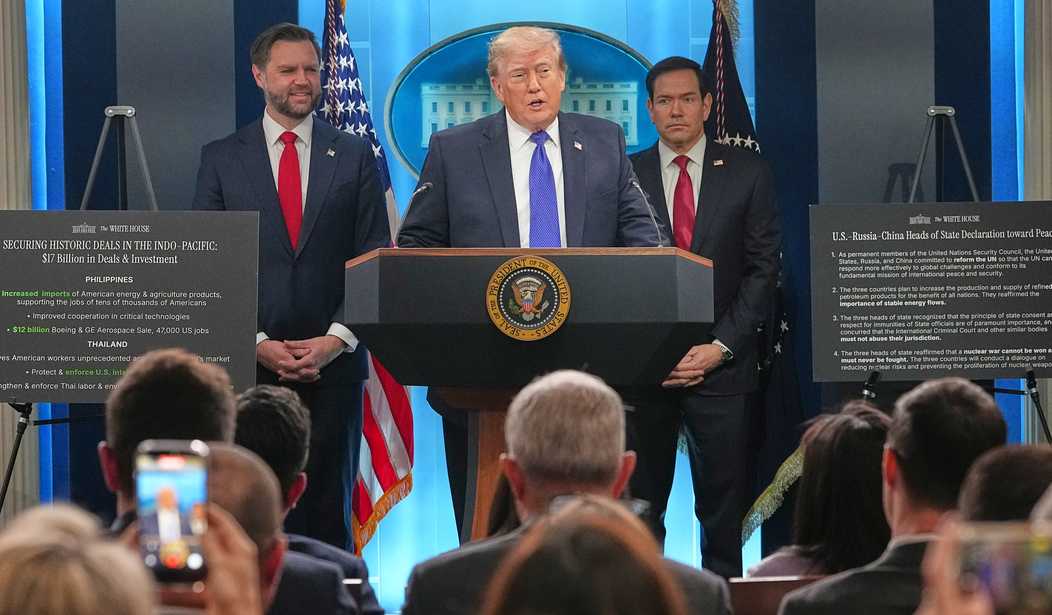
At the moment, much would seem to depend on Trump’s endorsement, though he’s been predictably and wisely cagey about his favorite. Realistically, however, much could change in this time of turbulent and even dangerous politics.
The potential GOP field is deep. I say "potential," which is different from realistic. Among the possible wannabes would be Texas Sen. Ted Cruz and possibly Kentucky Sen. Rand Paul.
Others could be former governors Glenn Youngkin of Virginia and Texas' Greg Abbott, whose states greatly prospered under their leadership.
Also, recently reelected Arkansas Gov. Sarah Huckabee Sanders, who may be too well aware of White House reality to want it.
At the moment (there’s that phrase again), the leading GOP possibles would be Vice President JD Vance, Secretary of State Marco Rubio, and possibly Florida Gov. Ron DeSantis, who is term-limited and leaves office Jan. 5.
The standard political assumption would suggest Vance as the most likely pick, even though most immediate or modern vice presidents have been unsuccessful moving up (Nixon 1960, Humphrey 1968, Mondale 1984, Gore 2000).
Vice presidents are supposed to be staunch loyalists as an extension of the Big Guy, which hinders developing their own political identity and brand for future use.
And historically, after a second presidential term, American voters tend to look for something different – Kennedy after Ike, Carter after Nixon/Ford, Clinton after Reagan/Bush, Trump after Obama.
The 42-year-old Vance is party finance chair, which gives him crucial access to GOP donors nationally. His home state of Ohio has produced seven presidents, second only to Virginia's eight.
Vance's Senate political career is brief, however, and began in outspoken opposition to Trump.
The vice president has also made it clear, for instance, that he was against attacking Tehran and openly blamed the severe Republican midterm losses on that unpopular war. An unhappy Trump pulled him off the peace talks. But they were doomed anyway since Tehran was simply dragging them out to sour the elections for Trump.
It worked.
But here is an intriguing intricacy in political strategizing: Creating that unexpected space from Trump today could give the VP some cover down the road from the unpopular war decision if Vance does run.
There have been some unattributed hints that Vance, who had a successful business career before entering politics just five years ago, might not run in 2028, preferring a comfortable life with family, newly enlarged to four children.
At 56, Rubio has frequently and wisely said he would not seek the GOP nomination if Vance does. Rubio has insulated himself from messy succession chatter by refusing to talk about 2028 because he's so focused on representing the United States for President Trump.
Hmm. It seems then that focusing on work and not seeking the presidency actually causes many people to see him as presidential. So, my theory might work.
Rubio is the first Cabinet member since Henry Kissinger a half-century ago to serve as both Secretary of State and National Security Advisor and clearly has easy and trusted access to the president.
A Roman Catholic, he is the son of Cuban immigrants; his father was a banquet bartender and mother a hotel maid. Their son is bilingual and comes from solid red Florida, which has 30 electoral votes, third most.
Rubio has proven to be an eloquent, affable, and detailed advocate for Trump and U.S. policies and was an effective demolisher of the corrupt USAID.
He explains in easily understood language such delicate and complicated issues as Venezuela and Cuba, the Iranian regime’s “cult of death,” and the administration’s thorny issues with NATO allies. Yet he has somehow avoided blame for their controversies.
And he handles antagonistic media with dismissive ease.
Nor does Rubio mind showing a sly and refreshing sense of humor. After speaking Spanish to one audience, he turned to Vance and said, “I just said I saved a bunch of money by switching to Geico.”
As VP, Vance has been predictably far ahead in 2028 poll favorability among GOP voters.
Recent polls, however, have shown a dramatic surge in Rubio's popularity among Republicans, with some showing him now leading Vance as the party's preferred 2028 candidate, a dramatic shift from just last year.
I would argue that Rubio's total focus on doing his current job accounts for that surge. And that is confirmed by abundant online praise and chatter for his intelligence and style.
Like Rubio, DeSantis was once a Trump competitor. But the president recently said he might invite him to join the administration next year and praised his conservative work for Florida.
The father of three, DeSantis has noted his state has four million more residents than New York yet operates with a state budget well under half theirs and without a state income tax.
With a state legislature undamaged by the midterm’s blue wave, DeSantis has balanced smaller budgets each recent year, slashed state debt by 54 percent, banned sharia law, prohibited DEI policies, and reformed property taxes, among other things.
An open presidential contest for both parties is an uncommon affair in recent times. Until now, we’ve only heard hints from candidates, though some are already secretly strategizing and lining up donors.
But with only 58 weeks until the GOP Iowa caucuses and 59 to the Dems’ first primary in South Carolina, it won’t be long until the intentional leaks come the day before the announcements begin.