



This week I thought we could all probably use a mental palate cleanser from the hectic midterm-election fleck assaulting our eyes and ears 24/7. And, who knows, maybe even take a few moments to celebrate the smarts, innovation, and goodness of our land and most of its people in a time of turbulent, transitory distractions.
You know what I’m talking about: the screaming online headlines laden with outrage and hawked by the overpaid pretty people on TV, the ones with their own designated hairdresser, reading scripts they don’t comprehend while trying to sound authoritative. And then, all the nonstop campaign ads invading even places like the Home & Garden Channel.
You may think this will all end on Tuesday. Oh, no! Then comes the aftermath coverage: How did all this happen and what does it mean for the future of humanity? At least until next weekend, when the 2028 campaign speculation and coverage begin. Please give us a wee break from anger.
So today, get set for a dose of awe over some real out-of-this-world details:
Space.
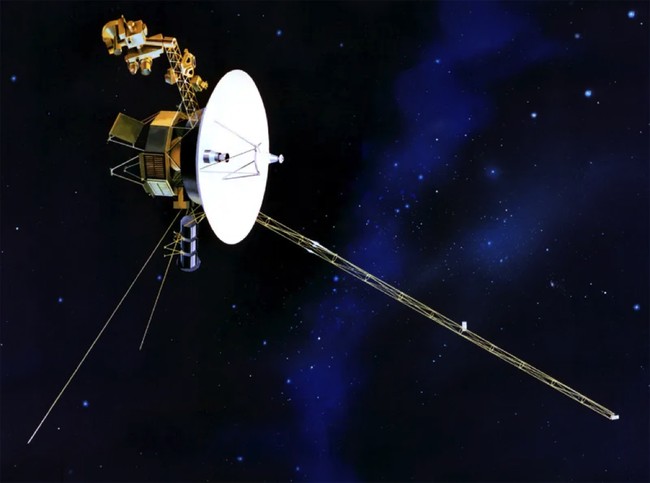
Remember Voyager 1? Fifty-four percent of Americans can’t because they weren’t even alive in 1976 when American engineers and taxpayers launched that intrepid little spacecraft into the unknown on one sunny September morning from Cape Canaveral.
That’s a very long time ago by Earth standards. The divisive Vietnam War had just finished; the good guys lost. We were entering the somnolent Jimmy Carter years that didn't work out either.
But by golly, Voyager 1 sure did. That 1,818-pound machine left Earth’s surface at 8:56 AM Eastern on Sept. 5. And it’s been streaking farther away every moment since, all the time that 190 million American babies were conceived and born, Russia’s 10-year Afghan war, our 20-year Afghan war, seven U.S. presidents, two planetary flybys, each with amazing discoveries.
That’s 18,320 Earth days. And Voyager 1 is still going, 10 miles farther from home every single second. That’s 38,028 miles every hour deeper into the vast unknown of interstellar space where nothing manmade has ever gone before, and no one knows what might be there.
At that speed, on Nov. 18 at 5:16:07 ET, after all those hours and days and years of lonely travel through a hostile, empty space, Voyager 1 will be one light-day away from Cape Canaveral.
You’ve seen how quickly a room lights up when you flip the switch. That’s light speed, 186,282 miles per second; that’s 7.5 times around the Earth in one second. One light-day is the distance light travels in 24 hours.
There is no day or night where Voyager ventures, just black. Voyager 1 will be 16,094,799,096 miles away on that Earth morning. That's just eight days before we celebrate the Pilgrims' first Thanksgiving; they were delighted to have survived a year after a stormy Atlantic crossing that took 66 days.
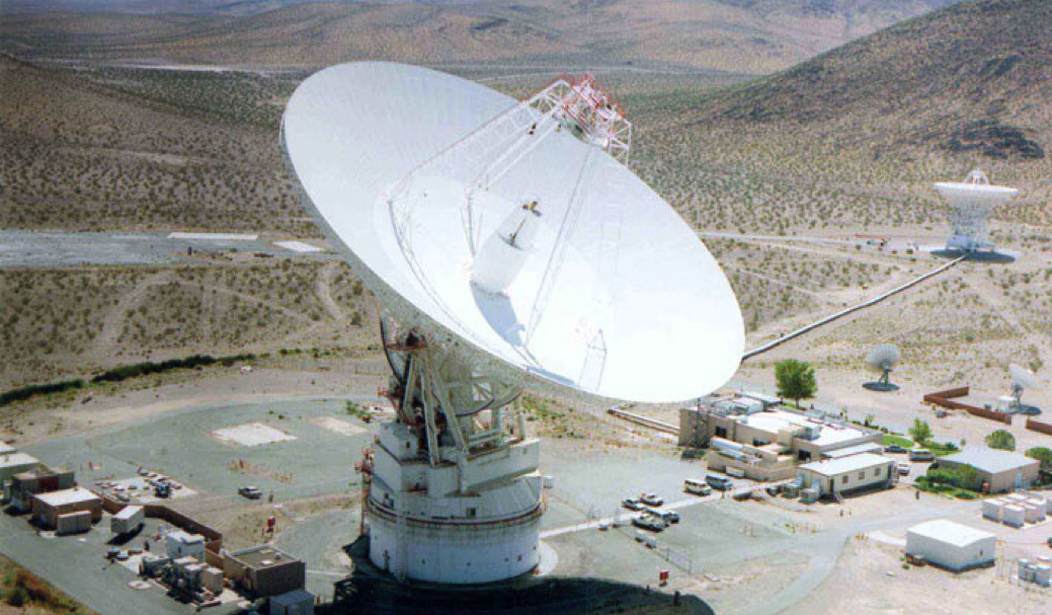
Like light, Voyager’s weak little radio signal will then take 24 hours to reach home. I’ve heard Voyager’s raspy voice. NASA needs special instruments to pluck the data blips out of the space static caught by the 210-foot-wide satellite dish at its Goldstone, California base and others in Australia and Spain. The Deep Space antennas are each almost the size of a football field.
The acre-sized metal dish weighs almost 3,000 tons. It glides on bearings covered with a paper-thin film of oil to track and talk to Voyager and other NASA robots in space, including its identical sister Voyager 2.
Voyager gets its power from three radioisotope thermoelectric generators. They convert heat from the radioactive decay of plutonium-238 into power.
At launch, Voyager could produce 470 watts of power. Now, it’s down to around 225, losing four watts a year.
NASA engineers turned off eight of its 10 instruments to save energy. But the little guy still records plasma waves in interstellar space and notes its own magnetic field moving along with it.
Voyager has genuine state-of-the-art tech — for 1976: a modified eight-track tape deck with 1,017 feet of half-inch tape, like an Olds Cutlass might have had back then to play the Captain & Tenille's "Muskrat Love" or the Eagles' "Hotel California."
Almost every day. Voyager dutifully phones home to deliver its 69 KB of data.
Three years ago, one memory chip failed, corrupting the data-collection system, causing Voyager to transmit intergalactic garble.
Now, to me, a serious tech challenge is convincing my DVR to display captions from across the room. However, the geeks at NASA and JPL, some of whom weren’t even born when it launched, patiently fixed the problem across billions of miles of space using ancient Fortran code. They restored Voyager’s very long-distance coherence.
These amazing advances by our country are too often unappreciated. We take inevitable progress for granted. When I was in kindergarten, we had no TV, a party telephone line, and the first jet broke the sound barrier at 767 miles an hour, Mach 1.
Today, ordinary passenger jets fly 600 miles an hour. Astronauts move into space at Mach 10. When I was a rookie reporter, I interviewed people watching the first Moon landing via an airport Jumbotron. Then came the Internet’s instant messaging and impatience when a colleague takes a whole 20 minutes to reply.
Today, people have cellphones in their pocket with more computing power than the Apollo astronauts took with them. And next year's models will contain even more.
We watched NASA’s rovers land on Mars inside a giant bouncing ball. One lander later got stuck in sand. A vicious windstorm eventually did another in.
But Curiosity is still poking around that hostile place looking for ancient signs of life 14 years after its own life was expected to end. Shift after shift, JPL engineers guide it from a console in Pasadena through that dish above.
Not long ago NASA landed a probe on an asteroid 206 million miles away, scooped up a soil sample, and seven years after launch, dropped it by parachute into Utah.
All the while, that little Voyager just keeps zooming away from home at 52,000 feet per second, 590 months into its high-speed, forever journey to no one knows where.
The craft carries a whole packet of Earth info in case someone or something finds it — greetings in 55 languages, photos of humans and animals, music recordings from Beethoven to Chuck Berry, and, unwisely in my opinion, space directions to Earth.
That seems like a kumbaya something that an old-fashioned Democrat like Jimmy Carter might conjure. Since we have no idea what kind of creatures or super-intelligent slime might come upon that map someday, that strikes me as dangerous, like putting your bank account info online in hopes that a Nigerian prince will deposit the millions he spammed about last year.
Voyager 1 has found all kinds of new things on its space odyssey. It sent back more than 32,000 trip photos to prove it: Passing Jupiter, Voyager detected a faint ring and two new moons.
Its photos showed hidden oceans, and then, close study of pictures of Io revealed immense plumes erupting from that moon's surface – one of them 190 miles tall — the solar system's first volcanoes discovered beyond Earth.
The magic of Saturn has fascinated me since childhood when I saw it live through a huge telescope. Voyager found an entirely new ring there and five new moons.
Just before leaving Saturn’s neighborhood in 1990, astronomer Carl Sagan suggested turning Voyager around and taking its last photo looking back toward home, then only 3.7 billion miles away. That produced the iconic pale blue dot picture, showing how terribly small we all really are in this vast place we rarely think about much.
Space isn’t called Space by accident. There’s a whole lot more of it where nothing is than where anything is. The Earth sky on some clear nights may look crowded. And the night sky on Mars sure does. But those dots of light are not just planets; each dot is an entire galaxy of planets.
Late one crisp, clear night years ago, Laura Bush and I and two other campaign aides lay on our backs in a Michigan meadow and gazed up. We fell silent. The sky's scale was almost inconceivable.
Gazing at distant stars tonight, realize that the twinkling light has been streaking toward your eyeball at 186,000 miles a second for the entire elapsed time since dinosaurs roamed our planet. Don't blink.
Our Earth is just one of three trillion planets in the Milky Way galaxy. Our Sun, which is puny compared to many other stars, is 1.3 million times the size of Earth.
Jupiter is 764 times larger than Earth. Saturn sticks out in the sky for good reason; it could hold 1,300 Earths inside, each with a 7,926-mile diameter.
The Sun is one of 200 billion other suns just within the Milky Way. And there are about two trillion galaxies like the Milky Way just in the observable universe we can see from here. More float beyond.
There is nothing in Voyager’s way now. It will slow slightly over time, but never stop. Recall so far that after 49-plus Earth years, Voyager is only now coming up on one light-day away from its home; the distance light travels in 24 hours.
So, 365 light-days is one light-year or 5.88 trillion miles. Our Milky Way is not one of the bigger galaxies. Which means that Voyager 1 should reach the edge of just its modest home galaxy after traveling another 26,000 light-years at 186,000 miles per second.
You do the math: 5.88 trillion x 26,000. Longer than driving across Pennsylvania in winter.
You may return now to the really important BREAKING TV news about all the things that are wrong with everything and everybody else here on Earth.