








It was a Monday 43 years ago. As usual, millions of Americans tuned their TV to NBC, where late every weeknight, Johnny Carson gave his opening monologue that made everyone at least smile, not cringe.
Johnny didn’t think it was his job to get political when putting America to bed. The ex-game-show host certainly did something right; his show went on for 30 years. Not long ago, I wrote about being behind the scenes at his show some nights.
“You know,” Johnny said, adjusting his tie, “we've got all sorts of shortages these days. But have you heard the latest? I'm not kidding. I saw it in the paper. There's a shortage of toilet paper.”
Toilet paper is something that touches people’s lives intimately every day, sometimes more than once. Millions of people laughed.
But by the next morning, millions of people were buying millions of toilet paper rolls, you know, just in case. A lot of people didn’t hear Johnny, but they saw other shoppers loading their cards with dozens of rolls.
So, they loaded up too, just in case.
In Seattle, one store owner heard the report, so he ordered 20 extra cases. When he got only three, he began rationing purchases. People heard about the rationing, so they bought a few extra wherever they could find them.
TV crews began filming empty toilet paper shelves in stores and interviewing worried customers across the country.
It was a classic study in rampant rumoring. There was no toilet paper shortage, that is, until frightened customers created one after an exaggerated joke. Scenes of frantic toilet-paper buying fed more anxiety that then worsened supplies further.
That week, I visited the Scott Paper Co’s plant in Chester, Pennsylvania. It was running full-blast as the world’s largest toilet-paper plant, rolling out 7,500 miles of toilet paper every 24 hours.
They didn’t mind brisk sales but knew nothing of any real shortage. However, the more that store managers and paper makers denied the shortage, the more folks bought toilet paper, just in case.
Turns out, there had been a TP shortage weeks before – in Japan. A Wisconsin GOP congressman, Harold Froehlich, had also heard of a pulp-paper shortage from constituents who suspected companies were selling paper’s raw material abroad to avoid Washington price controls.
Then, he saw a report of a shortage of bids on a contract for a massive government order of toilet paper.
Local members of Congress are hard-pressed to get any publicity on their D.C. work. So, he put out a news release, which are always ignored, usually:
The United States may face a serious shortage of toilet paper within a few months.
He also warned of possible rationing.
Johnny had spotted that. He ran with it. And later apologized on-air. “I just picked up the item from the paper,” he said, “and enlarged on it somewhat and made some jokes as to what they could do about it. There's no shortage.”
But after government shortages of gasoline, electricity, and some food items back in the 70’s, Americans were ready to believe another had arrived.
As usual in America, some creative entrepreneurs were prepared to take advantage of the TP-buying craze. One Chicago store urgently advertised there was no shortage of record players, hoping to ignite another panic.
Fifty-four summers ago, the American Medical Association released a study of the traits and locations of healthy Americans. I extrapolated from that study and found the healthiest American back then was a teenage farm boy in the Upper Midwest in the summer.
Soon after, I arrived on the farm of a family just outside Good Thunder, Minn. (Pop. 468) and spent a couple of days following Dick FitzSimmons around to see what made him so darned healthy.
He was 5-10 and 16, one of nine children. His Mom could not remember when anyone had been sick, beyond sore throats.
“I guess we just don’t have time to be sick,” she said. “I've never bought any vitamin pills. We never seemed to need them. We just get lots of fresh air, exercise, and work.”
I would say so. By dawn, Dick had already spent an hour on calisthenics preparing for the fall season of the Amboy-Good Thunder Chargers. So many FitzSimmons boys had been linebackers there, the coach gave their Mom a special certificate.
After the two-hour practice, Dick had his second breakfast, 20 ounces of milk and a couple of his favorite caramel rolls from a lunch counter.
Then, he joined his father and cousins, expertly stacking 300 50-pound bales of hay. “It's never cool when you're putting up hay,” Dick said, sweat streaming off his face.
By lunchtime, Bonnie FitzSimmons had finished four loads of laundry and prepared over three pounds of hamburgers, two dozen ears of corn, a salad, cottage cheese, peaches, and pitcher after pitcher of cold milk. In the summer, she bought at least 14 gallons a week.
Afternoons were full of more chores, tractor repairs, errands in town, and feeding 600 hogs. Then an early dinner of pork chops, green beans, carrots, salad, milk, and, often, a home-made doughnut or two.
By 6, Dick was back on the practice field until 8. He was in his bunk bed by 11. But first, some football catch with his brothers, more milk, and a long, quiet phone chat with his cheerleader girlfriend, Julie Shouts.
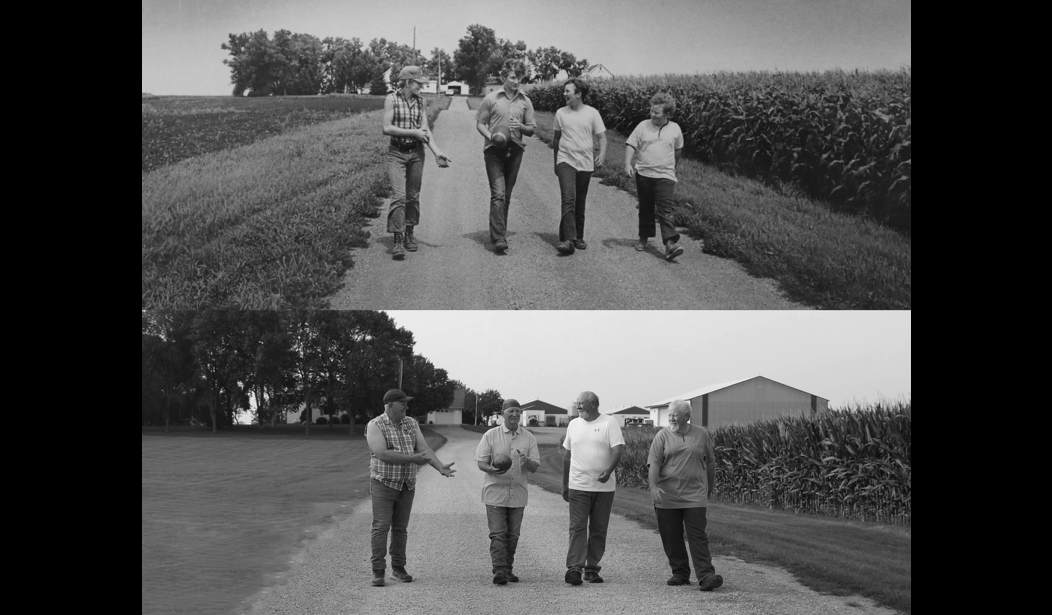
UPDATE: Since my FitzSimmons visit, the parents have passed away. The brothers and sisters married, and their children are now marrying. They’ve grown the family agri-business immensely. Our families became enduring friends, and as a memento, last year Megan Hollerich Schwanz, a niece of Dick’s, re-staged the photo above from my visit on the same dirt driveway in the same poses.
Dick and Julie, the high school sweethearts, have been married 48 years now with three grown children. And Dick, who now prefers Richard, remains the healthy prototype, having overcome brain cancer not long ago.
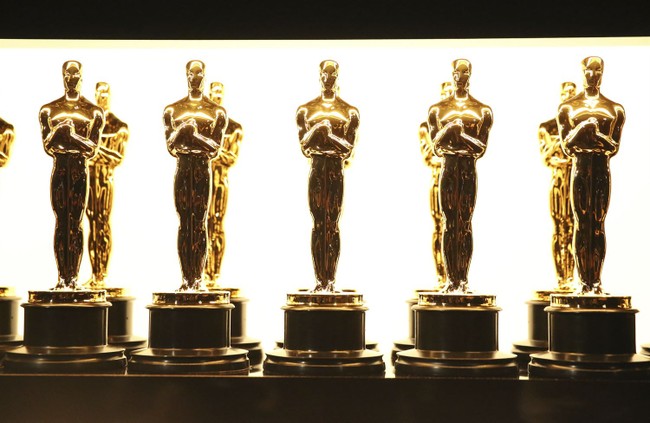
This is the time of year when what’s left of Hollywood prepares to congratulate itself on a year’s work with the Oscar awards, those highly coveted eight-pound statuettes that seem to show a crew-cut man holding his stomach.
By now, regular readers might suspect my curiosity would take me behind the scenes of all that pomp. They would be correct, sort of.
Many years ago, about this time of year, I went to the Dodge Trophy Co. in Crystal Lake, Illinois. There, in a cluttered backroom with loud radio music blaring, I met Paul Rathke, Keith Anderson, Charlie Pryor, Wayne Hodges, Gus Carlson, Maria Jimenez, and Rocco Mattio.
They made the Oscars — about 70 every winter. I gather the Academy of Motion Picture Arts & Sciences has changed manufacturers. But the process is the same.
“It's nice to see the movie people so happy and to see the Oscars sparkle on TV,” said Maria. She gold-plated the sparkle on each one.
When I see the Oscars on TV, said Rocco, “I say, ‘That's mine all right.’” He hadn’t been to a movie in 20 years, but still watched the event showcasing his handiwork.
“It’s great seeing them get what I made,” said Wayne, who solders out any imperfection in each casting. He couldn’t recall the last movie he saw, but his all-time favorite was “The Ten Commandments.”
Dodge had six facilities in those days, turning out hundreds of thousands of figures monthly, everything from discus-throwers, rabbits, and the back half of a horse to winged-wheels, Emmys, New Year's bowl trophies, and corn cobs.
Oscar work began about this time in winter when the four-piece mold came out of the safe. Once, Oscars were made of plaster. Later, a secret lead alloy was used.
In an impromptu fake ceremony during my factory visit, the crew awarded me an actual Oscar, which I gratefully accepted, thanking my family and everyone watching. The crew hastened to point out that I held it the wrong way.
Back then, backstage at the actual ceremonies in L.A., another Dodge employee, Fred Schaper, removed each numbered Oscar from its box for the next presenter. After each presentation, he reclaimed it for immediate engraving.
In Crystal Lake, Paul Rathke and others, who wore special gloves while crafting the awards, moaned over the bare, greasy hands grasping and waving and fondling their work on TV.
But it was time to start the next batch of trophies, some giant cows for the upcoming Heifer Association Awards.
This is the 39th in an ongoing series of personal memories. Links to all the others are below.
She Loved Books So Much She Opened a Little Library
Malcolm's Memories: The Day Bill Buckley Asked My Help; Small Town Etiquette
Behind Johnny's Desk, Before Ford Was POTUS, and a Dog Makes Her Rounds
A Hooker in the House, Whistle War, and Ann Landers' Worst Mistake
More Neat People and a Nuclear Sub I've Met Along the Way
Malcolm's Memories: A Toddler's First Fourth
Malcolm's Memories: Train, Streetcars, and Grandma
The True Story of an Unusual Wolf, a Pioneer in the Wild
That Time I Wore $15K in Cash Into a War Zone
I Fell in Love With the South, Despite That One Scary Afternoon
More Memories: Neat People I've Met Along the Way
Unexpected Thanksgiving Memory, a Live Volcano, and a Moving Torch
The Horrors I Saw at the Three 9/11 Crash Sites Back Then
The Glorious Nights When I Had Paris All to Myself
Inside Political Conventions - at Least the Ones I Attended
Political Assassination Attempts I Have Known
The Story a Black Rock Told Me on a Montana Mountain
That Time I Sent a Message in a Bottle Across the Ocean...and Got a Reply!
As the RMS Titanic Sank, a Father Told His Little Boy, 'See You Later.' But Then...
Things My Father Said: 'Here, It's Not Loaded'
The Terrifyingly Wonderful Day I Drove an Indy Car
When I Went on Henry Kissinger's Honeymoon
When Grandma Arrived for That Holiday Visit
Practicing Journalism the Old-Fashioned Way
When Hal Holbrook Took a Day to Tutor a Teen on Art
The Night I Met Saturn That Changed My Life
High School Was Hard for Me, Until That One Evening
When Dad Died, He left a Haunting Message That Reemerged Just Now
My Father's Sly Trick About Smoking That Saved My Life
His Name Was Edgar. Not Ed. Not Eddie. But Edgar.
My Encounters With Famous People and Someone Else
The July 4th I Saw More Fireworks Than Anyone Ever
How One Dad Taught His Little Boy the Alphabet Before TV - and What Happened Then
Muhammad Ali Was Naked When We Met
Editor’s Note: Do you enjoy RedState’s conservative reporting that takes on the radical left and woke media? Support our work so that we can continue to bring you the truth.
Join RedState VIP and use the promo code FIGHT to get 60% off your VIP membership!

Join the Conversation
VIP members get the ability to comment on articles.