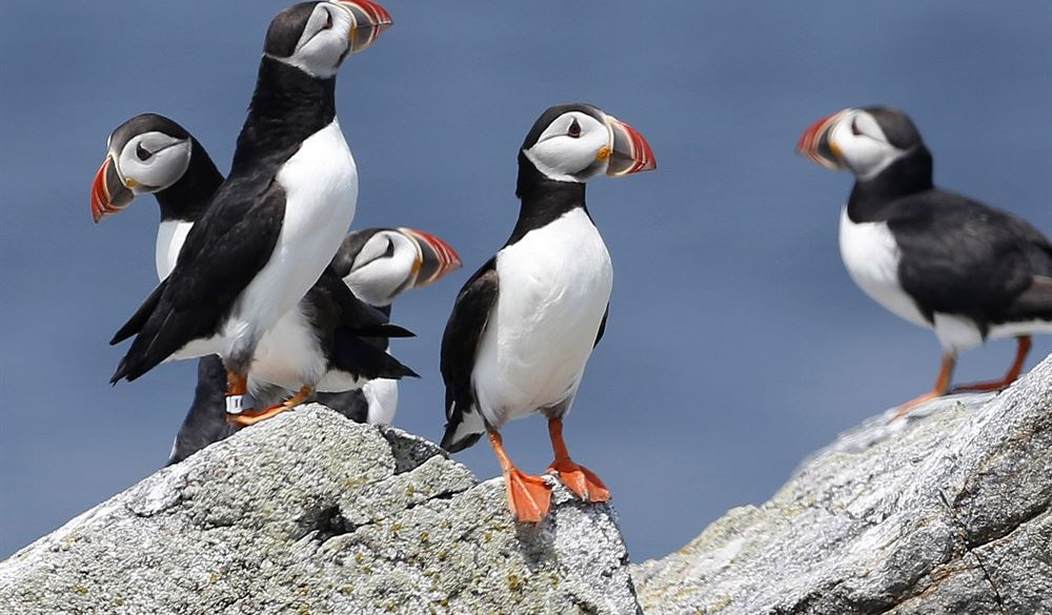

Puffins are appealing, plump, active little seabirds. Here in Alaska, we have two main species of puffin, those being the Tufted Puffin (Fratercula cirrhata) and the Horned Puffin (Fratercula corniculata). We see them when we take a boat out into Cook Inlet after salmon, rockfish, cod and halibut, as we do every other year or so. Unlike the gulls, the puffins aren't interested in or catch or when we are going to start filleting and throwing offal overboard; they prefer to catch their own.
Their Atlantic counterpart is the Atlantic Puffin (Fratercula arctica) which is the only puffin in the North Atlantic. They're popular in nature documentaries, for their black and white plumage and plump forms, along with their thick, colorful bills with which they can catch and carry several each of their traditional foods, that being sandlance (sandeel), sprat, capelin, herring, hake, and young cod, or any fish between 2 and 8 inches long.
Now, some of the North Atlantic regions frequented by puffins has been, like much of the northern hemisphere, warming, gradually, as it has been doing since the end of the last major glaciation. A new piece in the U.K.'s The Telegraph is sounding an alarm on how this warming is threatening puffin populations.
Puffins could almost disappear from the British Isles in the next 25 years, new research has warned.
Numbers of the seabird have fallen in recent years, leading to the species being declared vulnerable to global extinction.
Climate change, overfishing, invasive species, pollution and habitat loss are among the causes that have threatened their existence.
Research from the British Trust for Ornithology (BTO) has warned of a possible 90 per cent crash in the puffin population of the British Isles by 2050, amid a battle to reverse the species’ “catastrophic decline”.
It's not clear from The Telegraph's reporting, whether they claim the population is declining or just moving north, but what is certain is this: The U.K.'s largest puffin rookery, in a Welsh island called Skomer Island, puffins are doing very well indeed; in fact, their numbers are breaking records.
A record-breaking number of puffins has been counted on Skomer Island for the second consecutive year, highlighting the island’s growing importance for UK seabird conservation.
The Wildlife Trust of South and West Wales (WTSWW) confirmed that 52,019 puffins were recorded during this year’s annual seabird survey — around 8,000 more than the previous record set in 2025.
Conservation teams described the result as a “very pleasant surprise”, as such a large increase had not been expected.
Funny, that, how nature tends to throw these kinds of twists and turns at us.
This isn't to say that puffins and other seabirds don't face threats. They do. They compete to some degree with humans for some of their main food stocks, including sandlance and herring. Overfishing can threaten them. Human intrusions on their traditional nesting islands can threaten them. One of the worst threats these charming little birds face are invasive predatory species, like cats, dogs and foxes, not to mention one of the worst invasive species, the same nasty little critter that has spread along with humans since time immemorial — rats. Rats will eat puffin eggs and hatchlings, and once they are established on an island, there's no getting rid of them. The Telegraph does note that the UK has halted fishing for sandlance in British territorial waters in the Atlantic and the North Sea, which is expected to help puffins in places where they are declining.
In fact, at least one instance, in a place called Lundy Island, the puffin rookery was suffering badly from predation by rats. A heroic effort to eliminate the rats, amazingly, succeeded, and the Lundy Island puffin population exploded. No climate issues; just rats.
What's not presented here is numbers of puffins overall, as in, a species-wide count. The Telegraph is, granted, a UK publication and so they focus on British waters and islands. But the Atlantic Puffin is found all over the north Atlantic, from North America to the Baltic. The breeding population is estimated at 12 million, about half of which breed in Iceland.
Puffins and other seabirds in general seem to be doing alright in the slightly warmer north. But it's the Telegraph's reporting on this that we might take issue with. Their panic-mongering piece here makes no mention of the booming puffin population on Skomer Island, nor the success story of Lundy Island puffins after rats were eliminated from that island. Instead, they put the blame on climate change, by which they imply anthropogenic climate change, without doing a proper evaluation of all the many and varied threats and influences on the populations of these birds.
In this story as with so many pieces of "climate" reporting from the legacy media on both sides of the Atlantic, the Telegraph is just puffin' out some good old scare-mongering. Puffin and other seabird populations face challenges, yes; and we can and should help preserve them where we can, especially in cases like Lundy Island where the birds are suffering from something we did, in that case, introducing rats. But there's no reason to panic about climate change; the puffins won't profit by our covering every available space with solar panels and shutting down our traditional electrical generation sources.