






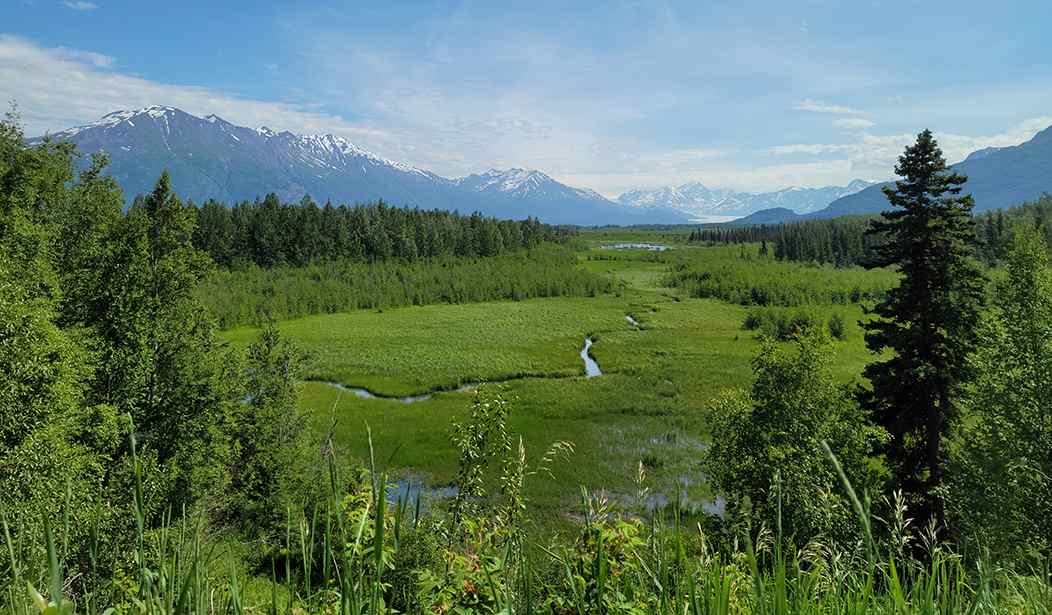
Alaska (he wrote, belaboring the obvious) isn't like the rest of the U.S.. Its vast size and small population, coupled with its abundant wildlife and its rich mineral and energy resources, make Alaska unique among the 50 states. And, while it's common to say that much of the state is simply empty, that's kind of an anthropocentric view; there may be huge areas of the state where there are no people, but that doesn't mean they're empty.
And, that being the case, it stands to reason that the decisions regarding much of Alaska's resources, such as wildlife harvests, subsistence hunting and so forth, should be left up to Alaska. And now, with the release of a revised rule from the Department of the Interior and the National Park Service, that's what's happening.
The Department of the Interior and the National Park Service today announced a final rule restoring the longstanding Alaska-specific regulatory framework governing wildlife harvest, subsistence-related activities and certain public access procedures in national parks and preserves across Alaska.
The rule restores much of the regulatory framework developed under the Alaska National Interest Lands Conservation Act of 1980 that guided management of Alaska national parks and preserves for more than three decades. The action advances President Donald J. Trump’s direction under Executive Order 14153, Unleashing Alaska’s Extraordinary Resource Potential, and Secretary’s Order 3422 of the same name, issued by Secretary of the Interior Doug Burgum.
More than 60 percent of Alaska's land area is owned by the federal government, in the form of national parks and the Bureau of Land Management (BLM) and a few other agencies. But Alaska has been subjected to one-size-fits-all regulation by Washington, D.C., and these rules were all too often written by people who don't understand Alaska very well.
That's ending now. For now.
“For more than three decades, Alaska’s national parks and preserves were managed under a framework that recognized Alaska’s unique circumstances, respected the State’s role in managing fish and wildlife, protected subsistence uses and conserved these remarkable lands and resources,” said Secretary of the Interior Doug Burgum. “This final rule restores that commonsense framework and gives Alaskans a stronger voice in decisions affecting the lands, wildlife and traditions they know best, while ensuring the National Park Service continues to protect park resources for future generations.”
ANILCA established a management framework for Alaska that differs in important ways from much of the National Park System. The law provides for subsistence uses in certain Alaska park areas and allows sport hunting and trapping in national preserves under applicable state and federal law. The framework also recognizes distinct but complementary responsibilities among the State of Alaska, the Federal Subsistence Management Program and the National Park Service and provides opportunities for local participation in decisions affecting subsistence and other authorized uses.
This is a good plan. There are still a significant number of people in Alaska who depend on subsistence hunting, especially some of the Native communities, people in the Unorganized Borough, the remote villages and much of the North Slope. There are, perhaps, even more people who aren't strictly speaking subsistence hunters, but who nevertheless prefer moose, caribou and grouse over store-bought beef, pork and chicken. And its not completely accurate to describe this as "sport hunting," as that is too often a term used by non-hunters to describe the illegal practice of taking an animal's pelt or antlers and leaving the rest; in Alaska, as in all the other 49 states, the law requires the removal of all edible meat from the field.
The Trump administration has been pretty great to Alaska. The days of the Great Land being treated as a gigantic national park have ended. America's treasure chest is open, and development of Alaska's vast mineral and energy resources is ramping up. Now, Alaskans have a greater say in our wildlife and land resources. That's a good thing — and one we Alaskans should vote to protect.
Editor's Note: Do you enjoy RedState's conservative reporting that takes on the radical Left and woke media? Support our work so that we can continue to bring you the truth.
Join RedState VIP and use promo code FIGHT to receive 60% off your membership.

Join the Conversation
VIP members get the ability to comment on articles.