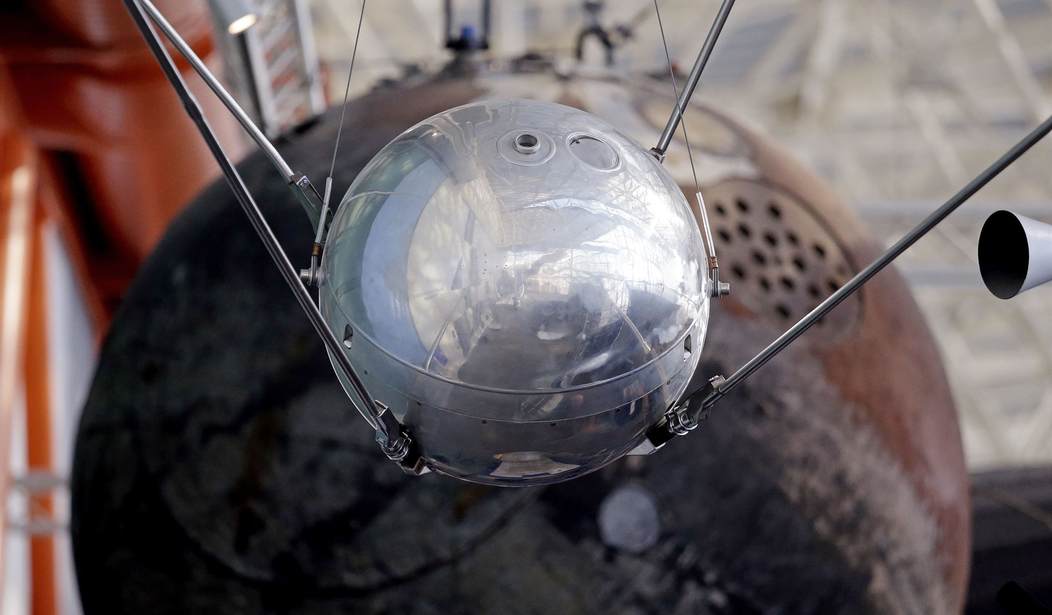

On October 4, 1957, 69 years ago on the date I write these words, the world looked on in amazement as the Soviet Union did something no nation had done before: Launched an artificial satellite. That satellite was Sputnik 1, followed by Sputnik 2, and they moved the Cold War into space. German V-2 rockets had, during the war, technically gone into space in their ballistic arcs, but they didn't orbit the Earth; the Sputniks were the first to do that, and it was a big propaganda victory for the Soviet Union — for a while.
Neither Sputnik (Sputnik 2 was launched in November 1957) had anything much in the way of capability. They were simple devices, with no instruments, no detectors, just an onboard transmitter that let out regular radio "pings" so that the devices could be tracked by ground stations. The batteries died in about three weeks, and in time, they crashed back into the Earth's atmosphere; Sputnik 1 is thought to have broken up on re-entry somewhere over the western United States.
They were, in effect, proof of concept, and more concerning for the West, proof of capability. NASA, in a press release on the 60th anniversary of the Sputnik launch, wrote:
The American public felt echoes of the Japanese attack on Pearl Harbor less than 16 years before," NASA wrote on the 60th anniversary of Sputnik's launch in 2017. "Americans feared that the Soviets — whom they believed were behind the U.S. technologically after the devastation of World War II — could launch ballistic missiles armed with nuclear weapons at the United States.
At first, the Eisenhower administration downplayed the launches. President Eisenhower himself was rumored to have called the Sputnik 1 a "useless piece of iron." But that attitude didn't hold out; this was a scientific and technological Pearl Harbor for the West, most especially for the United States. But the Soviet lead in the space race wasn't to last.
A year later, in 1958, the United States put the Explorer 1 satellite into orbit. With this, the space race began in earnest. The Explorer 1 had some instruments on board, and it was the first construct to detect what would be known as the Van Allen radiation belt around the earth. The Soviets scored one more technological first, with cosmonaut Yuri Gagarin becoming the first man to orbit the earth in 1961, but Gagarin was closely followed by the American Mercury program, in which Alan Shephard and John Glenn, the latter of whom made three complete orbits of Earth. When the Mercury program ended, both countries had put six men, each, into orbit.
Then the Americans, in 1961, launched the Apollo program. This was the program that would take men to the Moon, and it did so, in 1969, 1971, and 1972. No other nation has yet done this. That was where the space race ended up, and in 1991, the Soviet Union collapsed under the weight of its own economic stupidity. But it began, 69 years ago, with one simple little satellite with a radio pinger in it.
Now our primary rival in space is China, but that country has problems of its own, not least of which the fact that decades after Apollo 11, they still haven't landed humans on the moon. China has serious economic issues and even more serious demographic issues. But there's something else the United States has: Private-sector companies moving into space, like SpaceX and Blue Origin.
I have said, and written, for years that when humans move into space in significant numbers, it will be the private sector that takes them there. Elon Musk and Jeff Bezos seem determined to prove me right. Elon Musk, in 2026, said:
The future of humanity is going to bifurcate in two directions: Either it’s going to become multi-planetary, or it’s going to remain confined to one planet, and eventually, there’s going to be an extinction event.
Safe bet on the extinction event is "not very likely," as these things tend to be separated by millions of years; the last such was 66 million years ago. But there are resources in space, in the asteroid belt, in the moons of the gas giants, possibly elsewhere, that could be used to construct and supply human habitations off-Earth. The technological challenges are massive, but then, the technical challenges to get from 1888 to the Sputnik launch would have also seemed massive, to anyone alive and paying attention in 1888.
We solve today's problems with tomorrow's technology. And our technologies, from SpaceX rockets to AI, are growing exponentially. Who knows what may be possible, even accepted, 69 years from now, in 2095? But barring some historic disaster, we can hope and, probably, expect to find out. That's what people do. If we ever do stop pushing boundaries, if we ever do lose that eagerness to explore, to push out our horizons, that's when we really will start our slide into extinction.
That's the legacy of Sputnik, and of Explorer, and the Mercury, and Gemini, and Apollo programs. That way lies the future. And it began 69 years ago.