








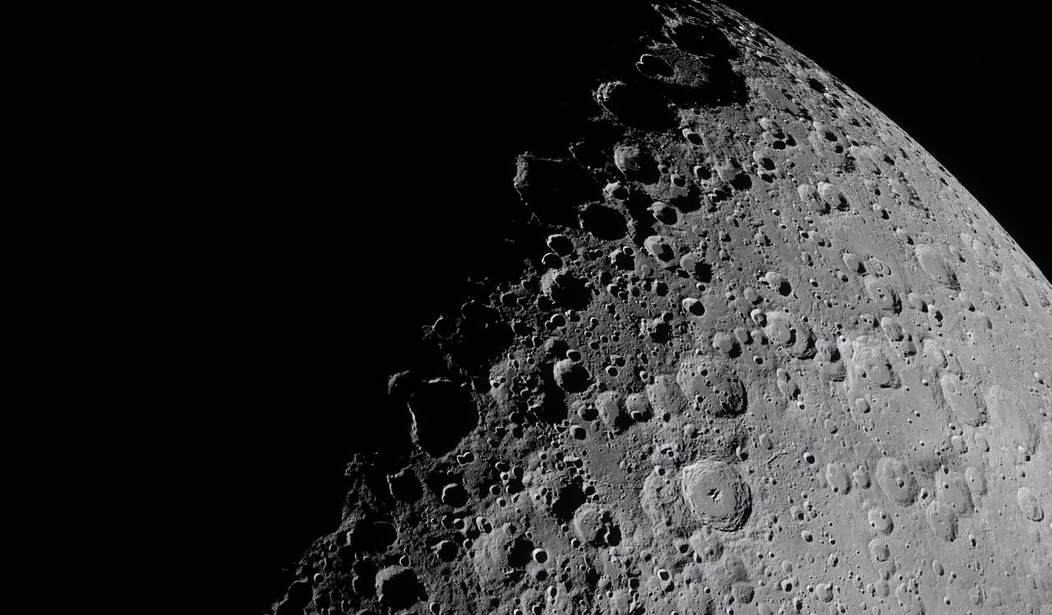
While the mainstream media loves to invent new "sky is falling" narratives around private space exploration, a spent upper stage from a SpaceX Falcon 9 rocket struck the Moon early Wednesday at roughly 5,400 miles per hour. The object, about the size of a school bus and weighing four metric tons, is leftover from a January 2025 launch that carried commercial lunar landers. Natural forces, including solar radiation and gravity, shifted its path over the past year and a half, positioning it to hit near Einstein Crater around 2:35 AM Eastern time.
Despite predictably breathless coverage, this is not a crisis. NASA has confirmed the impact poses zero threat to Earth. Space agencies and independent astronomers have tracked the stage carefully. The collision formed a crater roughly 60 to 90 feet across and about a dozen feet deep while throwing up a plume of dust and rock. While the flash and debris cloud proved difficult to spot with the naked eye, orbiting craft and telescopes were positioned to record every second of it.
What made the event useful was its predictability — and that is a direct benefit of American private enterprise.
SpaceX rocket crash lands on the moon Aug. 5th,2026 pic.twitter.com/TgPe2Aftke
— EverlastingLite (@BrandyAEckroth) August 7, 2026
Most objects that strike the Moon arrive without warning. Meteoroids hit regularly and leave fresh scars, but researchers rarely know the exact mass, speed, and composition of the incoming body in advance. Here, because private innovation built and launched the vehicle, the exact details were known. Scientists can compare before-and-after images, measure the ejecta, and test models of how surface material behaves under known force. Those observations refine techniques for tracking objects in space and improve our understanding of the lunar regolith itself.
The same data carries practical value closer to home. Earth faces its own share of impacts from space rock, though our atmosphere burns up most smaller pieces. Studying a controlled, high-speed strike on an airless body helps clarify how energy transfers into surface material, how dust clouds form and travel, and how crater shapes relate to the properties of the object that created them. That knowledge feeds into better models for planetary defense, whether the concern is a modest meteor airburst or a rarer, larger threat. It also informs planning for future operations on the Moon, where American astronauts and lunar equipment will face regular micrometeoroid hits.
If a SpaceX rocket hits the Moon and nobody sees it… did it really happen? 🌙🚀
— ☘️ Fighting Irish ☘️ (@LakerPatrick2) August 7, 2026
Since there’s no sound in space, probably not. 😂
Scientists say the crash happened as planned. The only thing missing is confirmation that SpaceX remembered to leave a note. 😉😁😂 pic.twitter.com/dBmyC6ox5Y
It is worth remembering how we got here: Private American companies, unencumbered by bureaucratic bloat, have driven the recent explosion in space access. The Falcon 9 has become an unbeatable workhorse for both commercial and government missions, lowering costs by orders of magnitude while drastically increasing flight rates compared to slow, over-budget government alternatives.
The stage itself followed standard passivation procedures after successfully delivering its payload. The later orbital drift was an unintended outcome of physics and solar radiation, not a failure of design. Treating this episode as pure carelessness misses the bigger picture entirely.
https://t.co/5KskBcv5Vn called the SpaceX crash on the moon, an 'energetic lunar touchdown...'
— Christopher Laird Simmons (@tophersimmons) August 6, 2026
Observers will gather what they can from the plume and the new crater, and orbiters in place should return clear images in the coming days. The results will add one more calibrated data point to the record of lunar impacts. In a field where controlled experiments are scarce, a known object arriving at a known time and place is a valuable scientific bonus — and a reminder that American free-market ingenuity continues to drive progress both on Earth and beyond.
Editor's Note: Do you enjoy RedState's conservative reporting that takes on the radical Left and woke media? Support our work so that we can continue to bring you the truth.
Join RedState VIP and use promo code FIGHT to receive 60% off your membership.



Join the Conversation
VIP members get the ability to comment on articles.