






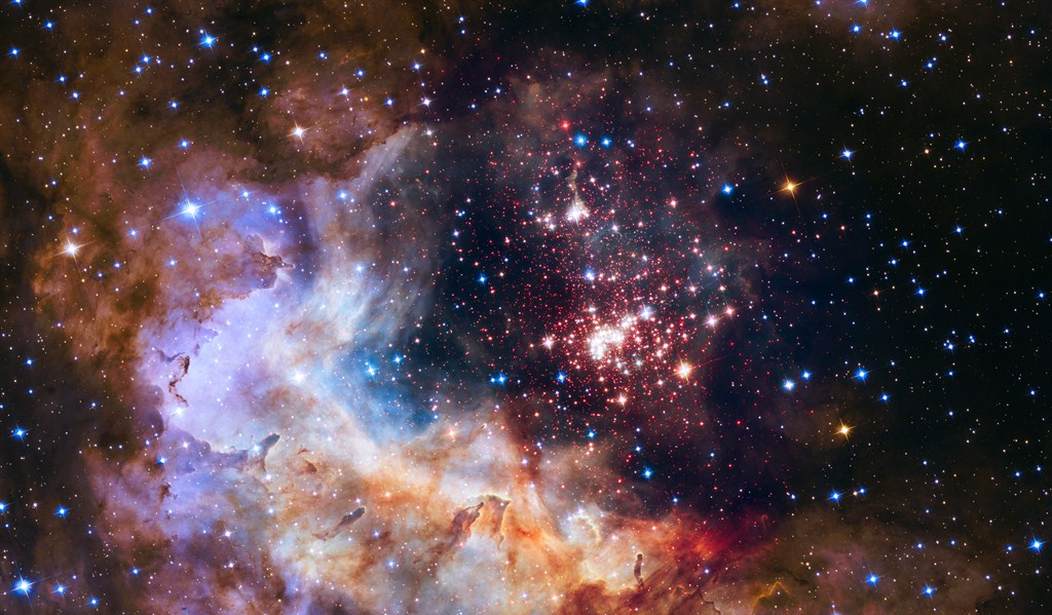
I remember very well when we first started seeing images from the Hubble Space Telescope in the early 1990s, after the unfortunate problem with the focusing mirror was resolved. Hubble gave us some amazing views, not only of things in our own solar system, but literally let us look at things that happened a long, long time ago, in galaxies far, far away. It's still working, but now it's getting a counterpart. On Sunday, a SpaceX (of course) Falcon Heavy booster lofted the NASA Roman Space Telescope into orbit, and the Roman has around 100 times the capability of the Hubble.
SpaceX launched the $4.3 billion Roman Space Telescope shortly after daybreak aboard a triple-the-fire-power Falcon Heavy rocket from Kennedy Space Center. Roman blazed toward an observation point 1 million miles (1.6 million kilometers) away that’s home to the Webb Space Telescope, one of NASA’s other big-ticket eyes in the sky.
The bus-sized telescope — named after the late Nancy Grace Roman, NASA’s first chief astronomer — will take more than three months to reach its destination. Once there, it will cast the widest gaze yet on the hidden parts of the universe from space, uncovering the unimaginable with unsurpassed speed.
“It’s going to find thousands of supernovae, tens of thousands of planets, billions of galaxies and tens of billions of stars,” said NASA science mission director Nicky Fox. “It’s going to be able to do things that we’ve never been able to do before with its massive field of view.”
With the speed of light serving as a cosmic speed limit, that means that with the Hubble, the Roman, or any other such observatory, we are literally looking back in time as we look deeper into the universe. Astronomers call what we are seeing "fossil light," because when we look at a galaxy that is 10 million light-years away, we are seeing that galaxy not as it is now, but how it was 10 million years ago. That's kind of mind-boggling.
There's more cool.
Roman’s superpower is speed.
A month of Milky Way observations by Roman would take Hubble a century to complete, according to McEnery. Roman should make quick work of scanning the galactic bulge at dead center, she added, providing the deepest look yet into the heart of our galaxy.
Besides a wide-field infrared camera that matches Hubble’s sensitivity but is 1,000 times faster, Roman holds an instrument to block out starlight. This experimental, eclipse-creating coronagraph will allow Roman to directly image any planet, however faint, that might be orbiting the masked star.
This may well be the first time that a telescope has had the capability to image, not a star, not a galaxy, but a planet.
There are a lot of expectations swirling around this new, powerful telescope, including some questions about the fundamental nature of the universe that the Roman may be able to lend some insight into. Things like dark matter, the cosmological constant, and so on. We'll have to wait until it deploys and goes into action, but expect some fantastic images.
Now, yes, things like this cost a lot of money. But the day mankind stops looking outward, stops striving to know, to learn, to discover, is the day we start to stagnate; and if you want to know what stagnation looks like, just look at the Middle East and much of Africa. No, the Western world and the United States should never stop looking outward, never stop striving. That's the spirit that took our ancestors across oceans and continents. That's the spirit that built a nation that literally spanned from sea to shining sea. And that drive to know, to understand, is what things like the Hubble and now the Roman space telescopes are all about.
So, it's all ahead, Cool Factor Eight. We'll be waiting for the first images with great anticipation.
Editor's Note: Do you enjoy RedState's conservative reporting that takes on the radical Left and woke media? Support our work so that we can continue to bring you the truth.
Join RedState VIP and use promo code FIGHT to receive 60% off your membership.



Join the Conversation
VIP members get the ability to comment on articles.