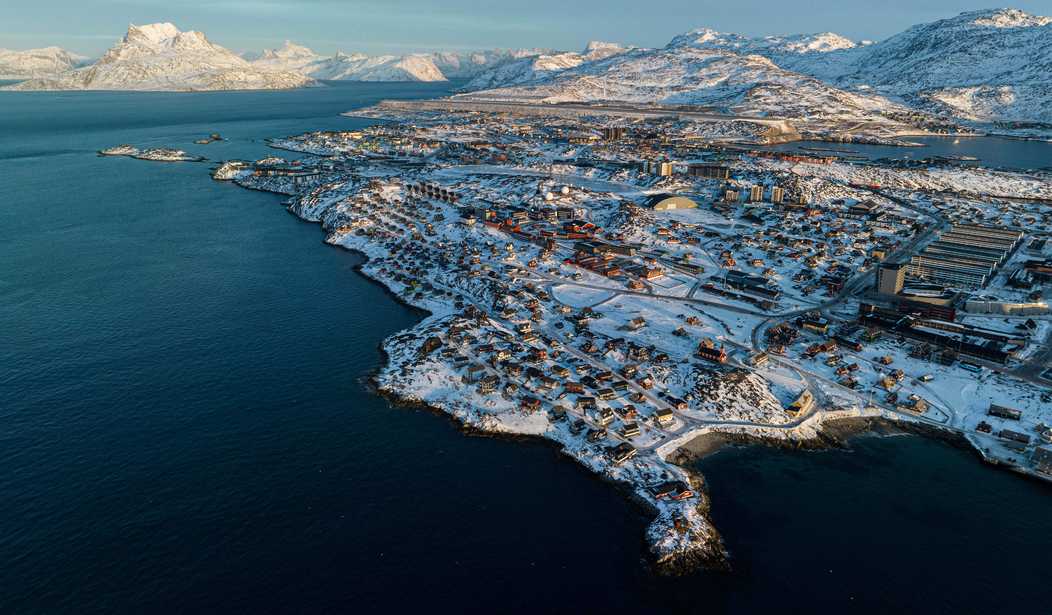

President Trump's deal for unprecedented American access to Greenland is the beginning of an alliance, the ramifications of which will be felt for many years to come. And, despite the shouting of Democrats and the far left (but I repeat myself) the United States has been trying to either make a deal like this with Greenland, if not to buy Greenland outright, since shortly after the Alaska purchase of 1867. In 1910, the U.S. Ambassador to Denmark tried to make a deal for purchase or at least access. More recent presidents, including Democrat Harry Truman, who offered Denmark $100 million for Greenland, have tried to make a deal like the one the Trump administration just concluded.
Now, it's done, and it's time to take stock of what may come of it.
A piece Sunday on Fox described some of that in broad strokes.
Greenland may be covered in ice, but beneath its surface could be resources critical to the global economy — including rare earth minerals, nickel, copper, palladium, cobalt, oil and natural gas.
The Arctic island’s location is just as valuable.
Positioned between North America and Europe, Greenland sits along key military and shipping routes. As conflicts in Ukraine and Iran expose vulnerabilities in global energy and supply chains, the island has become increasingly important to the United States and other world powers.
Those factors help explain why President Donald Trump has spent years pushing for greater American control and influence in Greenland and why his administration recently reached a new security agreement with Denmark and Greenland.
The deal, which Trump signed on the sidelines of the United Nations General Assembly, will expand the U.S. military presence on the island while keeping Greenland under Danish sovereignty.
Again, it wasn't just President Trump who has been pushing for a deal along these lines. Secretary of State Seward, the key player behind the purchase of Alaska from Russia (an act in history for which I am personally very grateful) also tried to strike a similar bargain for Greenland. This isn't a new thing; not by a long shot. And what are we gaining? Well, there are three major aspects in which this is a great deal for the United States: Minerals, energy, and strategy.
First, Greenland's mineral wealth has the potential to further reduce our dependence on places like Russia and China for rare earth elements. These strategic minerals are used in a wide variety of applications, from computers to weapons, and Greenland has them. Greenland is also known to have deposits of coal, gold, iron, lead, zinc, uranium, and other minerals. This alliance with the United States should bring more immediate development of those resources — oh, and good-paying jobs for lots of Greenlanders.
Second, Greenland is expected to have greater energy resources than have been developed to date. The island's geology closely resembles the petroleum and natural gas-rich North Sea, and there are already indications as to how far-reaching those resources might be:
Price’s Greenland Energy Company is pursuing permits for an exploratory oil well planned for 2027 on the island’s eastern side, where he said the geology resembles the petroleum-producing North Sea.
"Our licenses are similar to the same petroleum system as the North Sea," Price said, adding that the company has sampled oil on and below the surface.
The increasingly milder climate in the far north, thanks mostly to the natural climate cycle of this interglacial warming period, is making these resources more readily recoverable. That's a good thing for the USA and for Greenland.
Third, and perhaps most of all, Greenland occupies a position of vast strategic importance. It is, in effect, the Alaska of the Atlantic. Like Alaska, Greenland has significant mineral and energy resources, which in and of itself would be enough to warrant an American presence there. But also like Alaska, Greenland bases give whoever holds them a commanding presence over the Atlantic approaches to the Arctic, just as Alaska does the Pacific approaches. Russia, unfortunately, also has such a commanding position, with their Baltic and White Sea bases, not to mention their Pacific base at Kamchatka. Russia already commands around half of the Arctic Ocean coastline; it's not in our interests to let them have unimpeded access. Between NATO bases on Iceland and U.S. bases on Greenland, we now have a more commanding view of the Arctic Ocean's Atlantic passages.
Also, again, with the milder interglacial period we are still entering, it's a near-certainty that commercial shipping in the area will increase. American bases on Greenland will help the United States continue the role it has had in maritime trade since 1945; enforcing a Pax Americana on the world's shipping lanes, keeping the sea lanes open for trade. With Alaska, we have eyes on the north Pacific. With Greenland, we now have an increased presence in the Atlantic. That's a good thing, and this is a good deal.
The ramifications of this deal will still be making themselves known decades from now — that is, if some future Democrat president doesn't screw the whole thing up. And, if you need another reason to vote this November and in 2028, well, here you are.