






This summer, the summer that's now fading into fall, we celebrated the 250th birthday of American liberty. That was a great landmark, and for the most part, Americans celebrated it appropriately and with gusto. That's as it should be.
This Monday, though, sees another significant anniversary; today, our national anthem, the Star-Spangled Banner, is 212 years old, having been penned by Francis Scott Key on September 14th, 1814. Or, at least, the lyrics were. The tune? That's another story.
First, Mr. Key's adventures that led up to the famous lyrics.
Francis Scott Key was an American lawyer and an amateur poet. He and many other Americans were not all that happy when the U.S. declared war on Great Britain, starting the War of 1812. The British war machine greatly outgunned the young U.S. army and navy. The war was also bad for American business, since Great Britain had been the biggest trading partner of U.S. merchants.
U.S. forces struggled to match the British on land, sea, and the Great Lakes. Then in August 1814, British forces raided Washington, D.C. They torched the White House, the buildings that housed Congress, and other government buildings. The destruction of the U.S. capital was a huge blow to American morale. But it also fired up a lot of Americans, including Francis Scott Key, to get behind the U.S. war effort.
That's how Francis Scott Key came to be involved, and that's why, on the night of September 13th, 1814, he was part of a party of two that rowed to a British warship in the Patapsco River to try to negotiate a prisoner release.
That meeting went well enough, with Key's party even having dinner with the British officers. But when the Americans made to leave, they were denied; there was an action underway, and the Americans had seen too much of how the British ships were arrayed to attack the American Fort McHenry. The British couldn't very well let Key's party go, to relay what they had seen.
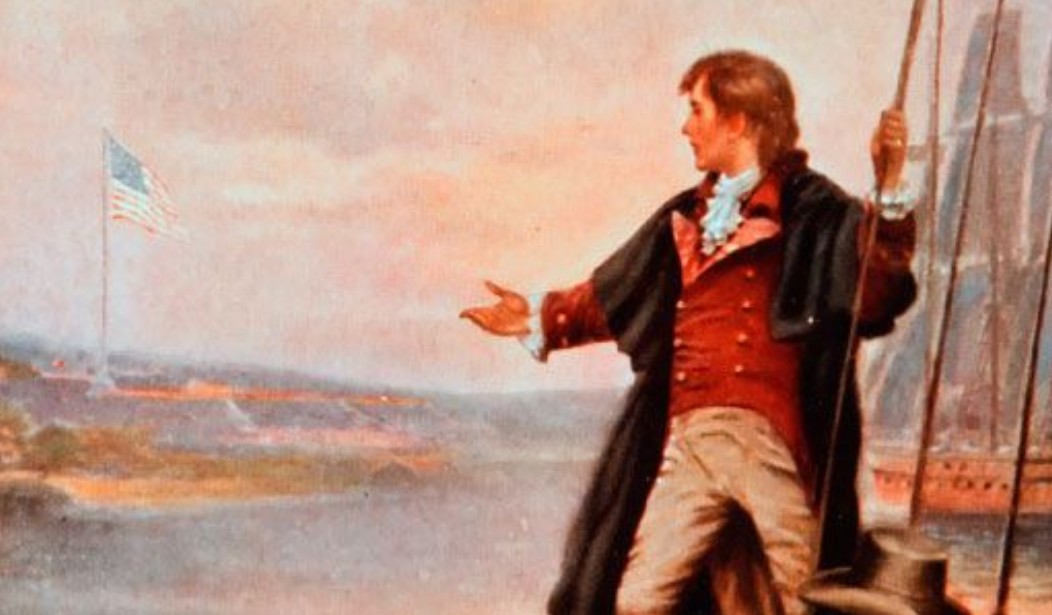
When night fell, the bombardment of Fort McHenry began, and in those days, nobody could do a naval bombardment like the Royal Navy. They intended to reduce the fort's defenses with artillery and then to capture the fort, using it as a base for raids on nearby towns and cities, including Baltimore. But their efforts were in vain; the men holding the fort were stubborn, and when the dawn broke after the night's barrage, there was the red, white, and blue flag of the young republic, that star-spangled banner, yet waving over the battered fort.
Francis Scott Key quickly scribbled out the lyrics, literally on the back of an envelope. And, here's the eye-opening part: He set it to the tune of a notorious drinking song, To Anacreon in Heaven, written by British composer John Stafford Smith.
While The Star-Spangled Banner remained a popular patriotic song for many years, it didn't become officially our national banner until 1931, when Congress passed and President Herbert Hoover signed a law making it so. Now, today, for patriotic Americans, that song still makes us stand a little taller, look a little more imposing, fills us with a swell of pride.
That's pretty darn good for a song scribbled on the back of an envelope and set to the tune of a British drinking song. And it happened 212 years ago, on September 14th, 1814.
Editor's Note: Do you enjoy RedState's conservative reporting exposing the radical left and woke media? Support our work so we can keep bringing you the truth.
Join RedState VIP and use promo code FIGHT to receive 60% off your membership.


Join the Conversation
VIP members get the ability to comment on articles.