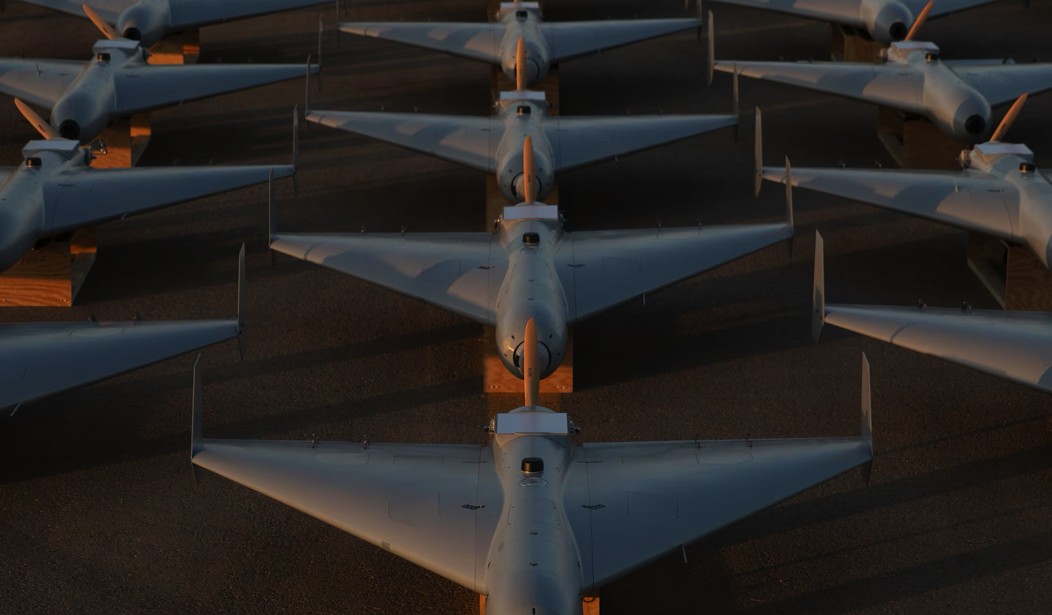

There's an old saying in military circles, observing that military organizations are always training to fight the last war. We saw it in World War II, when the Pacific Fleet was caught flat-footed by Japan's carrier-launched aircraft attack. The same applies to the increasing use of drones in warfare, with Ukraine in particular making some innovative use of these cheap, precise systems for delivering ordnance on point targets. And, only recently, Iran-backed militia groups in Iraq are suspected of launching a drone attack against a major oil pipeline in Saudi Arabia.
But we've only seen the beginning of what drones may be capable of. With some quality equipment and good programming, drone swarms are capable of some pretty impressive coordinated performances.
We saw a peaceful example of this recently right here in the Great Land, at the Alaska State Fair.
But the implications for wartime use are more significant; indeed, according to defense technology expert Sorin Adam Matei, advanced drone swarms in the near future may act in a way that's very nearly biological; not as in human biology, but likely more like a swarm of social insects.Much of the current discussion about drone war begins and ends with arithmetic. Analysts imagine ever-larger swarms of cheap, flying munitions blotting out the sky and saturating defenses by sheer numbers alone. Quantity matters, of course because mass has its own logic. But this vision makes the old mistake of linear interpolation: it takes today’s loitering munition, multiplies it by a thousand, and calls the result the future. That is not foresight; it is photocopying.
The error goes beyond bean-counting. It assumes drones are essentially single-purpose objects: airborne delivery systems for explosives, useful mainly because they are plentiful, expendable, and precise enough. On this account, the swarm is just a buzzing cloud of dumb but stinging bees. Each unit is a near-identical creature. They are drones in the literal sense of the word. Military advantage comes from adding more drones. The swarm overwhelms just as a flood drowns.
That is indeed how drone swarms are being deployed now. There's another old military saying, that quantity has a quality all its own, as the German tank crews in their magnificent hand-crafted Panthers and Tigers learned when overwhelmed by mass-produced Soviet T-34s and American Shermans. An old apocryphal quote usually ascribed to one German general or another that a Tiger "...is worth five American Shermans, but the trouble is, the Americans always have six."
You could apply this as well to drone swarms. But consider more advanced swarms of drones capable of changing purpose on the fly, drones perhaps controlled by artificial intelligence (AI).
Yet, this logic is too simplistic. Real drone warfare is already more interesting than that. Even now, operations in Ukraine, Iran, or Gaza tend to depend on combinations of platforms and functions: some systems scout, some relay communications, some jam, some deceive, some strike, some assess damage, some map routes, some hunt emitters, some simply extend the awareness of the others. The relevant metaphor is not a cloud of identical insects but of a well-integrated body. Modern drone warfare increasingly resembles a set of specialized organs acting in concert, each amplifying the rest and all controlled by both a sympathetic (conscious) and parasympathetic (unconscious) nervous system.
The metaphor here perhaps isn't a swarm of identical insects, but rather closer to a colony, like a termite nest, with differing castes of insects: Workers, drones, soldiers, all working in harmony to expand the colony and protect the queen. But Mr. Matei is seeing ahead to the next stage.
That is the real revolution: not size alone, but plasticity. The most formidable swarm will be the one that can thicken or thin, simplify or elaborate, depending on the mission and losses. In one environment, it may behave like a reconnaissance web, stretching wide, sensing lightly, and avoiding detection. In another, it may condense into a hard striking fist. In yet another, it may become a moving electronic-warfare screen, with decoys on the edges, relays above, strike assets tucked behind. Complexity itself becomes scalable. The swarm can grow organs when it needs them and shed them when it does not. Drone swarm, thy name is Chimera.
Such swarms will not be confined to the air. The truly formidable architecture will be cross-domain. Aerial drones will work with land robots, amphibious systems, static sensors, climbing machines, communications nodes, and perhaps disposable micro-devices scattered across terrain like seed. The old picture of the drone as a flying bomb will look, in retrospect, as crude as imagining a computer as a typewriter with electricity.
We might note that some of the first computers, in the form of word processors, were pretty much typewriters with electricity; things of this nature always start simple.
Here's the thing I find worrisome: the combination of this kind of coordinated, interacting, adapting, reactive drone hive controlled and coordinated by AI. Even the AI, given powerful enough networking, could be dispersed, with a little piece of the code carried in each of the thousands, tens of thousands of drones. Drones that could fill in the blanks as some are damaged or lost, controlled by an AI that can do likewise. Consider the reaction times of a drone swarm controlled by AI, analyzing and reacting to inputs literally at the speed of light; such an automated swarm may be capable of reacting so quickly that humans in their environment may as well be fixed, static objects. These swarms will overpower an enemy not by drowning them in numbers, but by analyzing, probing for weak spots, exploring, expanding, and learning as they go.
We solve today's problems with tomorrow's technology. This kind of technology is probably a few years away, but it's probably going to happen, one way or another. And whichever nation manages to make this work first will have a big advantage in this messy, human, geopolitical world. And, speaking and writing as an American, I will say that I'd feel a lot better if we we're on the crest of this wave, rather than China.