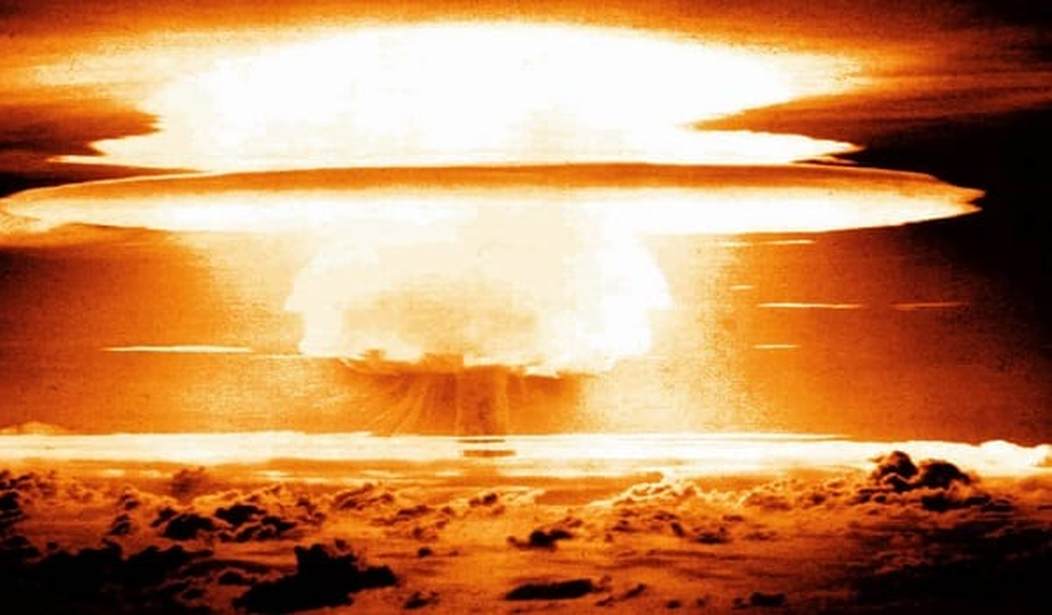

One of the few hard-and-fast rules in geopolitics seems to be this: Once a nation develops nuclear weapons and becomes a nuclear power, it is treated differently. Suddenly that nation has become a much more difficult nut to crack for any potential aggressor. It worked in the case of the Soviet Union and China, even with India and Pakistan - so far.
It's even worked for North Korea, where that isolated hermit kingdom is run by a stunted little gargoyle with bad hair from a line of stunted little gargoyles with bad hair. They have nukes, and they may well have missiles that can reach our West Coast - and they can, for sure, hit our ally Japan.
Every rule has its exception, though. Only one nation, so far, has built nuclear weapons and then given them up. Others, like Ukraine, Kazakhstan, and Belarus, have had nuclear devices within their borders that were built by the Soviet Union and then removed after the fall of that communist country. But only one nation gave up their nukes, destroying them, voluntarily. That nation?
The circumstances in South Africa in 1989 enabled the successful denuclearization. At Pelinda, a highly secure and clandestine military facility, unfolded an unimaginable chapter. Arrayed there were six deadly nuclear weapons, capable enough to reduce any city to a heap of ash in the blink of an eye. However, it was then that the country’s President F.W. de Klerk ordered the end of the nuclear weapons program and oversaw its nuclear disarmament process.
The move left defense experts across the globe utterly stunned as South African forces dismantled their own greatest defensive shield. This was a “political maneuver” that caught the entire world off guard. But why did South Africa take such a step? Did it lack faith in its own incoming government led by Nelson Mandela, or did the White House orchestrate it? The journey from being a nuclear power country to a nuclear-weapon-free nation is no less than a thriller movie.
They had their reasons.
In the late 1970s and 1980s, the South Africans, with rumored help from Israel, built six simple nuclear warheads, very similar to the very first nuclear device ever used in war: The bomb dropped on Hiroshima. This was a gun-type uranium device; simple and easy to maintain, as these things go.
Then came the end of the apartheid era. In 1989, South African President F.W. de Klerk ordered the nukes program terminated. The six weapons were disassembled, the enriched uranium in the warheads was melted down, and all of the components and documentation were destroyed. That was the end of South Africa as a nuclear power.
Read More: Iran Floats Hormuz Deal: Ease the Squeeze - but Stall the Nukes
This brings up the question: Why? Consider what else was going on in South Africa at that time.
One of the most significant aspects was the fear of a transfer of power. President Klerk knew that the era of apartheid was drawing to a close and that the power would be passed into the hands of Nelson Mandela and his African National Congress (ANC) soon. The white African-led government did not want a black African-led government to possess such a nuclear weapon.
That statement makes it sound as though the decision was tinged with racism, and indeed, there may have been an element of that, at least for some in the last white-majority South African government. But there was a larger issue. The African National Congress (ANC), which would be taking over South Africa, was a communist organization with communist inclinations, and in those closing days of the Cold War, no sensible people wanted to see nuclear weapons in the hands of an organization that was taking over the most technologically advanced nation on the continent.
So, what relevance does this incident in history carry for us, now, all these years later?
Simply this: Every American president since Ronald Reagan has spoken of the need to prevent Iran, a theocratic lunocracy that is the world's foremost state sponsor of Islamic terrorism, from becoming a nuclear power. This has been President Trump's primary stated goal since reassuming office in January, 2025. In Operation Midnight Hammer, the United States destroyed much of Iran's nuclear infrastructure. Starting in February of 2026, the United States and Israel started methodically dismantling Iran's military and civil government. All of this has one goal: Preventing Iran from developing a nuclear weapon.
This is the needful act. Consider what would happen if the world were faced with a nuclear-armed Iran. Even if they didn't use a nuke, and they almost certainly would, suddenly the threat they pose to the world is greatly magnified. Every action taken against Iran or Iranian proxies anywhere in the world would have to be weighed against the possibility of a nuclear response.
If Iran ever achieves a nuclear weapon, it will not give it up.
South Africa gave up and destroyed its nuclear weapons because they were worried about leaving nuclear warheads in the hands of communists. The United States has to prevent Iran from developing nukes, so we don't have to deal with nuclear warheads in the hands of jihadis. And in this case, an ounce of prevention really is worth a pound of cure.