
Last March, I attended the Conservative Political Action Conference (CPAC) with several of my RedState and Townhall media colleagues. These gatherings are always interesting; there are always plenty of people to talk to, contacts and connections to make, and not least, the chance to sit and catch up with friends and colleagues that we usually only see, perhaps, once a year.
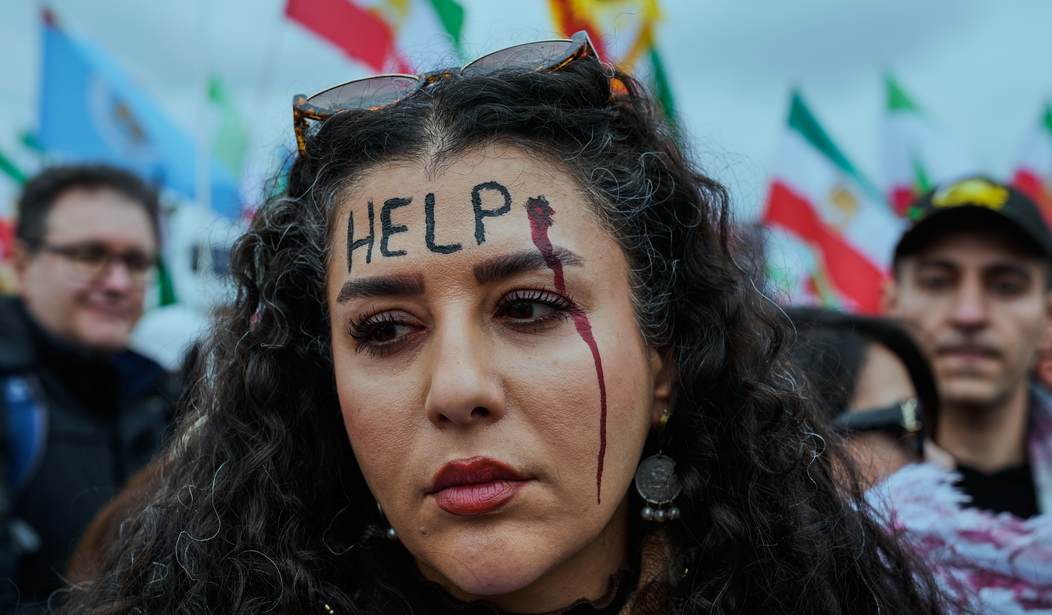
One of the high points for me, though, was the chance to visit with several Iranian ex-pats, refugees in fact, from the Iran of the vicious 7th-century rule of the mullahs. These people were universally supportive of President Trump and his trouncing of Iran, which was in its early stages at the time. Most of these folks, while proclaiming their love for America, wanted nothing more than to go home, but their home isn't there, as long as the mullahs are in charge.
Now, it's four months later. One has to wonder, at this point, what a post-mullah Iran will look like. It's a fair question, after all, since there has been an enormous expenditure of American munitions and even American lives, to try to bring this about. I'm not saying this isn't worth doing; Iran will remain a threat to the security and safety of the region, perhaps the world, if the mullahs keep their grip on the country. As I see it, there are two possible scenarios.
First, the best outcome: A secular Iran with reliable, clean elections, an elected Parliament, and a guarantee of the natural rights of the people. Ideally, the post-mullah Iranians would just translate the United States Constitution and the Bill of Rights into Farsi and ratify it, but that's probably too much to hope for. An elected Parliament with guarantees of free speech and freedom of conscience, though, would seem to be attainable - if the mullahs and the Islamic Revolutionary Guard Corps are, to put it bluntly, no longer a factor.
This outcome would usher in a new era, not just for Iran, not just for southwest Asia, but for the world. The world's foremost state sponsor of Islamic terrorism would be transformed to a modern nation with a freely elected government and a guarantee of essential human rights. Oh, there would still be Islamic terrorists, probably for a generation or two to come; Afghanistan, and the ruling Taliban, would remain a problem, as would remnants of Hamas, Hezbollah and related groups. But those groups have, historically, been funded, trained and equipped by Iran. Imagine a free Iran, with a newly liberated population who lived under the iron sandals of the mullahs, instead joining in to hunt down and eliminate the remnants of those groups.
This task, this fundamental reorganization of a major nation, won't be easy. But it's happened before, with Germany and especially Japan, following their defeats in World War II. It could happen again, and it would be rendered easier if the Iranian people had a standard to rally around. They do: The son of the late Shah, Reza Pahlavi, who has declined any royal ambitions but who has offered to serve as just such a unifying standard. Only last January, Pahlavi said:
Our goal is no longer just to take to the streets. The goal is to prepare to seize and hold city centres... I too am preparing to return to the homeland so that at the time of our national revolution's victory, I can be beside you, the great nation of Iran. I believe that day is very near.
It wasn't as near as it seemed. But Reza Pahlavi was a keynote speaker at last March's CPAC conference I mentioned above, and not only did he get a thunderous standing ovation after his remarks, but he was also the only speaker that jammed the hall to capacity. He may be just the right man to bring a post-mullah Iran together.
Read More: Watch: Trump Fields Iran Questions, Claims 'We've Been Very Nice'
Whoa: Trump Just Told Iran Exactly What He'll Blow Up If They Attack Another Ship
Still, there's another possibility for a post-war Iran.
Suppose the reorganization of Iran fails. Suppose the remnants of the old regime take to the hills, or seek refuge in someplace like Afghanistan, and continue trying to keep Iran from forming a modern government. The result could be chaos, anarchy, violence, and terrorism within and without Iran on a scale we haven't yet seen or imagined. Iran would be prevented from building a nuclear weapon; anarchy isn't conducive to the development of nuclear technology. And, remember, President Trump's oft-stated goal is just that: To prevent Iran from obtaining a nuclear weapon. That could be achieved by defenestrating the remnants of Iran's civil and military leaders, but would the United States and the nations of the Gulf be able to walk away at that point? Or would the promise of option 1 be enough for the rest of the world to preserve Iran's security while the new democracy stands up?
At this point, of course, this is all conjecture. But it's something that President Trump, his administration, the nations of the Middle East - yes, including Israel - had better be considering. If the present regime in Iran is removed, if the mullahs and the IRCG are crushed, something else has to stand up in its place, and that will take an involvement by America and the Gulf states, not in war, but in peace, in rebuilding, perhaps with a sort of Marshall Plan for Iran. It's something that we had better be prepared for, if this war is going to be prosecuted to the only logical conclusion: Victory.