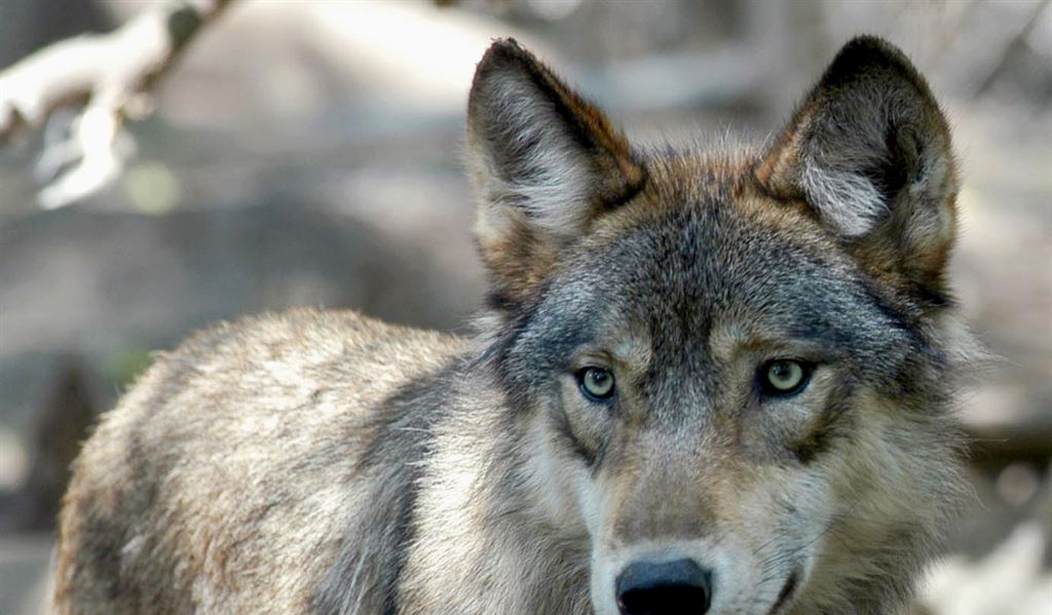

Here in Alaska, we're pretty accustomed to wolves. We have a local pack right around here, about seven or eight animals. We hear them singing now and then, normally at night, normally back in the expanses of spruce bogs off to the east of us. I have stood in the driveway in -20 temps for ten minutes to listen to wolf song. We see them now and then, too. The first year we lived here, one frigid February night my wife and I were driving back from town, when we came around a corner and there was a large black form standing on the side of the road. I was struck by the form: Long legs, huge paws, the big, thick ruff of black fur around its neck, the piercing, intelligent eyes. My wife saw it, and said, "Oh, look, someone's dog got out oh my that's not a dog!
It wasn't. It was a big, magnificent black male wolf, waiting to cross the highway.
Here though, not many people run cattle. What stock people do keep are pretty well protected; no free range up here. But in California, where the wolves are re-establishing themselves, people do run cattle, and the problem is that these returned wolves are depending more on cattle for food than on their traditional prey.
Researchers from the university collected scat from “wolf pack territories of the Lassen (2022 and 2023) and Harvey (2023) Packs in the Northeastern region of California),” according to the study. Samples were opportunistically collected from roadways and game/livestock trails between June and October of 2022 and 2023, then DNA sequenced and analyzed to determine what animals contributed to their contents.
The analysis resulted in the successful identification of 20 wolves, consuming a diet consisting of 86 percent cattle in 2022 and 55 percent cattle in 2023. The research notes the 2022 data included exclusively scat from the Lassen Pack while the 2023 data included scat from both packs. The combined average beef content of both packs’ diets was 72 percent for the duration of the study.
That's a problem, yes, and to an old rural Iowa kid who descends from a long line of farmers and stockmen - my Dad raised black Angus cattle for many years - I can see the obvious solution. Wolves aren't stupid. Shoot a few and the others will stay away from cattle.
But that's not allowed. Not in California.
The current conservation plan does not allow for hunting, trapping, or “caught in the act” protections for domestic livestock because gray wolves are considered an endangered species in California by the state and federal government. There needs to be a change in how wolves are managed in the state to allow the ranching community a respite from the ongoing attacks to their herds.
That last is something of an understatement. The wolves should, at least, be delisted under the state's California Endangered Species Act, which doesn't allow for the killing of wolves even in the act of preying on cattle.
Read More: Cry Wolf! Wolves Here and There
Wolves at the Door? Break Out the AC/DC Albums
Now at least in this case, wolves weren't brought in and reintroduced at taxpayer expense, as has happened elsewhere. These wolves have come in naturally, and it's generally good to see a species bouncing back. Even wolves can live with humans, to a certain degree; we certainly do, here. But ranchers and farmers must be allowed to protect their property as well.
The problem is that human livestock, not just cattle but sheep and other domestic stock, present a pretty irresistible draw for big predators. Compared to wild animals like elk, moose and bison, human livestock is a pretty soft touch. Cattle aren't that hard for a pack to take down, especially calves and yearlings. Any predator will always go for the easier prey. That's how they survive. Every wild predator walks on the edge of an internal, instinctive energy budget. They must make kills regularly enough and easily enough that the energy input from eating their kills exceeds the energy output from the hunt, the chase, and the final attack.
That's what California wolves are doing when they attack cattle. And ranchers are following a similar instinct, an economic one, that tells them not to let their valuable stock be food for wolves.
In states with predators protected by the state and/or federal government, the “shoot, shovel, and shut up” method of management is sometimes employed as a last resort to keep children, pets, and livestock safe. When people feel they have no options to provide safety for their loved ones, they can occasionally step outside the letter of the law. Rather than allowing the current situation to escalate that far, state officials have an opportunity to bring stakeholders together now and create solutions that honor the desires of everyone to keep rural communities whole while respecting the wishes of conservationists.
That is precisely what will happen; the "shoot, shovel and shut up" rule has been a thing for so long because it works. The best way to keep large predators from human settlements and human livestock is to make sure there are consequences for those that do.
Here in Alaska, we love having wolves around. We love the occasional glimpse of them in the woods, and we love hearing them sing on those dark, cold winter nights. But Alaska is a very different place. We're not raising cattle. A co-existence that works here won't work the same way in California, and that would seem to be what Sacramento can't quite figure out. But the ranchers will, and that's for sure and for certain.