
I'm fond of saying and writing the old saw about how history may not always repeat, but it frequently rhymes. It's apt right now, as we are seeing, right here in these United States, a disturbing return of one of the cruelest, most murderous, impoverishing political philosophies in human history: Communism. Oh, yes, they call themselves "democratic socialist," but that's a canard, and misleading to boot; there's nothing democratic about socialism. It is, at its core, a totalitarian system. And what the more extreme of these nuts, those that make up the Democratic Socialists of America (DSA) are espousing is communism, and nothing but.
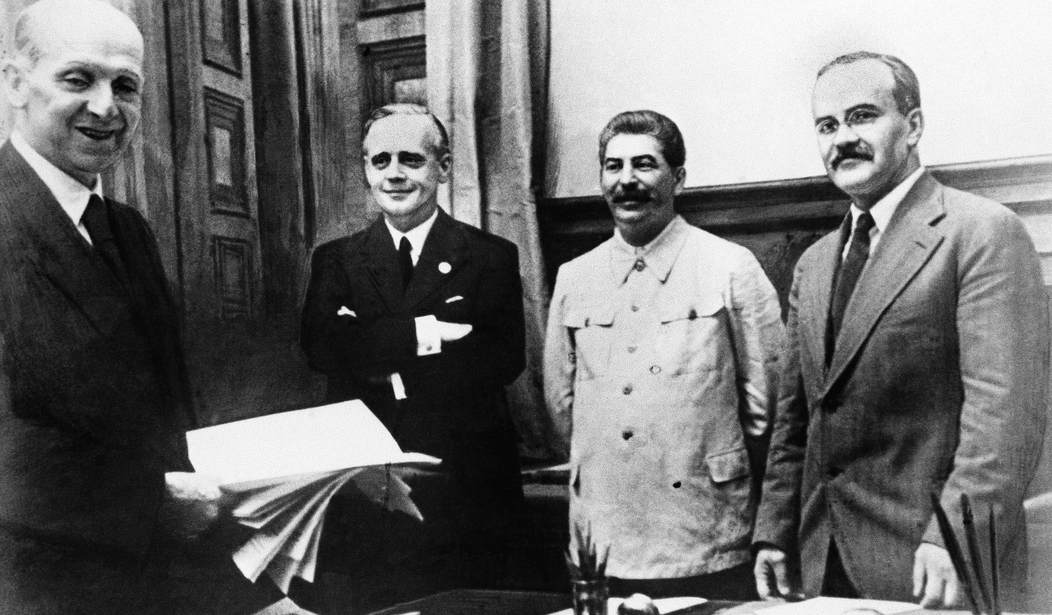
Since history so frequently rhymes, it's instructive to look at one of the most prominent communist dictators in history: Joseph Vissarionovich Dzhugashvili, later known as Joseph Stalin.
Stalin came to power after the death of Vladimir Lenin. He was General Secretary of the Communist Party of the Soviet Union from 1922 to 1952, and Chairman of the Council of Ministers from 1941 until he died in 1953. But it's how he came to be there that's interesting; he did so ruthlessly, shoving aside and, in some cases, killing his competition. Once in power, he used the power of the state to murder millions more.
What's interesting is that Lenin and Stalin had a major falling-out not long before Lenin died in 1924. Lenin, in his personal papers, indicated he wasn't overly fond of Stalin. Some historians question those writings; some claim that Lenin's wife, Nadezhda Krupskaya, worked with Leon Trotsky to produce those supposed personal memoirs, presumably to give Trotsky a better shot at the top spot.
That's not how it worked out, though.
Lenin suffered a stroke in 1922, during which time Stalin struck up a working relationship with Lev Kamenev and Grigory Zinoviev, who helped Stalin repress Lenin's disparaging writings until after Lenin's death and Stalin's ascension to General Secretary. So, he took power, in part, by concealing information.
But it was what happened next that reveals communism for what it is: Murderous.
Read More: Life Under Communism: What Was a Soviet Vacation Like?
UK's Labour Party Now Proposes 'Stalinist' 15-Minute Cities Nationwide
One of the first actions taken by Stalin became known as "The Purges," or "The Great Terror."
The period of Stalin’s rule in the Soviet Union was marked by a series of political purges aimed at eliminating perceived enemies of the state. These purges, which began in 1928 and continued until Stalin’s death in 1953, were characterized by their brutality and the scale of the repression. The purges were carried out in stages, with each stage targeting different groups of people and using different methods of repression.
In the purges, as many as 20 million people are thought to have perished, either by immediate execution or as a consequence of exile to the gulags. Of those gulags, the famous Russian patriot/Soviet dissident Aleksander Solzhenitsyn wrote:
Unlimited power in the hands of limited people always leads to cruelty.
That's the primary aspect of communism: A ruthless disregard for the lives of the people who live under the iron boot of the regime. And another aspect of communism: Sooner or later, one thug-dictator eventually rises to power, and as Solzhenitsyn notes, that always leads to cruelty. Power corrupts, as the saying goes, and absolute power corrupts absolutely. It even leads to the rise of political violence, and even assassination; that's something else Stalin was known for.
In 1940, Stalin sent the People's Commissariat for Internal Affairs (NKVD) after his rival, Leon Trotsky, who by that time had fled to Mexico. Stalin wanted his primary rival for almost 20 years out of the picture, so Trotsky had to go; so, while Trotsky was in exile in Mexico, a Spanish communist named Ramón Mercader won the confidence of Trotsky's inner circle, with disastrous results.
He secured access to Trotsky’s household by forming a relationship with Sylvia Ageloff, a trusted member of the inner circle.
Over time, he won the confidence of the staff and appeared to be a harmless admirer seeking Trotsky’s editorial guidance.
His mother, Caridad del Río Hernández, a committed communist, also helped organise and support the operation.
On 20 August 1940, Mercader arrived at the compound and used the excuse of discussing a political article he had written.
Once inside the study, as Trotsky read the document, Mercader produced an ice axe and struck him in the head.
That's the other aspect of communism that always seems to follow: The ruthless elimination of the dictator's rivals.
We are not immune to this sort of thinking right here, in these United States. We're seeing the seeds planted right now, seeds that threaten to bear bitter fruit indeed. It all started with some rather laughable figures, including Sen. Bernie Sanders (I-VT) and Democratic Rep. Alexandria Ocasio-Cortez (NY-14), who were and who remain rather comical figures; but behind them is the DSA, with a much more radical platform, which is as alarming a political document as we've seen in some time, and they are in earnest about this.
Add all that to the troubling increase in political violence, including three attempts on the life of the president of the United States, and an increasing acceptance of violence as a political tactic on the left, and history does look as though it is about to start rhyming again.
But this is the United States. Not the Russian Empire. Not China. The communists won't find the American people quite so easy a nut to crack. But that doesn't mean they won't try.
Of course, in Communist China, Chairman Mao made Stalin look like a piker when it came to mass murder. But that's a story for another time.