
It's almost certainly not a coincidence that the rise of social media and the rise in "teen takeovers", which we may do better to describe as riots and looting, have coincided. Social media enables these events to be planned and coordinated, and the only bright side of this is that the use of social media to plan and coordinate these mobs is that it also allows law enforcement to learn about them ahead of time and hopefully to forestall them.
Here's the interesting thing: This all started with the advent of what was called, in the late 1990s, "flash mobs." Most of these were innocuous and even amusing: A large group of people, normally young people, would arrange to all gather in one place at a given time, do a dance or act out some kind of scenario, then disappear.
So, what happened? A recent piece at the Pacific Research Institute has an interesting notion: The rise of "likes."
A few years ago, a flash mob meant gathering in a public place to dance, or engage in some harmless act of collective absurdity. The goal was novelty. The participants sought attention, but not victims.
In May, approximately 200 teenagers gathered at The Pike in Long Beach after a meetup circulated through social media. The evening ended with a mass brawl and multiple arrests.
A few weeks later, hundreds of teenagers descended on Crown Beach in Alameda after invitations spread online. The gathering deteriorated into fights and two were shot.
Around the same time, two people suffered serious injuries on Hawaii’s North Shore after a large group of teenagers allegedly attacked one victim at random and then assaulted another who attempted to intervene.
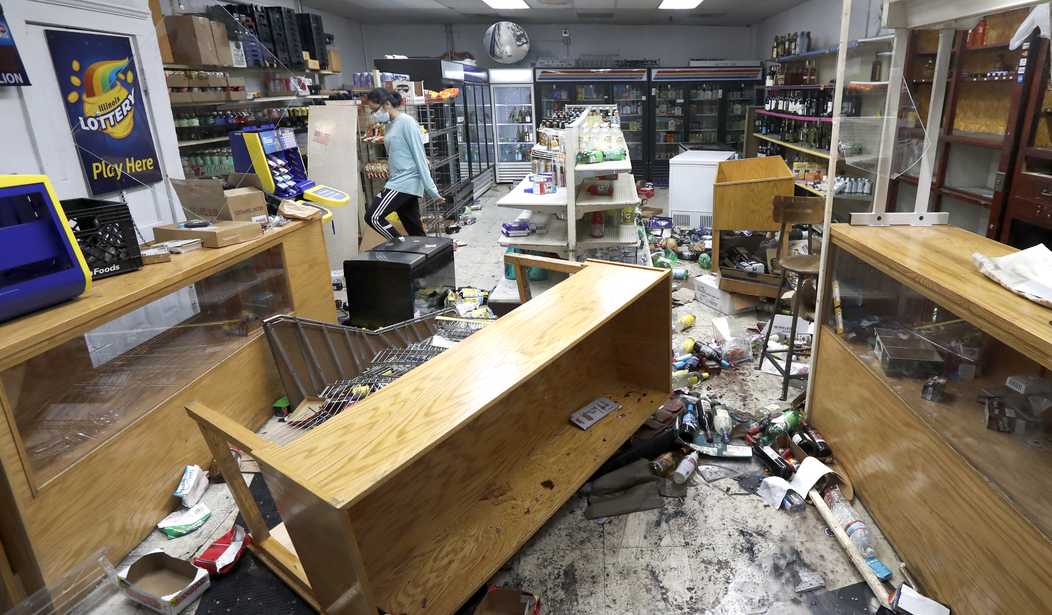
These are no longer the innocuous and entertaining flash mobs. These are riots, with all the vandalism and looting that one associates with a riot, and this may well be due not only to the use of social media in coordinating the attacks, but also to the value an individual perceives in having a high profile on any given social media platform. It's a search for followers, a search for upticks, and it appears to be addicting to the young goblins who are so easily led to the riot.
The incidents unfolding on beaches, in shopping districts, parks, and entertainment venues suggest a different question altogether: What happens when online behavior begins reshaping public order offline?
That question receives surprisingly little attention.
One reason may be that policymakers continue to examine social media, juvenile justice, youth mental health, alcohol and drug use, and public safety as separate issues. Increasingly, they may be interconnected.
Social media platforms don’t need to encourage violence to reward escalation as the incentive structure or “likes” can do that on its own. What makes this particularly challenging is that many of the institutions responsible for governing modern adolescence were designed for a different social environment.
Today, a young person’s status can be measured instantly through likes, views, followers, and engagement metrics visible far beyond their school or neighborhood.
So, how do we fix this? Well, there's an old saying that applies: An idle mind is the devil's workshop.
Read More: Out-of-Control Teen Takeovers Now Sparking Fear Across July 4 Weekend
The Downfall of America's Cities: Why Is NYC Mayor Mamdani Letting Homeless Encampments Fester?
Here's one possible solution: Iceland, yes, bucolic, peaceful Iceland, has had a similar problem with their youth: Not rioting and looting, but rather an increase in alcohol and drug use. How did they deal with it?
In the 1990s Iceland experienced some of the highest rates of teenage alcohol, tobacco, and drug use in Europe with all the attendant negative social consequences: public intoxication, fights, vandalism, and thefts. In 1998, 42 percent of Icelandic teenagers reported being intoxicated in the last 30 days, 23 percent used tobacco, and 17 percent marijuana. Yet, by 2019, that same study showed those numbers dropped to 7, 6 and 2 percent respectively.
Here’s another statistic: 74 percent of teenagers had reported being out after midnight; by 2016, the number had dropped to 31 percent.
The Icelandic response had five key principles:
- Apply a primary prevention approach that is designed to enhance the social environment
- Emphasize community action and embrace schools as the natural hub of neighborhood/area efforts to support child and adolescent health, learning, and life success
- Engage and empower community members to make practical decisions using local, high-quality, accessible data and diagnostics
- Integrate researchers, policy makers, practitioners, and community members into a unified team dedicated to solving complex, real-world problems
- Match the scope of the solution to the scope of the problem, including emphasizing long-term intervention and efforts to marshal adequate community resources
In other words, the Iceland model is focused on engaging young people in the community, and vice versa. Here's the catch: This model hinges on involvement by the schools and by the parents. That's where an American application may well fall apart. Why?
Because too many parents, especially in certain mostly urban demographics, simply aren't involved in their teenage children's lives in any meaningful way. What's more, the schools are not really institutes of education anymore, so much as they are sinecures for the pets of the teacher's unions. The urban family has been destroyed by decades of replacing responsible, working fathers with welfare programs, and the urban schools have been destroyed by failing to teach basic skills - reading, writing, math, and most of all, civics. Add to that the rise of an increasingly online life, and you have a roiling kettle of dysfunctional youths.
But there's still some merit in the Icelandic model, at least to the notion of keeping these youths busy and engaged in their communities. How? By a change in sentencing for the young skulls full of mush caught by law enforcement. Instead of the typical fines and probation, let their sentences include cleaning up the mess they made, under the direct supervision of law enforcement and the owners and employees of the businesses they looted and destroyed. Give them shovels and rakes and set them to cleaning up. Force them to interact with the people whose property they have destroyed. And let their social media accounts show that as well; any social media accounts they have will be tagged with a video of them at work.
It's a bit harsher than the Icelandic method. But it has a neatly American twist to it, and one thing is for sure: The current practices of dealing with these mobs isn't working. It's time to try something else.