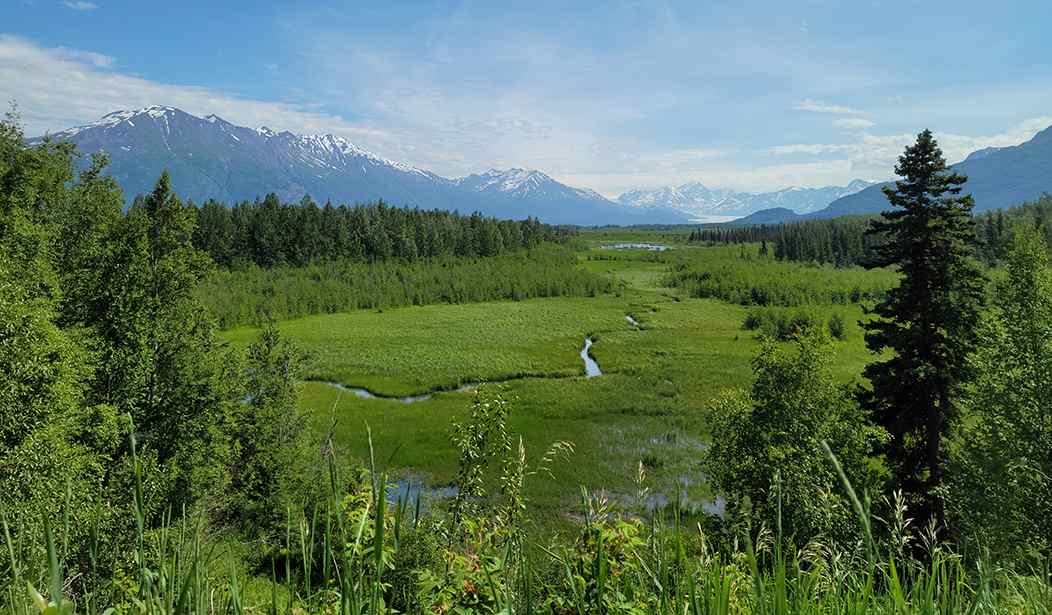

Alaska's oil, natural gas, and mineral wealth have been the subject of much discussion in recent months, from the White House to Congress, from Washington to the North Slope oil fields. Alaska is, as I am in the habit of pointing out, America's Treasure Chest. Since President Trump resumed office, the official policy has gone from maintaining Alaska's status as the world's largest national park to "drill, baby drill" and "mine, baby, mine." We need the oil, we need the gas, and we need the minerals, so that's all to the good.
There's just one problem: Alaska suffers from a serious lack of refining capacity. That's most visible in the matter of gasoline, heating oil, and diesel fuel, which explains why we are paying (with the ongoing Iran war) nearly $5 a gallon for diesel fuel while Alaska sits atop an ocean of petroleum. But it affects mineral processing, as well, wherein ores and materials, only through the first elementary processing steps, have to be sent to the lower 48 for refining.
That could be changing soon. The Alaska Miners Association has a proposal to fix this, to turn Alaska not just into a raw materials source, but to go from ore to refined metal, all right here in the Great Land.
From antimony to zinc, Alaska's vast and largely untapped mineral endowment is increasingly viewed as a strategic national asset in a world reshaping its supply chains around critical minerals.
In fact, it should always have been viewed that way. Previous administrations ignored Alaska's untapped wealth too much of the time. That's changing now, but to make it stick, it would be preferable to do something previously unheard of: Make Alaska an industrial powerhouse. Here's how the Alaska Miners Association plans to do that:
But unlocking that potential will require more than discovering and developing new mines.
It will require building an integrated system capable of sustaining Alaska's mining industry for decades – an approach that aligns squarely with the Alaska Miners Association's 2026 spring convention theme: "Built to Last: Alaska Mining for the Long Haul."
For Alaska's mining leaders, that theme is more than a slogan – it reflects a pivotal moment for the industry.
"At this point, Alaska's mining industry has lived through the ups and downs, but remained resilient and committed," said AMA Executive Director Deantha Skibinski. "With such a strong foundation of people and mineral potential, we'll be here for the long haul."
A mines-to-metals strategy that builds on that foundation and positions Alaska as a cornerstone of American mineral independence is beginning to take shape.
Extraction and refining, all here in the Great Land. It's much more efficient, after all, to ship refined metals to their point of use, instead of raw ores or only partially refined metals.
Read More: America Tops World Oil and Gas Production Under New Agenda
Nova Minerals Boosts Estelle Project With New High-Grade Gold Target
And while we're at it, how about encouraging some manufacturers to look at the Great Land? To build plants near the refineries, to invest in Alaska?
It's unclear as to whether that last part will happen. There are pros and cons to this plan, as there would be to any additional development. The pros? The Alaska Miners Association's plans would be great for Alaska's economy. It would be great for America to secure our supply chain by decentralizing refining capabilities. It would bring the Great Land a lot of jobs.
The cons? A lot of these extraction sites are pretty remote. Besides the North Slope, there are mining sites in some pretty distant locations, like the Ambler Mining District and the Susitna West project. Would it be better to build any refining facilities there? Or near the port at Anchorage? In either case, there would be serious infrastructure projects involved, like running increased electrical generation out to the sites, and building solid, year-round roads.
A rail line from the lower 48 to Alaska wouldn't be the worst idea, either. We already have the route scouted, after all; the Alaska Railroad could march alongside the Alaska Highway.
Right now, the momentum is in favor of more Alaska energy and mineral development. The Alaska Miners Association, Dave Larimer, is quick to point that out, and how best to make sure the momentum is sustained.
"The critical task for Alaska mining now is simple: don't let the momentum bleed out," said AMA President Dave Larimer. "The door has been unlocked; we have to open it and execute."
To capture this momentum, Larimer emphasizes that Alaska must move beyond extraction and build a complete mining ecosystem that includes processing, refining, infrastructure, energy, and workforce development
Ambitious? Yes. Challenging? Certainly. Likely to run afoul of any future Democratic administration or Democrat-majority Congress? Again, certainly. But Alaska can be the powerhouse that Mr. Larimer describes. And, as I am continually pointing out, Alaska is a vast enough state that we can have our cake and eat it, too; we can have the industry, the mining, the refining, and someday maybe even manufacturing, with plenty of wild, vast, clean, untouched vistas left over.
There may be a fair bit of wishful thinking in this proposal. The costs would be, well, staggering. But there are national security considerations along with the economic and industrial concerns - decentralizing our refining capacity, not least of which.
The question then becomes this: how much of this can we get done before a new Democrat in the White House brings it all to a screeching halt?