






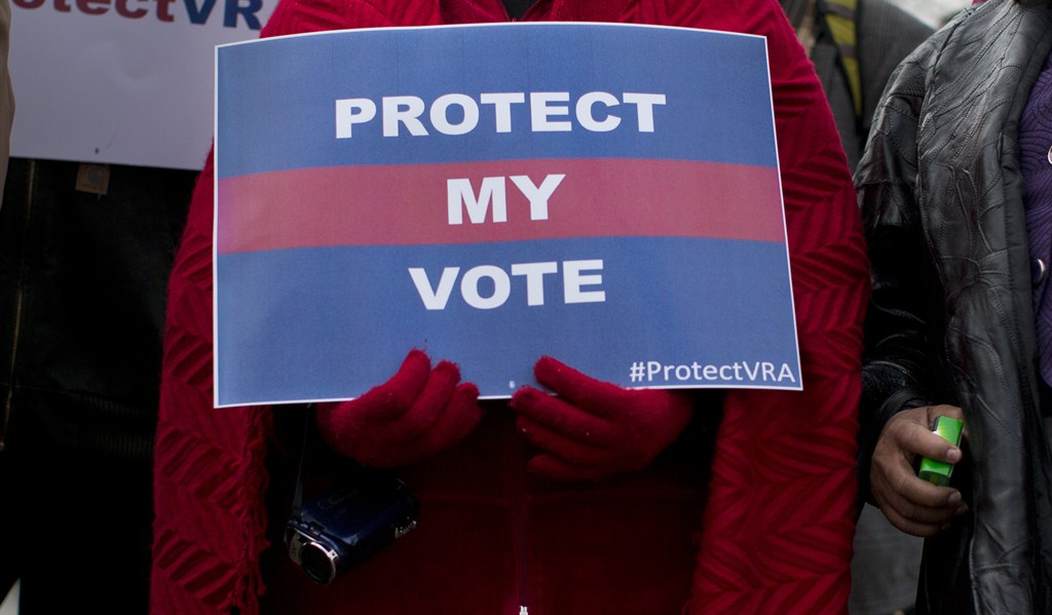
On the heels of Alabama's May 19 primary election, and ahead of the special election on August 11, a three-judge district court panel has reinstated its injunction against Alabama's 2023 map, which eliminated a recently drawn majority-minority district. After the United States Supreme Court decision in Louisiana v. Callais, the Alabama legislature voted to put these maps in use and established a special election for the voters of affected districts.
The district court panel claimed it is seeking to prevent chaos and confusion in the 2026 election.
I think that ship sailed quite some time ago.
A three-judge panel on Tuesday blocked Alabama Republicans’ congressional map that would’ve given the party a potential pickup opportunity in the midterms.
The judges ruled the Supreme Court’s recent blockbuster decision narrowing the Voting Rights Act does not impact their finding that the map intentionally discriminates against Black voters in violation of the Constitution.
It means Alabama cannot use its design this year unless Republican leaders appeal directly to the Supreme Court and succeed.
From the 102-page Northern District order.
After that exacting review, we conclude that a preliminary injunction must issue. Ultimately, we cannot see our way clear to requiring Alabamians to cast their votes in the 2026 elections under a districting plan tainted by intentional race-based discrimination. And under the unusual circumstances of this case, we conclude that a limited order requiring the Secretary to continue using this Court’s race-blind map will not disrupt Alabama’s elections (all candidates ran under the race-blind map until fifteen days ago, and all voters remain districted under the race-blind map in electoral computer systems.
Their doubling down on their prior decision is as confusing as their reasoning. The United States Supreme Court decided that maps drawn along racial lines under Section 2 of the Voting Rights Act were no longer valid, but when Alabama made efforts to correct this, the panel again barred them from doing so because their prior ruling deemed the maps were intentionally discriminatory based on race.
It makes no sense.
Read More: New: Alabama Is Free to Redraw Its Maps After SCOTUS Vacates District Court Ruling
The three-judge panel then insisted that Black opportunity is at stake and used the Southern districts of the state as its sole basis. However, the May 19 primary election results pretty much confirmed the SCOTUS decision was sound. So-called "Black opportunities" abound statewide, and they will choose their candidates without the assistance of gerrymandered maps. In two cases, one in a northern voting district, another in the majority-Black district to the south, incumbent state representatives were replaced by Black newcomers. The district in the northern part of the state is overwhelmingly Republican, while the southern district is overwhelmingly Democrat. It shows that if you leave it up to people to vote for the people and the party they desire, the voters get the results they want.
We do not lightly intrude in state affairs, but our previous review of the undisputed evidence left us in no doubt that Alabama’s legislatively enacted plan (the “2023 Plan”) intentionally discriminated based on race in violation of the Constitution. Our re-examination in light of Callais yields the same conclusion.
We again cannot understand the 2023 Plan as anything other than intentionally discriminatory. When the Legislature enacted the 2023 Plan, it made a calculated, purposeful decision to refuse to provide the remedy for discriminatory vote dilution that our order (affirmed by the Supreme Court) required. The Legislature well knew that a plan without an additional Black-opportunity district would dilute Black Alabamians’ opportunity to participate in the political process, and it intentionally enacted that very plan.
Republican representative and candidate for U.S. Senate Barry Moore (AL-01) weighed in.
The people of Alabama deserve fair representation, not activist judges rewriting our Constitution to impose Washington politics on our state. This latest ruling against Alabama’s congressional map is another example of unelected bureaucrats trying to override the will of Alabama…
— Barry Moore for U.S. Senate (@BMooreSenate) May 26, 2026
The people of Alabama deserve fair representation, not activist judges rewriting our Constitution to impose Washington politics on our state. This latest ruling against Alabama’s congressional map is another example of unelected bureaucrats trying to override the will of Alabama voters and punish our state for standing its ground.
I stand firmly with @AGSteveMarshall and the State of Alabama as they continue defending our lawful map and our constitutional right to draw districts without federal judicial overreach. The Supreme Court has already spoken on the importance of respecting the Constitution and the…
— Barry Moore for U.S. Senate (@BMooreSenate) May 26, 2026
I stand firmly with @AGSteveMarshall and the State of Alabama as they continue defending our lawful map and our constitutional right to draw districts without federal judicial overreach. The Supreme Court has already spoken on the importance of respecting the Constitution and the role of the states, and it’s critical these principles are upheld consistently and decisively moving forward.
This is a developing story. RedState will update as information becomes available.
Editor's Note: This article was updated post-publication to reflect that the primary was May 19, rather than March 19.
Editor’s Note: The 2026 Midterms will determine the fate of President Trump’s America First agenda. Republicans must maintain control of both chambers of Congress.
Help RedState continue to report on the Democrats’ radicalism and inform voters as our nation faces a crossroads. Join RedState VIP and use promo code FIGHT to receive 60% off your membership.
Join the Conversation
VIP members get the ability to comment on articles.