
You may recall the utter rending of garments over the Supreme Court's 2024 presidential immunity decision. When the High Court handed down its decision in Trump v. United States on July 1, 2024, the general consensus among the left and the legacy media (to the extent those are not one and the same) was that SCOTUS had effectively made presidents kings.
In a 6-3 ruling, the Court held that a former president has absolute immunity for his core constitutional powers. Further, former presidents are also entitled to at least a presumption of immunity for their official acts. Additionally, the Court's decision imposed limits on using evidence of protected official acts to prosecute unofficial conduct. However, the Court also held that there is no immunity for unofficial acts. In other words, while presidential immunity is fairly broad in scope, it does not encompass everything a president does while in office, and the fainting couches are unnecessary.
No Kings!
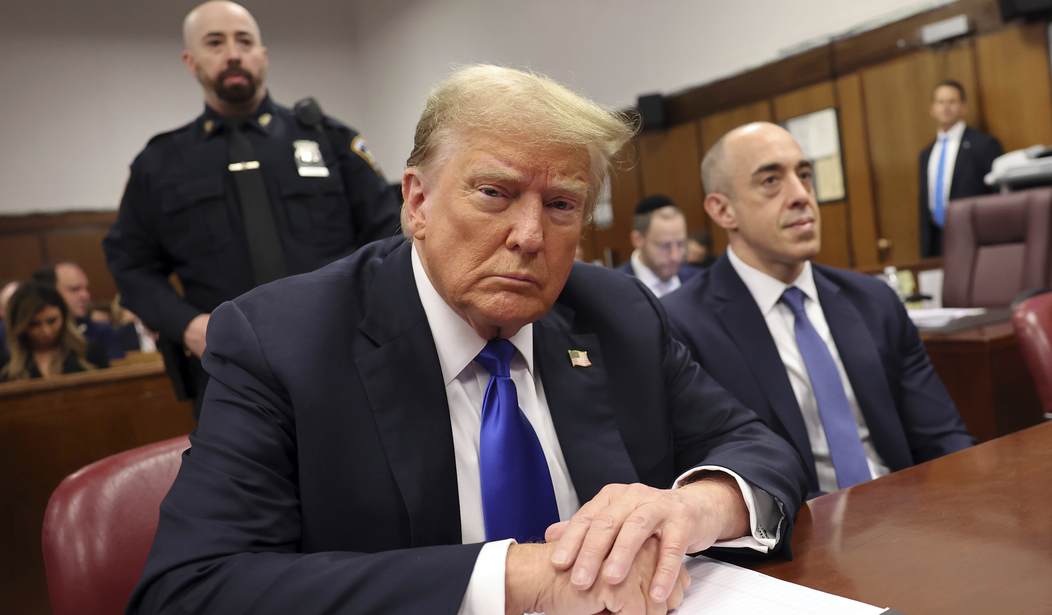
Lo and behold, we saw a prime illustration of this in a recent ruling from U.S. District Judge Alvin Hellerstein of the Southern District of New York involving...none other than President Trump himself. In a Friday decision, Judge Hellerstein rejected Trump's latest attempt to move his Manhattan criminal case into federal court. Per Hellerstein's determination, a president remains capable of acting as a private person, candidate, or party leader while occupying the Oval Office.
Readers, of course, will recall that Trump was convicted in May 2024 on 34 felony counts of falsifying business records stemming from reimbursements to Michael Cohen related to the Stormy Daniels payment. Trump was ultimately sentenced to an unconditional discharge in that case, and his appeal of the conviction remains pending in New York. Separately, he's been arguing that the prosecution belonged in federal court, not New York state court. Hellerstein rejected his first attempt to remove the case to federal court in 2023.
Then, in July 2024, the Trump v. United States decision was handed down, and Trump understandably invoked that ruling against the Manhattan conviction, arguing that the trial included evidence involving conduct from his presidency that should have been excluded.
After Hellerstein rejected Trump's second removal attempt, the 2nd Circuit Court of Appeals vacated that ruling and told him to reconsider several questions, including the effect of Trump v. U.S.
Now, Hellerstein has once again refused removal. In his ruling, Hellerstein identifies three independent problems for Trump:
- He didn't show good cause for waiting 64 days after the SCOTUS decision to seek removal.
- Federal criminal-removal law doesn't permit moving a case into federal district court after trial, conviction, sentencing, judgment, and the commencement of the state appeal.
- Even if Trump could overcome both procedural problems, Hellerstein finds the challenged evidence didn't concern official presidential acts anyway.
Trump has already filed his Notice of Appeal on this, so Hellerstein won't necessarily have the final word, but let's take a closer look at his rationale.
A Wrinkle in Time
After SCOTUS issued its July 2024 ruling, Trump first asked the state court trial judge, Juan Merchan, to set aside his verdict. But then Trump didn't seek (re-seek) federal removal of the case until 64 days later, as it appeared that Merchan was likely to reject his immunity argument and proceed toward sentencing.
Hellerstein asserts that's not diligence, but rather a strategic choice, stating: “He cannot seek victory in one court, and then, when it becomes apparent that the court will rule against him, seek to remove his case to another court.”
No Mulligans for You!
Hellerstein also rejects the idea that a completed state criminal prosecution can subsequently be routed through federal district court into the federal appellate system: “Federal district courts are not certifying clerks. Nor are they appellate courts.”
In other words, removal is supposed to change the courthouse in which a case is tried, not provide an alternative appellate system after you've already been tried and convicted in state court.
Officially Unofficial
But the real heart of Hellerstein's ruling is the application of the Trump v. U.S. holding to the challenged evidence. Trump identified several categories of trial evidence he contends implicated official acts (and thus should have been excluded at trial):
- Hope Hicks' testimony;
- Madeleine Westerhout's testimony;
- Michael Cohen's testimony concerning an alleged Trump/Attorney General Jeff Sessions discussion;
- several of Trump's presidential-era tweets.
At first glance, some of those have obvious presidential trappings: White House employees, communication with an attorney general, other presidential communications. But this is where the Supreme Court's official/unofficial distinction becomes key.
In assessing these evidentiary categories, Hellerstein applies the functional test rather than the “he was President when he did it” test. His basic question is not who Trump was talking to or where he was sitting, but what presidential function he was performing. Thus, he reasons, Hicks may have been White House communications director, but discussing how to respond publicly to the Daniels story doesn't necessarily transform the underlying private matter into official presidential business. And Westerhout worked in the Oval Office, but helping Trump process personal checks to reimburse Cohen doesn't become an exercise of executive authority simply because a White House employee handled the paperwork.
Further, while Trump's Twitter account carried official presidential statements, it also carried personal and political ones. Hellerstein analyzes the particular tweets and finds that those concerning Cohen, Daniels, the NDA, and Manafort were unofficial. The bottom line for Hellerstein: “Paying hush money to an adult film star or engaging in a cover-up of an embarrassment are not subsumed in presidential immunity.”
The Outer Limits
The toughest call involves Cohen's testimony regarding an alleged conversation between Trump and then-Attorney General Jeff Sessions. Trump argues that presidential communications with an attorney general sit especially close to the core of protected presidential activity — and Trump v. U.S. gives that argument some real weight.
But Hellerstein distinguishes the evidence actually presented to the jury: This wasn't Sessions testifying about a presidential conversation. It was Cohen testifying about what Trump allegedly told Cohen regarding Sessions. Cohen was Trump's private attorney, and the testimony arose from an FEC complaint involving efforts by former National Enquirer publisher David Pecker to suppress potentially damaging stories about Trump during the 2016 campaign. Cohen testified that Trump told him then-Attorney General Jeff Sessions would “take care of” the matter (though Trump denied that conversation with Sessions ever occurred).
Hellerstein therefore says whatever immunity might attach to a President-AG conversation doesn't automatically immunize Trump's later recounting of it to a private third party — particularly where the underlying discussion concerned what Hellerstein viewed as a private matter rather than the exercise of presidential authority. And this will likely be the portion of Hellerstein's decision most worth watching on appeal.
Regardless of one's view of Hellerstein's analysis, it highlights a critical point: Trump v. U.S. wasn't about whether Donald Trump personally deserves immunity. It was about protecting the office of the presidency — whoever holds that office — because fear of later prosecution could interfere with or distort a president's performance of his constitutionally assigned duties. And that is why SCOTUS, in its decision, repeatedly focused on the function being performed.
But applying that rationale necessarily creates an outer boundary: If the president isn't exercising presidential authority, the justification for presidential immunity disappears. Put simply: The immunity follows the office's function, not the man.
And Isn't It Ironic?
Following the Supreme Court's decision in 2024, the reaction (from many quarters) was that it established something approaching monarchical immunity. Yet the irony is that one of the clearest demonstrations of the limits built into Trump v. U.S. has now arisen in Trump's own case.
So, for all the caterwauling we heard over that decision, the bottom line is this: The Supreme Court's ruling did recognize and affirm that there are meaningful and powerful presidential protections. It did not establish that everything a president does while president is an “official act.”
Of course, none of this means the Manhattan conviction is sound — Trump's direct appeal presents separate questions about the prosecution's legal theory, trial rulings, evidence, and ultimately whether the conviction should survive. The final determination on those issues remains to be seen. And on the issue of removal, Trump may yet convince the 2nd Circuit that Hellerstein got some portion of this wrong.
But there's a valuable principle underneath the present ruling, whatever your thoughts on it or the underlying case: A president needs enough immunity to perform the duties of the presidency without fear of politically motivated prosecution. He does not, however, need immunity from every consequence of everything he happens to do while president. Nor will he have it.