
As we approach our nation's 250th birthday, our Ward Clark has been sharing the stories of some of the lesser-known yet key figures from the Revolutionary War. If you've not checked his Unsung Heroes installments out yet, I highly recommend them. In fact, Ward's efforts inspired me — so saddle up and ride along with me on my quest for an elusive Revolutionary War era ancestor of my own...
I am my mother's daughter — I am my father's daughter, too, in the political junkie, legal career, corny joke sense, but there is no denying I am the organizing, list-making, ancestor-hunting mini-her (though, at 93, she's shrunk enough that she's shorter than me now).
I often remark that one of my earliest memories is of helping my dad put up campaign signs. But another of my earliest memories is of accompanying my mom to the downtown library to scan through microfiche records for hours, and as she traipsed through graveyards, collecting etchings of ancestors' gravestones. (These were the analog days, before smartphones and cameras were ubiquitous.)
Thus, it was inevitable that I'd catch the genealogy bug at some point. I've dabbled in it on and off over the years — even did the 23andMe DNA thing a few years back (although, if I'm being perfectly honest, that was spurred primarily by a desire to one-up Sen. Elizabeth Warren (D-MA) and affirm that I had more Indigenous ancestry than she does — I do; twice as much, TYVM — rather than a desire to fill out the family tree).
But something got me digging again a few months ago, and now, it's become my obsession. Like, probably borderline unhealthy obsession. I may need an intervention.
Without question, genealogical pursuits are quite different in the digital age than they once were. But even with all of the technology readily available at our fingertips, there still are impediments to tracking down long-ago forebears. Sometimes, the records just aren't there — there may be lore or hints or intuitive guesses, but without the documentation, you can run into what's known as a "brick wall."
A brick wall is an ancestor who eludes you — you think you know who (s)he is, there are breadcrumbs that suggest it, but the paper trail just isn't there, either due to records being lost or destroyed — or predating systematic recordkeeping. You can't reliably confirm where they came from or who their parents were...and it can drive you batty.
I have the benefit of my mom's years of genealogy work to rely on. With old-fashioned research (including countless typewritten letters to distant relatives or rumored relatives), she managed to build out our family tree for generations back — in some instances, as many as 19 generations back (I believe the earliest we have is one Sir Thomas Wyther, who died in 1329), though granted, at a certain point, it's all educated guesses.
Still, I didn't want to just copy her work — I wanted to affirm it and build on it. I figured I could leverage the technological advances of DNA and AI to help me with that — and I have. I've made some hilarious discoveries along the way (like the fact that my great-grandfather caused a mistrial of the prosecution of my great-grandmother for getting into a brawl with their neighbor...by buying the jurors and judge a beer — true story; I have the receipts...or, at least, the newspaper clipping).
Apparently...I come from a long line of hooligans, including a great-grandmother who fought with neighbors and a great-grandfather who caused a mistrial by buying beer for the judge and jurors. 👀
— Susie Moore ⚾️🌻🐶 (@SmoosieQ) May 28, 2026
Nana the Brawler https://t.co/pd3vOtSAhh via @_newspapers
ALSO SEE: Unsung Heroes of the Revolution III: Abraham Clark
Unsung Heroes of the Revolution IV: Sybil Ludington
But I've also run into my share of snags — the brick walls are brick walls for a reason. One of those is my 4th great-grandfather, John Benning Moore. We know a good deal about his later life, as he's the one who planted his roots in Jefferson County, Alabama, in the early-mid 19th Century, and from whom hundreds of Moores have emanated.
My dad, Richard Moore (1933-2020), was born in Birmingham (and my grandfather, Harry George Moore Sr. (1904-1982), just a bit northwest of there, in Dora, Alabama), though the family moved back to St. Louis, where my grandfather had attended medical school and met my grandmother, in 1935.
I'm not certain if this is still true, but for years, they held Moore Family reunions in June at the old homestead and church near the Moore Family Cemetery in McCalla. I attended at least one when I was young, and returned for one in, I believe, 2011. I knew my grandfather came from a large family (he was the third of Nathan Jones Moore Sr.'s (1873-1956) 11 children), but I wasn't fully immersed in the family tree and history at that point.
Nathan's father was George Washington Moore (1841-1917). (I had two great-great-grandfathers named after the nation's first president — I highly suspect that's true for many.) George's father was James Bonaparte Moore (1799-1884). And James' father was Rev. John Benning Moore (JBM) (1771-1857).
But JBM's father (and mother)? The answer to that has been infamously elusive to many an ancestor-hunter for years. There are multiple hints and suggestions, but do you have any idea just how many Moores there were in Virginia (where JBM is believed to have been born) in the mid-late 1700s? A LOT. And most of them were named James or John or Robert or William, which isn't confusing at all. 🙃
Even with the distinctive middle name, most of the records don't include such. At best, they might include a middle initial. And that's assuming you can locate the records, to begin with. You see, John Benning Moore was — allegedly — born in Buckingham County, Virginia, which was established in 1761 from the southeastern portion of Albemarle County. The catch with Buckingham County is that it's a "burned county" — the courthouse that housed almost all of the County's vital records burned in 1869, compliments of an arsonist, wiping out deeds, wills, land grants, marriages, and census data dating back to the county's 1761 founding.
Thus, searching for documentary evidence of JBM's early life is like looking for a needle in a nonexistent haystack. While blindfolded. Nevertheless, I persisted. As part of my newly reacquired hobby, I've been, as noted, taking my mom's prior work and building from it, piece by piece, ancestor by ancestor. (This should probably take me well into retirement, as we're at 1200 ancestors and counting — and I've only just begun.)
So most of my focus has been on the more recent generations, cross-checking information against available documentation as I work my way slowly back up the tree. Still, references to JBM have cropped up fairly frequently, and I've found myself wandering down the rabbit trail, wondering if this time, I'll serendipitously happen upon that one record that busts through that brick wall.
The first trap you learn to avoid is simply adopting what others have in their family trees. Even if they're well-intentioned distant (or not-so-distant) cousins, that doesn't make them infallible. Lots of mistakes get made — and then copied by others and perpetuated.
Now, AI can be very helpful in several regards, offering suggestions about where exactly to look or how to go about tracking certain types of records down. And it can serve as a good sounding board — sort of a high-tech scratch pad while you work through theories. But it's also prone to hallucinating things, mixing and matching generations, and getting stuck in feedback loops. On balance, it's a plus — you just can't rely on it blindly.
One thing that repeatedly crops up when nosing around about JBM is that there are several competing theories as to his parentage. I'm just going to share what Google AI says when asked about what those theories are:
Due to Buckingham County's status as a "burned county," there is no definitive, universally accepted primary record identifying the parents of John Benning Moore (1771–1857). Consequently, his parentage is a subject of ongoing debate among genealogists, with two primary theories and a highly probable naming connection.
## 1. The Andrew Joseph Moore & Anna Fitzgerald Theory
In online genealogical repositories like [FamilySearch's John Benning Moore Profile], he is frequently attributed to Andrew Joseph Moore and Anna Fitzgerald.
- The Record: These crowdsourced family trees suggest he was born to them in Buckingham County in 1771.
- The Caveat: Because Buckingham County courthouse records were entirely incinerated in the 1869 arson fire, there are no surviving deeds, wills, or birth records to securely prove this link. Many professional genealogists view this parentage as unverified.
## 2. The Debunked William Moore Theory
Some older, unverified family trees previously listed his parents as William Moore and Nancy McClung. However, regional historians on platforms like [WikiTree's John Benning Moore Profile] have thoroughly cast doubt on this match:
- William Moore and Nancy McClung were married in 1779 in Rockbridge County, Virginia—eight years after John Benning Moore was born.
- William Moore was a prominent Lexington merchant with no documented ties to Buckingham County.
## 3. The "Benning" Clue (Maternal Lineage)
Because middle names in late-18th-century Virginia were almost exclusively used to preserve a mother's or grandmother's maiden name, genealogists strongly suspect John Benning Moore's mother belonged to the prominent Benning family of the Goochland and Buckingham County areas.
During the mid-to-late 1700s, families like that of [Major John Benning] owned large tracts of land and slaves in Buckingham County. It is highly probable that John Benning Moore was a grandson or nephew of this Benning line, making a Moore-Benning marriage the most likely origin of his parentage, even if the specific mother's first name remains lost to the courthouse fire.
If you are trying to break through this specific genealogical brick wall, let me know if you would like to look into:
- Surviving Buckingham County land tax brick-wall substitutes (like the 1782 tax lists)
- Tracing his adult migration through South Carolina and into Jefferson County, Alabama
- Connecting with specific DNA surname projects for the Moore or Benning lines
Let me know how you would like to proceed with your family history search!
I started out taking this assessment at face value: Okay, rule out Andrew Joseph Moore/Anna Fitzgerald and William Ross Moore/Nancy McClung. Hmmm — I wonder about those Bennings of Buckingham County? That middle name sure does invite further investigation. Well, I'll cut to the chase there — it's possible there's a family connection, but if so, you can't get to it through the Buckingham records.
The saving grace there is that the Bennings were Huguenots — Protestants who fled severe religious persecution in France during the 16th and 17th centuries, many of them landing in Virginia, in a settlement called Manakintown. And the Huguenots kept very thorough records — they're just not readily available online. So, much as my mom used to do in the olden days, I've written to the Huguenot Society (though via email, not snail-mail) and asked for an assist with tracking down any pertinent records. We'll see if that pans out.
In the meantime, though, Benning connection or no, there's a male Moore out there somewhere who's JBM's dad. So, I returned to Buckingham County and started delving into those "land tax brick-wall substitutes" our friend Google AI referenced. It turns out there are, indeed, tax records that survived the arsonist's malevolence. Of course, they're 250-ish-year-old, handwritten records and, as such, not exactly easy to search through.
But good news: There's a guy who actually wrote a book — two, actually — summarizing and indexing the records: Personal Property Tax Lists of Buckingham County, VA, 1764-1792, with Volume 2 covering 1792-1802. (All hail Randy F. McNew Crouse — I don't know what possessed him to do this, but props.) Of course, they're a bit on the pricey side (understandably so), and not even being certain there's anything worth finding in them, I was loath to shell out the money to purchase them.
But more good news: The St. Louis County Library has copies of them on the shelves. So, resuming my mother's methods, I made an evening trek to the library last week to inspect them. And...they were interesting. There certainly are Moores referenced: A bunch of references to a Robert, several to a Richard, several to a William, several to a Benjamin, and a few other odds and ends, but none to John Benning Moore. There is/are one or two references to a John or Jonathan Moore (ca. 1790, 1791), but they don't appear to be our JBM — and there's nothing that establishes a pattern or consistency.
Now, one thing that is abundantly clear from the Buckingham County tax records is that John Anthony Benning (the Huguenot) and his family are well established, as is Nehemiah McShane, father of Mary "Polly" McShan (or McAshan — the name varies along the way), who we know married JBM sometime in the 1790s, as their first child, William B. Moore, was born in 1797, followed by my great-great-great-grandfather James Bonaparte in 1799. But John Benning Moore? A virtual ghost — at least as to his Virginia days.
After chasing that ghost for several weeks with little to show for it (other than a nostalgic trip to the library and a bunch of screenshots of old tax records), I had an epiphany of sorts: The records may be flimsy, and no one with actual knowledge is among the living — but the DNA (The Science!) should provide some objective insights, at least in theory. It's not subject to the failings of lost or illegible records, human recall (or wishful thinking), or arson (absent exigent circumstances), though interpreting it still requires good genealogy.
Both of my parents submitted DNA samples to Ancestry years ago. (As I indicated previously, I went the 23andMe route — but because I have access to both their accounts and my own, I can suss out DNA connections and other handy inferences across both platforms.) Ancestry includes a feature called "ThruLines" that links you to your DNA matches and suggests how they might fit into your family tree. It doesn't always get that relationship descriptor right, but if your DNA matches, it's a virtual certainty that you're related.
If you track my dad's ThruLines on up, they take you back through Harry ➡️ Nathan ➡️ George ➡️ James ➡️ John Benning Moore. And then, predictively, the ThruLine suggests:
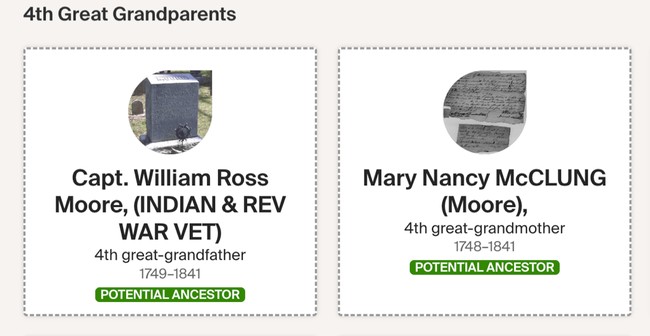
Well, okay, that's not definitive. I mean, they're just suggested as potentials. But...here's the thing — my dad's got 62 DNA matches that (seemingly) run through William Ross Moore (and 54 through Nancy McClung). But it isn't just that. Whether or not William is, in fact, JBM's father, what is fairly well established (compliments of...actual documentation) is that William's father was David Leander Moore. And guess what? There are 31 DNA matches through David Leander Moore. Not only that, but there are 25 through John William McClung, known father of Nancy McClung. So, to sum up, my dad is showing DNA matches that run right up his known tree and then through one of the theoretical fathers of JBM, up to his known father. One DNA match can be coincidence. Dozens of independent matches converging on the same ancestral couple are much harder to dismiss.
But...what about the William Ross Moore (WRM) theory having been "debunked"!? Well, let's take a closer look at that. The number one reason WRM has been ruled out as JBM's father is that he and Nancy McClung were married in 1779, while JBM was born in 1771, eight years prior. And yeah, sure, a pre-marriage child isn't out of the realm of possibility, but that certainly wasn't the regular order of things back in the late 18th Century. But what are we basing the assertion that the marriage took place in 1779 on — where's the record? I'll tell you: We don't have it. All we actually have is one guy's (Jordan Dodd) compiled database transcription of it. Not the actual record. What if he made a transcription error? Okay, possible, though admittedly not enough to hang one's hat on.
One other thing to consider: If potential pops WRM and Nancy truly weren't married until 1779, that would make both of them over 30 at the time of their marriage — not unheard of, but a bit odd for that era.
The number two reason WRM has been ruled out is that he "was a prominent Lexington merchant with no documented ties to Buckingham County." Rather odd if JBM was from Buckingham County...but what are we basing that assertion on? There sure as shootin' aren't records linking JBM to Buckingham. (And there can't be, thanks to the arsonist.) We know his wife, Mary "Polly" McShan/McAshan, came from there. Her dad's firmly established there. So was the assumption just that because Polly came from there, JBM did, too?
What if JBM wasn't from Buckingham? What if he was actually from Rockbridge County, where WRM was firmly established? Well, guess what? There are tax records that show WRM had a white male over the age of 16 living in his household, long about 1788, and continuing on until about 1792 or 1793. And once a John Moore crops up on the Rockbridge County tax records, there's a notation next to him that says "Wm son."
Now, Rockbridge and Buckingham aren't exactly neighbors (they're 71 miles apart), so something needed to bridge that gap. I cannot say for sure what it was, but I can say that by 1797, JBM and Polly were (presumably) married and living in South Carolina because that is where their first child was born. And did I mention what his name was? William B. (Don't yet know what the "B" stands for — Benning? Bonaparte? Either way, interesting that JBM chose "William" as his first son's name, no?)
One added frustration: I have David Leander Moore's will (and yes, it names William as one of his sons/heirs). I have John Benning Moore's will (which, sadly, doesn't reference his parents, but I suppose that's to be expected). I've yet to be able to locate William Ross Moore's will. Truly, that would seal the deal.
But I have DNA matches that sure do seem to point to both William Ross Moore and Nancy McClung (and their respective fathers) as having a role in my dad's lineage. And the only thing "debunking" WRM as JBM's father is his assumed (but undocumented) marriage date and birthplace. Maybe the reason JBM has been a brick wall for so stinkin' long is that 1779 and Buckingham County are red herrings?
All of which is to say, if I had to place a bet today, it'd be on Capt. William Ross Moore as my mystery fifth-great-grandfather.
99% sure this is my 5th-Great-Grandfather. pic.twitter.com/Ujw1SAMV4T
— Susie Moore ⚾️🌻🐶 (@SmoosieQ) June 17, 2026
Now, what does that have to do with America's 250th birthday? Well, you might be able to tell from his gravestone, which is a little hard to make out, but reads:
WILLIAM MOORE
1749-1842
AN OFFICER IN THE WAR
OF THE REVOLUTION
And not only was he a Revolutionary War vet, but also an Indian War vet. In fact, according to the "Annals of Augusta County, Virginia, from 1726 to 1871," by Joseph Addison Waddell, he was quite the character (emphasis mine):
David Moore, with his mother and ten brothers and a sister, came from the north of Ireland to America, and settled in Borden's Grant. The maiden name of the mother was Baxter. When a young girl, she was in Londonderry, during the famous siege of 1689. David Moore's wife was Mary Evans, and his sons were William and Andrew.
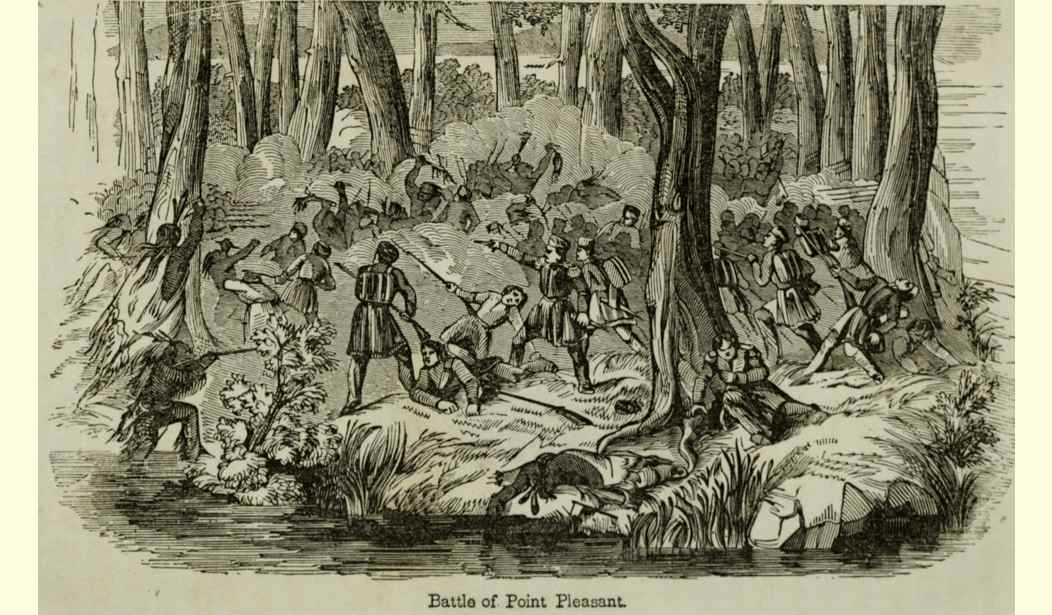
William Moore was born about the year 1748, at Cannicello, now in Rockbridge county, and received a plain education at schools in the neighborhood. From his boyhood he was remarkable for his temperate habits, intrepidity, and great physical strength. At times, when the country was in a state of alarm on account of the Indians, he would take solitary excursions and remain out all night by himself. In 1774, he participated in the battle of Point Pleasant. During the action, John Steele was wounded and about to be scalped, when Moore interposed, shooting one Indian and knocking down another with his rifle. He then shouldered Steele, who was a very large and heavy man, and after laying him down in a safe place nearly two miles off, returned to the fight. Steele was accustomed to say, '' There was no other man in the army who could have done it, if he would ; and no other who would have done it, if he could." Moore is believed to have been in the military service during the whole war of the Revolution, and at the surrender of Cornwallis, he held the rank of captain.
After the war. Captain Moore settled in Lexington as a merchant. It is said that he brought to that town the first sack of coffee ever seen there. Like most enterprising men, however, he was " in advance of his age." His customers were not acquainted with coffee, and it remained unsold till some Pennsylvanians arrived and purchased it. The people of Lexington and vicinity were quicker to learn the use of tea. As explained by an old lady living there, her husband " drank the broth," and she " ate the greens."
After merchandising in Lexington, Captain Moore had an iron furnace on South River, Rockbridge, and then lived near Fairfield. For many years he was a justice of the peace, and was high sheriff for two terms. He died in Lexington in 1841, aged ninety-three.
The wife of Captain Moore was Nancy McClung, and his children were Samuel, David, John, Eliab, Jane, Isabella, Elizabeth and Nancy.
(In case anyone's wondering what a book about Augusta County has to do with someone from Rockbridge: Cannicello was a historic, rural homestead and plantation in Rockbridge County, Virginia, originally part of Augusta County.)
Note that "John" is among the children of WRM listed. Our John? I believe he very well could be.
The capper? James Bonaparte Moore named his youngest son...Patrick Pleasant Moore. Coincidence? Maybe. But it's another small piece that fits the picture, particularly given that Patrick was born shortly after the man with a storied participation in the Battle of Point Pleasant passed away.
But I think I've made a pretty strong case for Captain William Ross Moore being the answer to the question: Who was John Benning Moore's father?
And, by the way, he was far from my only ancestor who served in the Revolutionary War. There are well north of 30, near as I can tell (I haven't had a chance to make a complete list just yet). No...I'm not going to write columns as in-depth as this on each. But I might just share a few more of those stories as time permits.