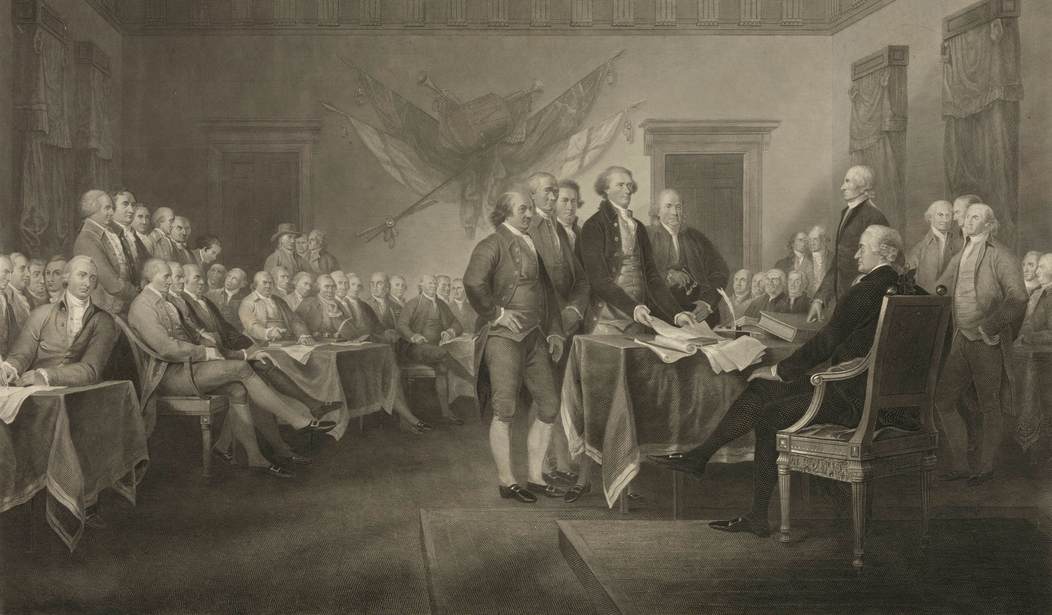

This year, we Americans celebrate our semiquincentennial, the 250th anniversary of the Declaration of Independence, in which we announced our intention to break away from the iron grip of the most powerful empire in human history at that time. The King demanded we return to the fold. The American people told him where to head in, and after a grueling war for independence, the United States of America was born. We have now taken the British Empire’s place as the most powerful nation on the planet, the most powerful nation in human history.
As we near the 4th of July, the date on which the Declaration of Independence was signed in 1776, we’ll be looking at and reading about the events that led up to that day, and what happened afterwards. We’ll be remembering the people involved: American heroes, like George Washington, John Adams, Thomas Jefferson, Benjamin Franklin, Paul Revere, Sam Adams, and more. But I’d like to take a look at some of the lesser-known but no less committed figures who contributed to our fight for freedom.
For this installment, we’ll look at someone who, on a fateful night, rode through her home county to rally the militia against the British who were coming – and someone who doubled the distance of Paul Revere’s rightly famous similar ride. Oh, and she was a 16-year-old girl at the time. She was Sybil Ludington, and she was a remarkable young woman, a committed patriot, and apparently quite the rider.
Sybil Ludington was born in April of 1761 in Fredericksburg, New Yok, the oldest of a family of 12. Her father was Colonel Henry Ludington, a mill owner and operator who had served in the French and Indian War and who commanded the local militia. Sybil apparently grew up a country girl, and she certainly wasn’t a stranger to a saddle.
Read More: Unsung Heroes of the Revolution II: Charles Carroll
Unsung Heroes of the Revolution III: Abraham Clark
Eight days after Paul Revere’s famous ride, the British were advancing on Ridgefield, Connecticut. Well, the Ludingtons were patriots and supporters of independence for the colonies, and they just weren’t having any of that. Now, reports are sketchy as to what happened next, but it would appear that Sybil’s father, Colonel Ludington, started organizing things while Sybil saddled her horse and – remember, this is an unarmed 16-year-old girl – set out into the night at a gallop. Her only defense was a stick, which she used to urge her horse on, and reportedly to fend off a highwayman who picked the wrong target. Sybil rode through the night from farm to farm, from hamlet to village to town, calling out the militia, calling them to assemble. It’s not known if she issued the famous cry, “The British are coming,” but it’s not unreasonable to presume she did so.
Sybil, according to reports, made her 40-mile ride, and arrived home at sunrise, exhausted. But the job was done. When her ride ended, she had assembled 400 militiamen. The assembled militia then engaged the British.
We mentioned earlier that details were sketchy, but not absent. In 1854, Sybil’s nephew, one Charles Ludington, who knew of his aunt’s exploits and wanted them memorialized. Sybil and her ride were also mentioned in an 1880 book about New York by a historian, one Martha Lamb.
Naysayers will claim that Sybil never made this ride, or question whether she was involved in the revolution in any way. I find it more likely that she was. The subsequent battle fought by Colonel Ludington’s militia, the Battle of Ridgefield, is known to have happened. The militia had been dispersed, in their homes, when the call came, and Sybil would have been a logical person to have made this ride; many young people took part in supporting the militias and even the Continental Army, and in 1777, a 16-year-old was, for all intents and purposes, an adult. Many a young woman was married and a mother at 16, while some others were engaging in acts of derring-do that would put many of their male compatriots to shame. Sybil Lundington would seem to be one of the latter.
Whatever the details of her ride, some aspects of her later life are known. In 1784, Sybil married one Edmond Ogden, with whom she had one child, a son. Edmond Ogden died in 1799, and Sybil went on as a widow, never remarrying, dying in 1839 in Unadilla, New York. On the shore of Lake Gleneida in Carmel, New York, near her childhood home, there is a statue depicting Sybil mid-ride. It depicts her, looking very young indeed, properly sidesaddle on a rearing charger, a stout stick in her hand, shouting the cry to arms.
Not everyone who fought, who served, who helped bring this nation into being, was a politician or a soldier. Sybil Ludington’s story, details aside, serves as a great reminder of that fact.