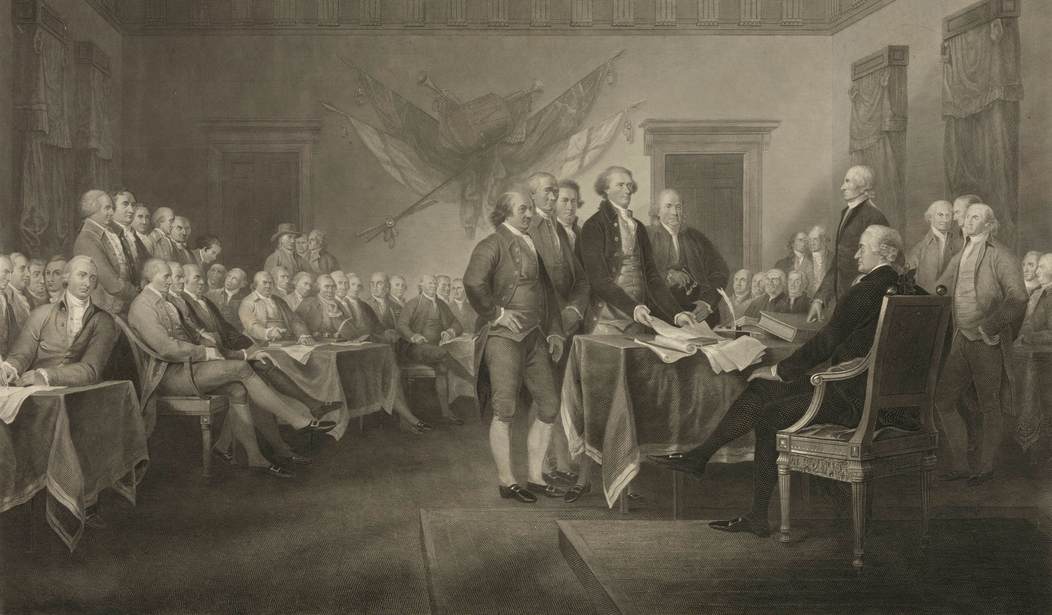

This year, we Americans celebrate our semiquincentennial, the 250th anniversary of the Declaration of Independence, in which we announced our intention to break away from the iron grip of the most powerful empire in human history at that time. The King demanded we return to the fold. The American people told him where to head in, and after a grueling war for independence, the United States of America was born. We have now taken the British Empire’s place as the most powerful nation on the planet, the most powerful nation in human history.
As we near the 4th of July, the date on which the Declaration of Independence was signed in 1776, we’ll be looking at and reading about the events that led up to that day, and what happened afterwards. We’ll be remembering the people involved: American heroes, like George Washington, John Adams, Thomas Jefferson, Benjamin Franklin, Paul Revere, Sam Adams, and more. But I’d like to take a look at some of the lesser-known but no less committed figures who contributed to our fight for freedom.
For this installment, we’ll meet a man born into slavery, a man who stood at the side of General George Washington throughout the Revolution, a man who had a great part in history that goes too often unremarked: William “Billy” Lee.
Read More: Unsung Heroes of the Revolution III: Abraham Clark
Unsung Heroes of the Revolution IV: Sybil Ludington
Not a lot is known about William Lee’s early life. He was reportedly born into slavery around 1750, likely in Westmoreland County, Virginia. He was often described as “mulatto,” meaning he may well have been the product of a white father and a black mother, which was not exactly unusual at the time. William and his younger brother, Frank, were sold to George Washington in 1768. Both men initially worked at the Washington home in Mount Vernon as house servants.
William was, in time, selected to be George Washington’s valet. This meant that William was not only a servant to the Washington household, but to George Washington in particular, responsible for everything from selecting and laying out his master’s clothing to delivering messages, helping George Washington with personal paperwork, caring for his horses, and carrying personal effects. William was reportedly an excellent horseman, accompanying George Washington on the galloping fox hunts of which Washington was reportedly fond. Of this, George Washington’s step-grandson, George Washington Parke Custis, later wrote:
Will, the huntsman, better known in Revolutionary lore as Billy, rode a horse called Chinkling, a surprising leaper, and made very much like its rider, low, but sturdy, and of great bone and muscle. Will had but one order, which was to keep with the hounds; and, mounted on Chinkling, a French horn at his back, throwing himself almost at length on the animal, with his spur in flank, this fearless horseman would rush, at full speed, through brake or tangled wood, in a style at which modern huntsmen would stand aghast.
This experience would come in very handy indeed, starting in 1775.
During the Revolution, William Lee was at General Washington’s side throughout. Several paintings and sketches of the day depict William Lee, generally in the background, including most notably Emanuel Leutze’s 1780 portrait of Washington leading his troops across the icy Delaware River. Look to General Washington's right front:
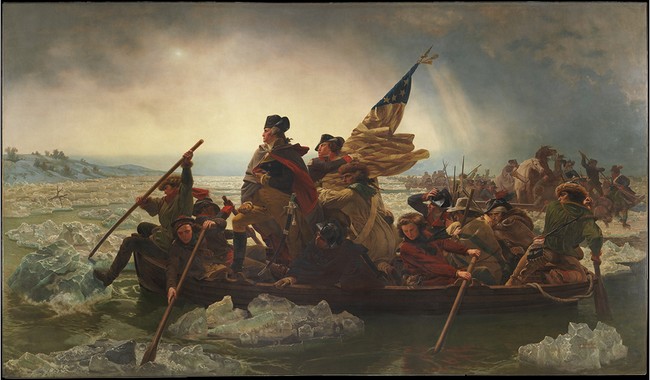
William accompanied the general from battle to battle, into the notorious winter camp at Valley Forge, and throughout the campaigns. He was always at the general’s side, bearing messages, taking care of the horses, making sure that the man tasked with taking on and defeating the most powerful empire in human history had to spend no time worrying about what were, by comparison, trivial matters. He became a conspicuous figure in the campaigns and encampments, always at the general’s side, and was well known to the soldiers and officers in the army.
In this sense, William Lee may have contributed to American liberty as much as his more famous master.
After the war, William suffered from bad knees, having broken both kneecaps in various incidents; details are sketchy on how he suffered those injuries, but they limited his duties. When George Washington was elected president, William at first accompanied him as he had, but in time, due to his mobility issues, was sent back to Mount Vernon to work as a shoemaker.
General Washington’s will left most of his slaves as the property of his widow Martha, but William Lee was freed. A provision of the will directed that William Lee be paid a stipend of $30 a month, not a bad wage at the time. William decided to remain on at Mount Vernon as a free man and a paid employee, reportedly continuing to make shoes. He is said to have married twice and fathered at lease one child, but again, details are sketchy.
William “Billy” Lee is said to have died in 1810, at (more or less) 60 years of age. He stands, today, not only as one of the more notable and yet often unsung heroes of the American Revolution, but as a testament that even enslaved people served the cause of liberty, even though it was applied unevenly. It’s an interesting story, and if William Lee had been white, who knows but that it may have been a more well-known one? But it is what it is, and William “Billy” Lee is, in this 250th year of American liberty, as deserving of recognition as any soldier or politician. We should remember him for that.