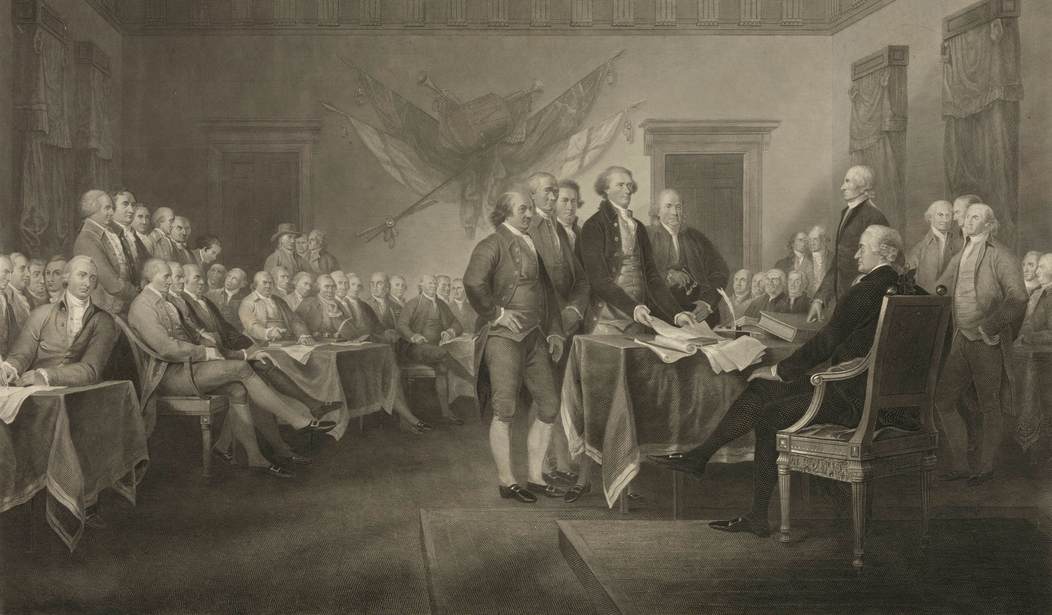

This year, we Americans celebrate our semiquincentennial, the 250th anniversary of the Declaration of Independence, in which we announced our intention to break away from the iron grip of the most powerful empire in human history at that time. The King demanded we return to the fold. The American people told him where to head in, and after a grueling war for independence, the United States of America was born. We have now taken the British Empire’s place as the most powerful nation on the planet, the most powerful nation in human history.
As we near the 4th of July, the date on which the Declaration of Independence was signed in 1776, we’ll be looking at and reading about the events that led up to that day, and what happened afterwards. We’ll be remembering the people involved: American heroes, like George Washington, John Adams, Thomas Jefferson, Benjamin Franklin, Paul Revere, Sam Adams, and more. But I’d like to take a look at some of the lesser-known but no less committed figures who contributed to our fight for freedom.
Read More: Unsung Heroes of the Revolution I: Thomas McKean
Unsung Heroes of the Revolution II: Charles Carroll
For this installment, we’ll meet another ancestor of mine, again a lesser-known signer of the Declaration of Independence: New Jersey’s Abraham Clark, attorney, surveyor, father of ten (!) known by the people of New Jersey as the “Poor Man’s Counselor.”
Abraham Clark was an early advocate of colonial rights. One of five New Jersey delegates to the Continental Congress, he voted for independence and actually signed the Declaration of Independence on August 2nd, 1776. But on July 4th, he wrote these words in a letter to an unnamed friend:
We are now, sir, embarked upon a most tempestuous sea, life very uncertain, seeming dangers scattered thick around us, plots against the military, and, it is whispered, against the Senate. Let us prepare the worst. We can die here but once. May all our business, all our purposes, tend to fit us for that important event!
That important event, or at least, one of them, wasn’t long in coming. Clark’s advocacy for independence came with a cost. Two of Clark’s sons, both of whom were serving in the Continental Army, were captured by the British and imprisoned. The British managed to get a message to Clark, implying they would release his sons if he recanted his advocacy for independence; Clark refused.
Consider the fortitude that must have required: To let two sons languish, knowing they were held on a notorious British prison ship in New York Harbor, maltreated and possibly starving – but remaining true to the cause. That’s a kind of dedication, of purpose, that we don’t see very often, then or now.
He remained in the Continental Congress until he was elected to the New Jersey Legislative Council in 1778. He served three terms there, and in 1804, Abraham Clark was the New Jersey delegate who formally motioned for the Constitutional Convention in the New Jersey Legislative Council.
It may have been his past as the “poor man’s councilor,” but Abraham Clark was known as a more of a proponent of democracy than republicanism. He was a staunch advocate of free speech, and wrote extensively about the right of the populace to petition their elected officials for a redress of grievances.
After the Revolution, Clark ran for the Senate but lost that race. He was invited to serve as a New Jersey delegate to the Constitutional Convention, and while it would have been interesting to see what his rather populist attitudes may have had on the Constitution, Clark declined, being too ill to travel from his home to Philadelphia.
In 1794, while overseeing the construction of a bridge on his family’s property, Clark suffered from sunstroke and died, aged 68. His farmhouse burned in 1941 but was rebuilt and stands today, as the Abraham Clark Memorial House, in Roselle, New Jersey.
Clark was an advocate for ordinary working Americans, favoring their interests over what he considered the elite interests of big plantation owners and Boston lawyers and businessmen, which honestly made up a large proportion of the Founders. He was a man of commitment, of courage, and of determination. We could use a few more like him today.