






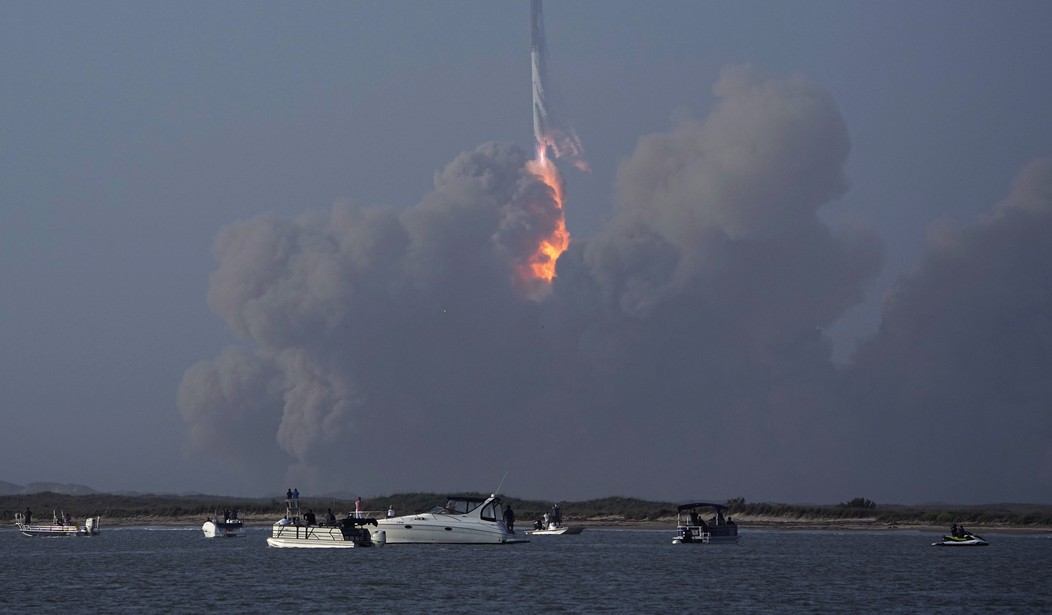
Elon Musk and SpaceX were at it again on Friday with the launch of their Starship.
SpaceX’s third-generation Starship, called V3, took off from a brand-new launch pad at Starbase in Texas. And the unmanned ship was quite something to see.
Liftoff of Starship! pic.twitter.com/LQLdjK5V6K
— SpaceX (@SpaceX) May 22, 2026
How cool is that? Very cool design as well, and it's 40 stories tall.
Amazing picture during the separation of the lower stage from the upper stage.
We are living in the best timeline
— Arthur MacWaters (@ArthurMacwaters) May 22, 2026
If this doesn't inspire instinctual awe in you, I don't know what possibly could
Humanity will be multi-planetary https://t.co/VJ0xqrmR6s pic.twitter.com/6hKOUaLTzz
Congrats and a huge thank you to the SpaceX team that always delivers. This was an incredible first flight of a brand new vehicle. Our collective future flying amongst the stars has become so much closer. https://t.co/97hdA6VEvZ
— Gwynne Shotwell (@Gwynne_Shotwell) May 23, 2026
Among the things the Starship was testing during flight were launching satellites and making a variety of turns. They had a problem with one of the engines not firing as the booster attempted a controlled return, and a couple of other issues. But they deployed a pair of camera-equipped Starlinks to provide views of the ship in flight, which was a pretty amazing first, and the flight was largely successful.
It was one of the heaviest payloads ever at 45 tons because they're testing the ability to carry a payload and the thrust needed for that. The goal: to use the vehicles to help NASA land astronauts on the moon, and ultimately go to Mars.
The SpaceX team was enthused.
SpaceX team chanting: "USA! USA! USA! USA!"
— Sawyer Merritt (@SawyerMerritt) May 22, 2026
🇺🇸🚀 pic.twitter.com/3iQctERDWB
The V3 had a lot of updates, according to the Fortune story linked above:
The revamped booster sports fewer but bigger and stronger grid fins for steering it back to Earth following liftoff, and a larger and more robust fuel transfer line to feed the 33 main engines. This fuel line is the size of SpaceX’s Falcon 9 first-stage booster. The retro-looking, stainless steel spacecraft also has more of everything — more cameras and more navigation and computer power — as well as docking cones for future rendezvous and moon missions.
Starship is meant to be fully reusable, with giant mechanical arms at the launch pads to catch the returning rocket stages. But on this latest trial run, nothing was being recovered. The Gulf of Mexico marked the end of the road for the redesigned first-stage booster, and the Indian Ocean for the spacecraft and its satellite demos.
READ MORE: SpaceX Did Amazing Things Again During 7th Starship Launch, but Then There Was a Problem
One Giant Leap? SpaceX Notches a Huge Victory With Successful Starship Booster Catch
Since neither stage was designed to be recovered in this test, the idea was to land the ship, nose up, in the Indian Ocean, which would be similar to being caught with the mechanical arms. Then it had a fiery, but expected, end. This was pretty awesome as it flipped.
— Elon Musk (@elonmusk) May 23, 2026
Elon pronounced that one of the other tests - the heat shield for re-entry - also looked good.
The Starship V3 heat shield held well https://t.co/iLNkKi7poq
— Elon Musk (@elonmusk) May 23, 2026
That effort is likely to help Musk's IPO.
Elon Musk’s aerospace and defense company is expected to raise around $75 billion in an IPO next month, after being valued at $1.25 trillion in February, when it merged with xAI, Musk’s artificial intelligence startup.
This is a developing story. RedState will provide updates as warranted.
Editor's Note: Do you enjoy RedState's conservative reporting that takes on the radical left and woke media? Support our work so that we can continue to bring you the truth.
Join RedState VIP and use promo code FIGHT to receive 60% off your membership.



Join the Conversation
VIP members get the ability to comment on articles.