






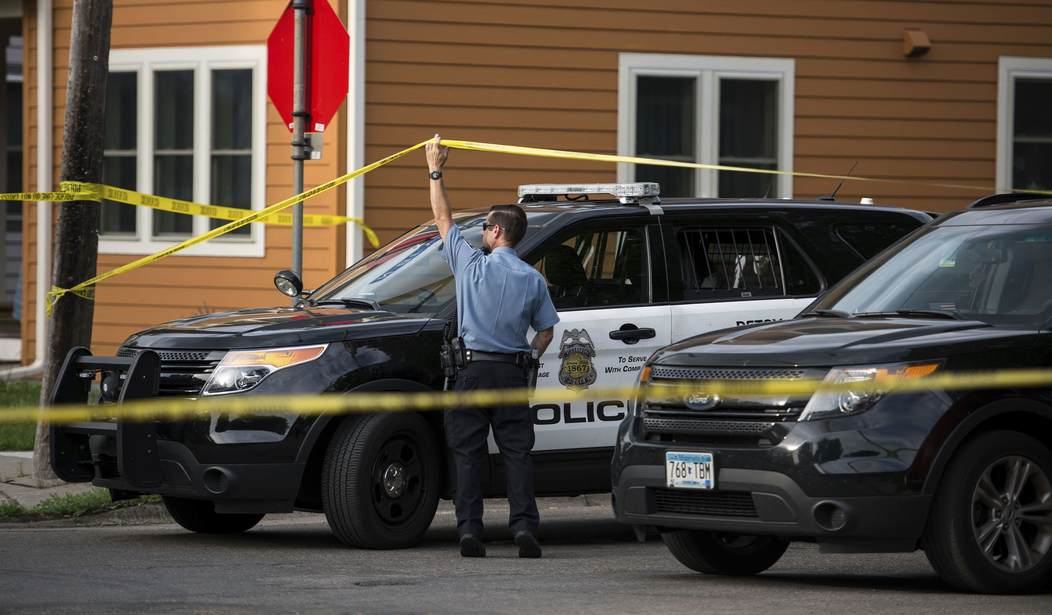
There's been another gruesome crime in Minneapolis, as a community that was once known as a quiet metropolitan area has been shocked once again by growing lawlessness.
Fresh details about the deadly Minneapolis apartment shooting on Wednesday are raising serious questions about how authorities could miss repeated warning signs about the gunman.
The suspected shooter has been identified as 35-year-old Carlton Neal Johnson II, a Shoreline Plaza resident who was already known to Minneapolis police — and whose recent history at the apartment building allegedly included assault, repeated threats and openly displaying a firearm.
Johnson had accumulated a whopping 34 separate criminal cases in the Twin Cities before Wednesday's bloodshed, according to public reporting based on court records. Most involved traffic violations, but his record also included charges in two domestic assault cases and two misdemeanor drug cases.
His troubles were ongoing. Johnson was in the middle of eviction proceedings at Shoreline Plaza, formerly Loring Towers, where management alleged a disturbing series of incidents during the months prior to the shooting.
Attorneys for the building served Johnson an eviction notice on June 16 alleging six lease violations between January and June. Among them: allegedly assaulting another resident in March, walking around the property displaying a firearm, threatening people with a gun and telling residents he “would kill someone.”
According to additional court-record reporting, Johnson allegedly entered the management office while displaying a firearm, told residents he had obtained a new gun and would kill someone, flashed a gun outside the building and threatened a security officer while lifting his shirt to display the weapon.
Johnson denied the allegations in court filings and maintained that he had a valid permit to carry a handgun.
But neighbors have now described even more ominous behavior immediately before the shooting.
Shoreline Plaza resident Chris Miller told the Star Tribune that Johnson said only days before the attack that he intended to shoot his ex-girlfriend and two property managers.
“He said, ‘I’m going to shoot people,’” Miller recalled.
Miller said Johnson had shown him his handgun and carry permit and described him as “very, very, very angry, drunk and mad.”
Another witness reportedly encountered Johnson shortly before the rampage and said he grabbed her while declaring that he was going to “kill my baby mama.”
Johnson's history of alleged violent behavior also stretches back years. In a 2018 domestic incident, he was accused of assaulting a sibling and reportedly said he had a gun and was “not afraid to shoot people in the face.”
He ultimately pleaded guilty to destruction of property while denying the assault allegation, served four days in jail and received probation. A judge reportedly remarked that Johnson appeared to have “anger issues.”
All of which leaves a disturbing question hanging over Minneapolis Thursday morning: How many warning signs does it take?
There is no indication in available reporting that Johnson had recently been jailed and released by prosecutors over the incidents at Shoreline Plaza. The building's allegations were being handled through civil eviction proceedings, with a hearing reportedly scheduled for Sept. 11.
But police acknowledged after Wednesday's shooting that Johnson was already known to them.
That is likely to bring renewed scrutiny to Minneapolis' handling of repeat offenders and public safety — particularly given the sweeping promises Minnesota Gov. Tim Walz made about transforming policing after the George Floyd riots in 2020.
“Minnesotans are demanding real change,” Walz declared at the time while backing a package of progressive law-enforcement reforms.
“This is a coordinated and powerful set of reforms,” Walz said. “Minnesota will change the way we do policing.”
Six years later, two civilians are dead, multiple others were wounded, and three Minneapolis police officers were injured while charging into a downtown high-rise to confront a gunman who, according to the emerging record, had been broadcasting violent threats for months.
The circumstances surrounding the shooting are as murky as the record of unheeded warnings. Police said officers reached the building less than two minutes after being dispatched. They responded to the sound of shots through a haze that severely limited their visibility. Officers exchanged gunfire with Johnson on an upper floor.
Johnson was found dead at the scene. Some reports say he died from a self-inflicted gunshot wound, although authorities initially said the precise circumstances of his death remained under investigation.
The shooting left two civilians dead and five others suffering gunshot wounds, including the two officers. A third officer suffered a non-gunfire injury and is expected to recover.
Walz praised law enforcement Wednesday and asked Minnesotans to pray.
“Grateful to law enforcement actively working to ensure the safety of our neighbors in Downtown Minneapolis this afternoon,” Walz wrote. “Minnesota is praying for our first responders.”
Those officers unquestionably deserve the praise and support of the community.
But as investigators reconstruct Johnson's path to Wednesday's massacre, the larger public-safety question is going to be harder to avoid.
Minneapolis Mayor Jacob Frey said the “death toll would have been far higher” without their actions.
The death toll might have been zero if the warning signs had been heeded.
Editor’s Note: Republicans are fighting for election integrity by requiring proper identification to vote. It's common sense, yet Democrats are spreading lies about the impact of such a measure.
Help us continue to call out these lies by joining RedState VIP and using promo code FIGHT to receive 60% off your membership.


Join the Conversation
VIP members get the ability to comment on articles.