
During the Cold War, millions of people fled communist countries for the United States because America represented something the governments they escaped did not: freedom.
Now, we’re increasingly seeing the same phenomenon in America: Millions of people fleeing from failed “progressive” states like California and New York to the free states of Texas and Florida.
Ever since socialist Democrats began ramping up their escalating set of demands on the middle class and the “wealthy,” there has been an uptick in such blue state refugees.
The exodus has begun. Much like it did with communist countries during the Cold War.
They came from Cuba, Hungary, Vietnam, Laos, Cambodia, Eastern Europe, and the Soviet Union. They fled collectivized economies, political repression, secret police, confiscatory states and, in many cases, governments that had made ordinary economic life miserable through central planning.
A 1983 State Department estimate put the number of people who had emigrated, fled, or been expelled from communist-controlled countries since 1945 at roughly 20 million, with nearly 2.5 million settling in the United States. A later Cato Institute review estimated that America accepted about 2.6 million refugees during the Cold War, most of them from communist countries.
The numbers become even more striking when broken down country by country. Hundreds of thousands of Cubans fled Fidel Castro's regime. After communist victories in Southeast Asia, the United States ultimately resettled more than 1.3 million refugees from the region, including more than 900,000 Vietnamese. Following the Soviet crushing of the Hungarian Revolution in 1956, tens of thousands of Hungarians found refuge in the United States.
Ronald Reagan understood what those refugees represented politically.
“If communism is the wave of the future, why do you still need walls to keep people in and armies of secret police to keep them quiet?” Reagan asked in 1983.
Then came the line that summed up the Cold War better than entire volumes of political theory: “The brave people who risk death for freedom are not fleeing from democracy — they’re fleeing to democracy from communism.”
Reagan later told the story of an American speaking with a refugee who had escaped Castro's Cuba. The American remarked that Americans did not know how lucky they were. The Cuban corrected him: “How lucky you are? I had some place to escape to.”
There was something profoundly American about the refugees of that era. Many became intensely patriotic precisely because they had experienced the alternative. They didn't need professors to explain the theoretical differences between capitalism and socialism. They had lived them.
Now America is experiencing a strange domestic echo of the same phenomenon.
America is not experiencing full-blown communism. At least, not yet.
Thus, moving from California to Texas is not exactly the same as escaping East Germany through the Berlin Wall. But if the socialist Democrats had their druthers, there would be no place to go to escape their policies.
After all, socialism is not voluntary. That’s the entire point.
Americans are currently free to move between states. The United States is the “laboratory of democracy,” and socialist Democrats increasingly treat Americans like guinea pigs in a science experiment that has failed dozens of times.
And unlike Thomas Edison, there is no light bulb that will go off that socialism does not work.
Thankfully, federalism gives people an escape hatch when their state governments become too expensive, too intrusive, or simply too incompetent. And Americans are using it.
Census data show a remarkably persistent internal migration away from some of the country's deepest-blue states and toward states across the South and Sun Belt. From 2020 through 2023 alone, Florida gained more than 818,000 residents through net domestic migration, and Texas gained more than 656,000, while California lost nearly 1.2 million and New York lost more than 882,000.
The pattern continued into the latest Census estimates. California was one of only five states whose overall population declined between July 2024 and July 2025, while Texas reached 31.7 million residents and Florida 23.5 million.
And the migration isn't merely a head-count story. It is increasingly a money story.
IRS migration data track taxpayers who change addresses from one state to another and the adjusted gross income that moves with them. Those data have repeatedly shown enormous income flows into Florida and Texas and out of California and New York.
One of the the biggest financial proponents of higher taxes, Nick Hanauer, said “virtually every wealthy friend I have has either left or is planning to” because of all the recent tax increases.
— Ryan Frost (@Frost_RyanWPC) August 30, 2026
Us “opponents of the income tax” are not “oversimplifying” anything, this is what’s… https://t.co/NLuncvkNbE pic.twitter.com/1IZP2LeCim
The pattern is especially pronounced among affluent taxpayers, which creates an obvious problem for progressive governments built around heavily taxing a relatively small group of high earners.
The high-income migration map is especially revealing. In one widely circulated analysis of taxpayers earning more than $200,000, Florida ranked first for net gains, followed closely by states including Texas, North Carolina, South Carolina and Tennessee.
California ranked at the bottom, with New York, Illinois, Massachusetts and New Jersey also among the worst performers.
Apparently the rich can, in fact, move.
That is an inconvenient fact for the socialist wing of the Democrat Party, which continues to build policy around the assumption that productive people are captive revenue sources.
New York City Mayor Zohran Mamdani is now putting that proposition to the test. His administration is moving forward with five municipally backed grocery stores, one in each borough, with a government-subsidized “core basket” of groceries offered at prices 30 percent below typical retail levels. The city has committed $70 million in capital spending, will provide the storefronts and cover expenses including rent and property taxes, while private operators run the stores.
That sounds wonderful until one remembers that groceries do not magically become 30 percent cheaper because the government declares them so. Someone absorbs the cost. Usually that someone is called a “taxpayer.”
Mamdani has simultaneously pushed for higher taxes on New Yorkers earning more than $1 million and higher corporate taxes. When Albany balked, his administration's preliminary budget contemplated a 9.5 percent property-tax increase to help close a $5.4 billion two-year gap. Mamdani put the choice plainly himself, arguing that “the wealthiest New Yorkers” and “the most profitable corporations” should pay more.
There is a certain Cold War familiarity to the whole arrangement: Government makes private economic activity increasingly expensive, announces that private markets have failed and then creates a government-run alternative subsidized by taxes imposed on the remaining private economy.
Eventually, you begin running short of people willing to pay for it.
Margaret Thatcher identified the flaw decades ago. “Socialist governments traditionally do make a financial mess,” she said in 1976. “They always run out of other people's money.”
A year earlier, she put it even more memorably: Socialist governments “have got the usual Socialist disease — they've run out of other people's money.”
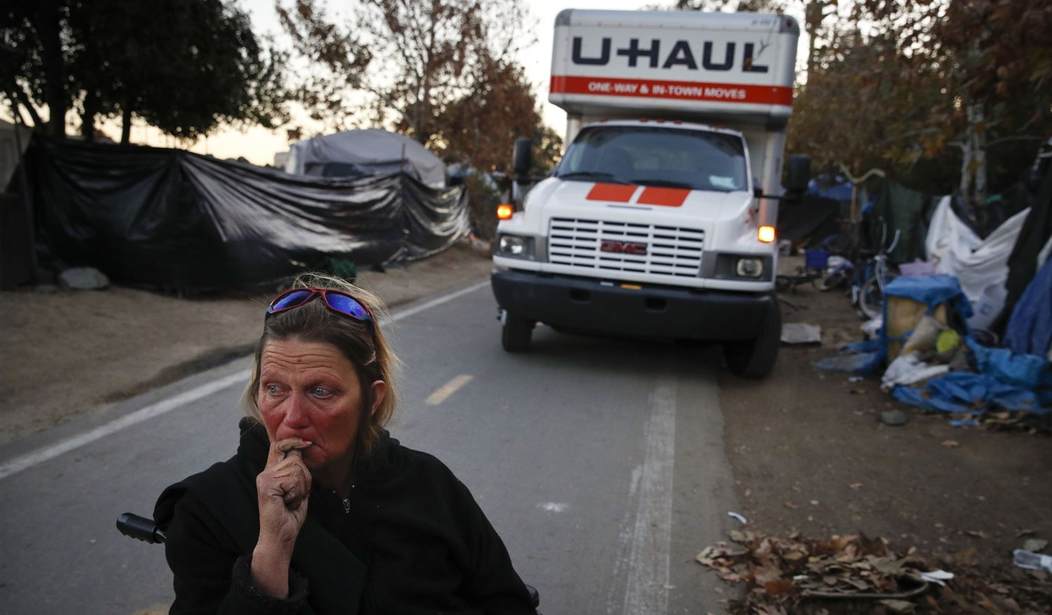
America's federal system makes that disease harder to conceal because the people supplying the “other people's money” are free to pack a U-Haul. And increasingly, they do.
Taxes are part of it. So is the cost of housing. So are energy prices, regulation, and the sheer question of what taxpayers receive in return for some of the highest tax burdens in America. Then there are concerns over crime and disorder, sanctuary-city policies and illegal immigration, and the lingering memory of COVID-era restrictions.
For many Americans, 2020 was the moment the contrast between red-state and blue-state governance became impossible to ignore.
While California and New York embraced prolonged shutdowns, school closures, mandates, and an increasingly expansive administrative response, Florida took a dramatically different path. DeSantis later called Florida “the escape hatch for those chafing under authoritarian, arbitrary and seemingly never-ending mandates and restrictions.”
That phrase — escape hatch — explains much of what has happened since.
People learned that they didn't necessarily have to defeat the politicians running their state. They could leave.
They could keep their American citizenship, keep their career, and increasingly even keep the same job while moving to a state with lower taxes, cheaper housing, and a government less interested in regulating every detail of their lives. Remote work made that arbitrage easier than ever.
The result is something resembling a domestic Cold War sorting process.
People who dislike the increasingly progressive economic and social model of California, New York, Illinois and other blue states are migrating toward Florida, Texas, Tennessee, South Carolina and other states offering a markedly different governing philosophy. The latest migration data show the broader trend has persisted well beyond the immediate pandemic years.
There is an irony here that Reagan would probably have appreciated.
During the actual Cold War, communist governments erected walls because their citizens kept trying to leave.
Blue-state Democrats obviously cannot erect walls around California or New York. But they increasingly face the same embarrassing political question: If your model of government is so superior, why are so many people leaving?
And perhaps an even more important question: Why are they disproportionately moving toward the states your party constantly tells them are backward?
The answer is that Americans vote in more ways than one. They vote at the ballot box, but they also vote with their feet, their businesses, their investment capital, and their taxable income.
The old Cold War refugees came to America because they understood that freedom had economic consequences as well as political ones.
Today's “blue-state refugees” are making a much less dramatic journey, but the instinct behind it is recognizable. They are leaving jurisdictions where government costs more, controls more, and increasingly promises to solve the problems created by its previous interventions with still more intervention.
And they are moving toward the “free states.”
The Cold War lesson was that people eventually run from systems that make their lives poorer and less free.
Apparently that lesson applies within America, too.