






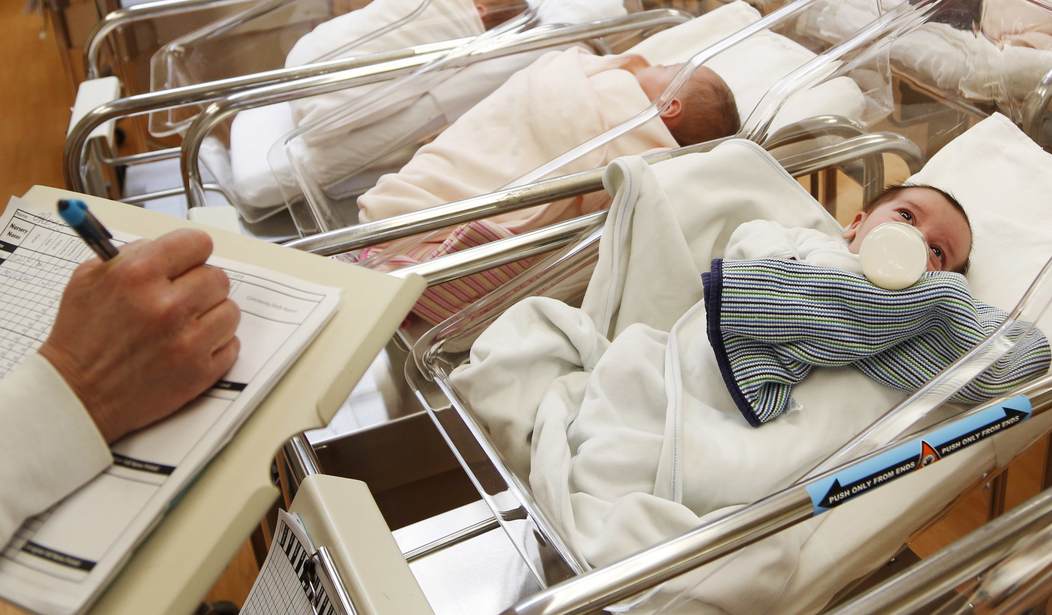
The Census Bureau released its Vintage 2025 population estimates last week, and the headline should set off alarms: America has roughly 1.8 million fewer children than it did five years ago.
The under-18 population fell 2.4 percent between 2020 and 2025. The West lost more than 1 million children, a 5.7 percent decline. The Northeast dropped 4.1 percent. The Midwest fell 3.9 percent. The South added about 304,000 residents under 18, a 1.1 percent gain.
Most regions are losing children. The South is not. That does not prove one policy caused the gap, but it does puncture the easy narrative that the blue-state model is where families thrive. If anything, the numbers point in the opposite direction.
The CDC’s National Center for Health Statistics recorded 3,606,400 births in 2025, down 1 percent from 2024. The general fertility rate fell to 53.1 births per 1,000 women ages 15 through 44, down 23 percent since 2007.
Read More: Humanity's Fertility Cliff: What Happens When the World Stops Breeding
The age breakdown shows where the drop landed. Births to women ages 20 to 24 fell from 611,800 in 2024 to 585,804 in 2025. Births to women ages 25 to 29 also fell, from 990,817 to 986,726. The 30-to-34 age group was essentially flat, with 1,112,107 births in 2025 compared with 1,112,409 in 2024. Births rose among women ages 35 to 39 and 40 to 44.
The South led every region in fertility. Its general fertility rate reached 55.8 in 2025. The Midwest followed at 54.7, the West at 51.0, and the Northeast at 49.9, the lowest in the country.
Not all of the South's child-population gain comes from births. Families leaving Illinois, New York, or California for Texas, Tennessee, Florida, or Georgia take their children with them, and those children show up in the Census counts. The South gained population across all five age groups the Census Bureau tracks: children, adults in prime family-formation years, and older residents, the people who fill classrooms, buy homes, and eventually shape congressional apportionment.
The Census Bureau described the national fertility decline as broad, but uneven:
"The nation's fertility rate has dropped nearly every year since 2007, but this national decline masks substantial geographic variation. Fertility rates differ widely across U.S. counties, and even within individual states there are often both high and low fertility counties."
This is where the usual big-state bragging rights fall apart: raw birth totals do not measure fertility rates.
Los Angeles County produced more than 91,000 births in 2025, more than any other county in the country, but posted a general fertility rate of just 44.1. Dallas County recorded 37,108 births at 62.6. Harris County had 65,753 births at 59.2. Tarrant County posted 27,795 births at 57.0. All three Texas counties outperformed Los Angeles on fertility by a wide margin despite producing far fewer total births.
The fertility rate for females ages 15 through 19 dropped 7 percent in 2025 to 11.7 births per 1,000 females. Rates for both the 15-to-17 and 18-to-19 age groups also reached record lows.
The South’s gain was not evenly spread across the region. Metropolitan counties added more than 361,000 residents under 18 between 2020 and 2025. Smaller Southern cities lost 18,280 children over the same period. Rural Southern counties lost another 39,508.
Still, the South is attracting and producing families better than the rest of the country; but even there, the gains are concentrating in metro areas. For the states losing children, the message is harder to dodge: make it expensive and difficult to marry, raise kids, buy a home, and stay put, and families will eventually vote with their feet, and their birth certificates.
Editor's Note: It’s America’s 250th birthday! Help RedState celebrate the greatest nation in history by honoring its past, defending its present, and preserving its future with reporting you can trust.
Join RedState VIP and use promo code AMERICA250 to receive 74% off your membership.



Join the Conversation
VIP members get the ability to comment on articles.