








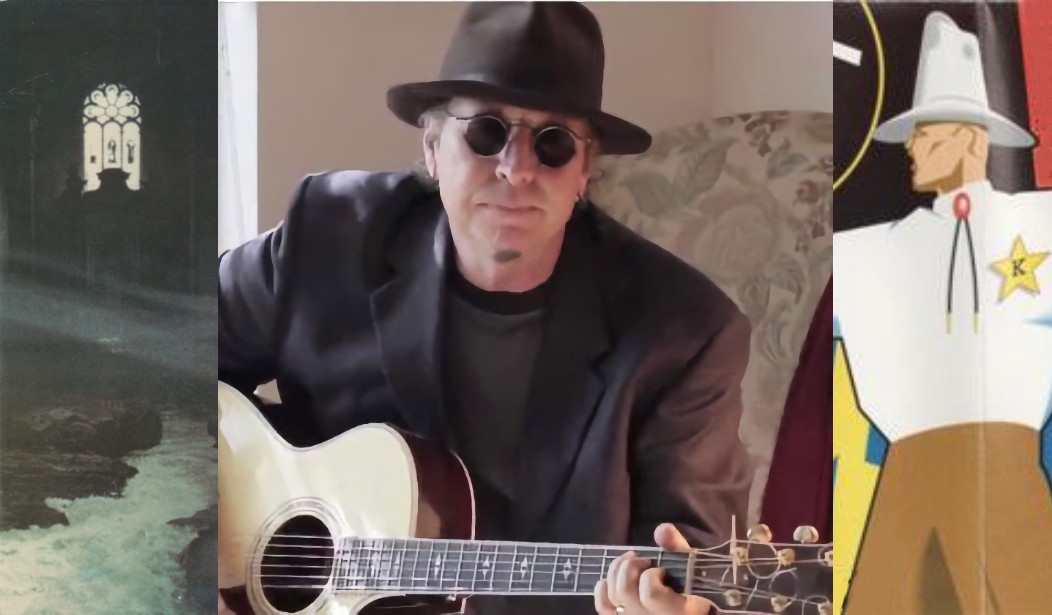
The other day (September 27, 2026), I published an interview here with Terry Scott Taylor, the leader of the pioneering Christian alt-rock band Daniel Amos and co-head of the Americana ensemble The Lost Dogs. During our interview, Taylor went into depth on several subjects that warrant this expanded look at an artist deserving of maximum attention. Not to downplay or demean any other Christian artists, but Taylor has definitely earned the title of Christian music’s thinking man whose observations on life and faith extend to all, believers or no. (Further recommended reading is our Sister Toldjah's observations on progressive Christianity.)
“Fearful Symmetry” was the fourth and final part of The Alarma Chronicles. How much, if at all, did you have its trajectory in mind before you started writing it?
It’s really hard to pin down where you’re going to go with these things. It wasn’t mapped out. I’m guessing, because I can’t put myself back all those years ago and know exactly when that idea sprang forth. It must have been pretty early on that I knew we’d be doing these four records, so we’ve got to wrap it up somehow.
It seems fitting to me that, since with the first three records we were talking about and critiquing the culture, not only the societal culture but the education culture and so forth as we often did, that the fourth record of the Chronicles would look into the celestial. There were only a couple of things that were preplanned, and that was sonically. As far as the written story that’s contained in the Alarma Chronicles, there was a linear narrative. The records themselves were fairly loose in terms of what song should work on this record once you get the sonic idea down. A lot of times, the lyrics would spring from that. For example, with “Vox Humana” we were down to a four-piece band when we started that record. (Guitarist) Greg (Flesch) hadn’t joined yet, and (guitarist) Jerry (Chamberlain) had left the band. So, we had the four-piece with Rob Watson on keyboard. The idea was, “OK, what will make the most sense with this lineup?” From that came the idea of doing something sonically that would make the listener connect to the idea of old-school sci-fi, so you had songs like “(It’s The Eighties So Where’s Our) Rocket Packs” and “When Worlds Collide.” Out of that sonic stew came a lot of lyrical ideas. Now, you could mix up all those songs on the four records. You could have put “William Blake” from “Vox Humana” on “Fearful Symmetry.” But it wouldn’t have worked sonically.
The first three were almost anything goes as far as lyrical content. With “Fearful Symmetry,” there were uncertain limitations there because, unlike the others, which were almost a kaleidoscope of lyrical content covering a lot of different subjects, “Fearful Symmetry” was very specific in what it wanted to express about the afterlife. So, there was a certain confinement there that didn’t exist in the approach to the other records.
Regarding “Fearful Symmetry,” you mentioned that the lyrics were influenced by classic Romantic poets such as Wordsworth and Byron, using imagery and metaphor to explore themes such as the afterlife as detailed in Christian doctrine. What led you down that path, and why do you hear so little, if any, of that in today’s Christian music, which is overwhelmingly basic praise and worship?
There are probably several factors involved. One of them is that at one point the praise and worship industry was a money-making machine.
Another factor narrowing off the music, which disappeared behind the praise and worship thing, was when the culture was changing, as it does. Remember that a lot of the Maranatha stuff is in an almost Americana vein when the hippies were coming to Calvary Chapel in the early 1970s. There was a great revival. There was a real nostalgia for that, and a certain degree of sentimentality that didn’t allow Maranatha Music to grow. Some of the new music that the young Christian bands were doing there in the 1980s was more showmanship. There was more experimentation. It didn’t fit the former way of life, which itself had become sacred — “This is how we’ve always done it, this is where God moved, this is what God did in those early times.” It became more troublesome for Maranatha Music and Calvary Chapel to be able to deal with something that turned them off. It wasn’t the old way, which was much more blatantly Gospel-oriented and aimed at the nonbeliever. When they began to make praise records, that paid off for them and they didn’t have to deal with the change in culture.
There are a number of praise songs that are wonderful, but the vast majority of them are horrid and formulaic to the point where it’s adverse to me. I don’t negate anyone’s sense of the presence of God and the feeling that a certain song is creating in them a desire to praise the Lord, but a lot of it is emotional manipulation. That’s not okay. It’s not praise. I find real praise in reverence and quiet time, stimulated by beauty, not racket.
Which leads back to the matter of creativity and finding God’s presence in creation.
I can be moved by a song like “Wichita Lineman” or “Moonlight in Vermont,” or see a film like “My Dinner With Andre,” and come out floored by what I feel is the presence of God, which is not confined to this meat-and-potatoes approach to songwriting or filmmaking or whatever where it has to be specifically spelled out that each time you need to get John 3:16 in there. Hans Rookmaaker said, “Art needs no justification.” Just as nature doesn’t, nature being the handwriting on the wall of God Himself. We see His Majesty and glory and all in nature, and we can see it in a song by not only Christians but a song from Jimmy Webb or whoever, who may not acknowledge the Creator or even believe in Him but nevertheless, because he’s made in the image of God, is reflective of the Creator’s creativity.
Are you tired of the mainstream media disparaging your faith? Do you want to find a place where you will be politically and spiritually accepted? Here at RedState, you have a home. Please help us in our mission to continue proclaiming the truth on all fronts by becoming a VIP member. Help RedState fight the liberal media by helping yourself to daily riches of learned political, cultural, and Spirit-led commentary. Knowledge is power, so feed the mind and join in the fray. Join RedState VIP today!



Join the Conversation
VIP members get the ability to comment on articles.