






The recent kerfuffle involving British popster Ed Sheeran and his train wreck of a current stadium tour, which was derailed by opening act Macklemore’s thinly disguised antisemitic rants that eventually saw him kicked off the bill, is a reminder that while seldom failing to garner attention, artistic controversy in and of itself is no guarantee of acclaim from any element of current culture. There are artists such as Bruce Springsteen and Tom Morello who have turned strident political stands into a cottage industry, knowing their every statement will be lapped up by an in-agreement media and thereby fueling the milking of whichever pose neatly fits within today’s cause du jour for maximum profit.
The flip side of this is those artists who say things guaranteed to gore someone’s sacred cow not because of a desire for attention, but rather out of the need to tell the truth laid upon their heart, mind, and soul regardless of attractiveness to the entertainment industry, which to a significant degree includes the news media. Or, in the case of an artist who unashamedly identifies as a follower of Jesus, upsets the church that should be supporting their professions of societal truth alongside eternal faith. Indeed, such artists fully understand that speaking up and out will cost them in terms of establishment support and commercial appeal, trusting there will be a sufficient number of people who catch the vision to keep them going outside the mainstream.
Art, particularly music, created with this mindset, regardless of its pure value, seldom ages well because it must engage with current issues. Some works transcend this inherent pitfall courtesy of sheer quality and by addressing eternal truths in addition to matters of the day. Such is the case with Christian music pioneers Daniel Amos. You may have never heard of or heard them, but their body of work from the 1970s through the early 2010s changed Christian music in ways many of its even most devoted fans have never learned about.
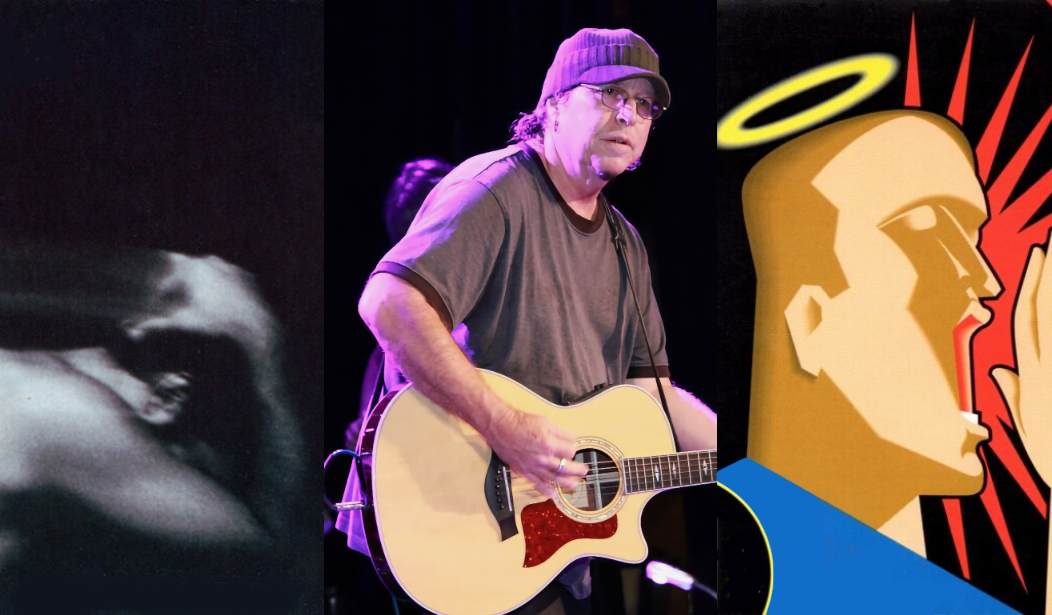
For the uninitiated, a brief introduction. Daniel Amos is the band name of an ensemble formed in the mid-1970s as part of the Southern California Jesus Revolution movement led by the late Chuck Smith, pastor of Calvary Chapel Santa Ana. The band was and is led by Terry Scott Taylor. Musically, Daniel Amos has encompassed a wide, powerful vision. Starting as a Laurel Canyon-flavored country/rock outfit, the band shifted over its history first to a more mainstream rock vision and then to an edgy, multifaceted modern rock sound. Throughout it all, as its lead singer and priority songwriter Taylor shepherded Daniel Amos through eras of pure basic evangelism into blistering critiques of evangelical church and media excesses at the expense of Jesus-following truth, always with following Christ and His teachings at the heart of it all, as Taylor sang in “Central Theme” from the 1981 album “¡Alarma!”
The upcoming re-release of two albums from the Daniel Amos catalog, 1986’s “Fearful Symmetry” and 1991’s “Kalhöun,” provides a welcome reason to catch up with Taylor. Speaking from his Pacific Northwest home where he remains active writing and recording for the faithful, Taylor first reflects on “Fearful Symmetry,” the fourth and final installment in a quartet of albums (the aforementioned “¡Alarma!”, 1983’s “Doppelgänger”, and 1984’s “Vox Humana”) thematically tied together with an accompanying story entitled “The Alarma Chronicles.”
“We wanted to create a soundscape that had an ethereal, dreamlike element,” Taylor explains. “I envisioned it as more of an almost orchestral type of thing because it used nature for metaphor, which was inspired by the (British) Romantics — (William) Wordsworth, (William) Blake, (Percy Bysshe) Shelley. The whole essence of that record was to say something about death and the afterlife, and I had to find a way to try to express something inexpressible.”
Taylor continues, “So often, we get childlike images of Heaven — pearly gates, streets of gold, those sorts of things. I wanted to transcend that thought, and it’s a challenge to talk about something like the new Heaven and the new Earth. Words are always going to fall short; they are always going be inadequate. The poems of the Romantics got more to the heart of what I was trying to say through God’s creation. So, what naturally followed is how do you how do you put that in what kind of musical surroundings? What powerfully conveys that stylistically? A lot of different things go into that. I envisioned something more along almost a dream state.”
What about the Romantics’ work inspired Taylor? “I always enjoyed reading Wordsworth and Blake; people like that. When I was in the Lake District (in Cumbria, England) when we were over there with Daniel Amos, I was able to go to where Wordsworth wrote some of his poetry. That was very inspiring. I also picked up a collection of (Joseph) Addison’s writings (NOTE: Addison predated the Romantics era). All of that work has a certain melancholy that’s very appealing to me. Also, there is the idea of God as Creator and we being co-creators. I saw that connection in in these poems about nature, although many of the poets of that time elevated nature to a point of pantheism. I came at it with a Christian worldview, letting it speak to me not of the supremacy of nature but the supremacy of God in creating nature itself.”
Musically, “Fearful Symmetry” sets its theme at the very beginning with “A Sigh for You,” which has a dreamy staccato dance-pop feel, briefly interrupted by a dissonant guitar break. This is followed by “The Pool,” which has a Farfisa-like organ dancing around a serious beat and barely restrained guitars threatening to burst out into full fury but always holding at the precipice. Throughout the album, there is a musical spirit of pushing the envelope without abandoning either melodicism or intelligent usage of dissonance to make a point.
This same musical theme, albeit with more aggressive guitar work, permeates “Kalhöun.” By this time (1991), Daniel Amos’ heavy touring days were behind them. Yet the album bristles with live energy. About this Taylor notes, “With ‘Kalhöun’ and (1994’s) ‘Bibleland’ we stripped it down to a pretty raw sound. The approach was influenced by having done a more complicated orchestral-type thing, so let’s try doing a live thing. Let it be raw. If (drummer) Ed (McTaggart) speeds up a little bit in the bridge, so what? Let it go if there’s a mistake. I loved mistakes on all the records I listened to as a kid or teenager. It didn’t bother me. It made it that much more fascinating. I’m not saying we made a bunch of mistakes on these albums, but we let things stand a little bit more. We didn’t scrutinize it as much. We let our hair down and created something that was much more edgy.”
One of the album’s many standout tracks is “Father Explains,” a song written from the perspective of a family caught in one of the seemingly interminable conflicts in the Middle East. Not exactly the subject matter one expects from a record available at your local Christian bookstore. Still, Taylor remembers no pushback. “I never got a complaint. I assumed that it was going to be controversial. I imagine if Facebook had been around, that kind of stuff would have shown up. I do remember when we were recording the song, (the late) Gene (Eugene, leader of the brutally cutting edge Christian alt rock band Adam Again and also a member alongside Taylor of the Americana band the Lost Dogs) said, ’Terry, I don’t think that anyone’s ever written a song from this point of view.’ I don’t know if that’s true, but I didn’t think about that at the time. I was trying to enter into the humanity of all people involved in war and the horror of it, and what it does to humanity.”
The conversation turns toward what Taylor calls the mysterious process of songwriting. “So often, I listen back on some of the stuff that we’ve done and I have this reaction not only to lyrics, but also to what’s being played, and go, ‘How in the world did we come up with that? Where did that come from?’ It’s a very mysterious process. You can’t go too far and say, ‘Well, it’s like the Bible in that God gave it to you — here it is and now write it down.’ It’s not automatic writing. But, there’s something involved in this.”
Final thoughts? “I will brag about Daniel Amos. The kind of thing that we were doing — the experimental, the willingness to extend the creative landscape and kick down some walls, and that’s exactly what we did — made it possible for other bands coming up behind us to do what they did. We were on the front lines taking the heat. One of the other things that I always loved about Daniel Amos is that the members — whoever was involved in each record — always seemed to be immediately on the same page. They understood the vision. When I write a song, because I’ve got a bit of (record) producer’s blood in me, my process is to hear the song close to its entirety while I’m arranging in my head as I’m writing the song. Once we’re in the studio in rehearsals, everyone contributes, giving us as much part as a part of it as I am. I can lay out a skeletal structure, but it’s up to everybody else to put the blood and guts and the flesh on it. The band often came up with some brilliant ideas and excursions.”
Taylor continues, “(The late) Tim (Chandler, bassist for Daniel Amos and The Choir who often co-wrote music for Daniel Amos projects with Taylor) had his process, which was always to read my lyrics. It touched my heart that it was important to him to know what I was trying to say and to help me say it not only lyrically but musically. He would sit quietly, bass in hand, listening before he would begin to devise some kind of a bass pattern. Everything was meticulously chosen. He fought beyond simply doing a part, instead working on how he could contribute to both the musical and lyrical vision. I can say categorically that never once, in the studio, in all the years we were together recording as a band, did we clash about anything. Which is pretty remarkable; I’ve produced many records where the opposite was true.
“The very first song on The Alarma Chronicles — “Central Theme” — was part and parcel of our experimentation, doing things that hadn’t been done before and expressing things in ways that hadn’t been expressed before. We knew it would come under scrutiny and would upset a lot of people who wanted meat and potatoes while we were adventurous in our approach to what we were doing. We took the risk of being accused of downplaying the Gospel and not talking about Jesus enough. ‘Central Theme’ stated that we know what the Heart and Center of all that we do is. Creativity in itself — whether the subject matter is Christian or otherwise, what people call secular — creativity itself is a reflection of Who God is.”
Are you tired of the mainstream media disparaging your faith? Do you want to find a place where you will be politically and spiritually accepted? Here at RedState, you have a home. Please help us in our mission to continue proclaiming the truth on all fronts by becoming a VIP member. Help RedState fight the liberal media by helping yourself to daily riches of learned political, cultural, and Spirit-led commentary. Knowledge is power, so feed the mind and join in the fray. Join RedState VIP today!


Join the Conversation
VIP members get the ability to comment on articles.