








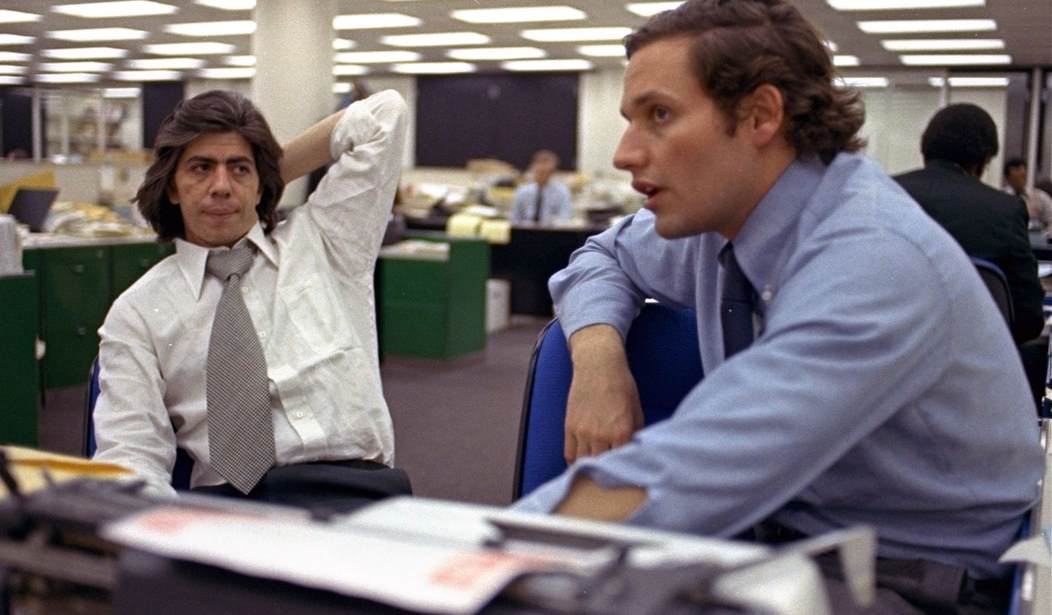
Today marks the 50th anniversary of the motion picture that has to be regarded as the quintessential Hollywood release centered on journalism. Directed by Alan J. Pakula, the casting of stars Dustin Hoffman and Robert Redford bolstered the production, and the success elevated their careers to an even higher level.
Despite the known result, the staging and pacing were exemplary in laying out the effort of committed journalism and exposing a story that no one wanted exposed. The process of ferreting out the truth, chasing down leads, knocking on doors, and convincing superiors is presented compellingly.
It was professionally done across the production, earning eight Academy Award nominations and netting four wins, including Best Adapted Screenplay and Jason Robards' Supporting Actor win for his role as the Washington Post Executive Editor Ben Bradlee. It was also the film that saw a transformation of the journalist from a quasi-blue-collar level job to a career to be lauded.
The film opens with an extreme close-up of a paper as a typewriter slams words and numbers into place, the keystrokes exploding on the soundtrack: JUNE 17, 1971.
TRIVIA: Only one person involved in the real-life Watergate story appeared as themself in the reel-life portrayal in the film — Frank Wills. He was the security guard who discovered the door with its latch taped up and phoned the police, foiling the attempted bugging of the Democratic offices.
This indicates the initial reporting of the break-in at the Watergate Hotel in Washington, D.C., where five individuals were caught breaking into the offices of the Democratic National Committee. Bob Woodward (played by Redford), working as the lowly city desk reporter, is sent out to cover the arraignment of the five and is struck by the curious act of them receiving private legal counsel, despite none of them having placed a call. This sends the Post down the road of exposing more and more curiosities in the case, leading all the way to the White House.
#MarchMovieChallenge #Bales2026MovieChallenge #Bales2026FilmChallenge
— Joel Shiffman (@joels5370) March 7, 2026
March 7 Telephone
All The President's Men pic.twitter.com/zbBNdgspN1
So much of what is accepted today was revealed to the general public in 1976, from the use of anonymous sources to the editorial decision-making and office politics that drive the news industry, to the well-trod aphorism to “follow the money.” The moniker “Deep Throat” today is more well-known as the cloaked, shadowy information source than the porn film inspiring that sobriquet.
As a result, reporting became glamourized, and we are left to ponder if journalism today has suffered for it. The gruff, rumpled cliche of the gumshoe reporter was elevated to near celebrity status, in part due to celebrities playing the roles of the grinding hacks, working the phones and plying details out of hesitant figures. The fact that their efforts led to the toppling of a president became the inspiration for a new generation of hopeful journalists.
After this film, it was a common refrain heard from journalism school students: “I want to make a difference,” “My goal is to fight corruption,” “I intend to hold truth to power,” etc. These were herds of kids entering the profession with an agenda already established, the truth secondary to their goal.
What stands out is the display of tactics fifty years ago that are commonplace today. One pivotal scene comes after an editorial board meeting with the foreign editor, played by John McMartin. Speaking on the Watergate story, he mentions being bothered by unnamed sources, other papers not reprinting their reports, and suggests the story was dubious because the Republicans did not need to execute the conspiracy.
The outstanding "deep throat" scene from ALL THE PRESIDENT'S MEN.pic.twitter.com/u8QSDCM1AZ
— All The Right Movies (@ATRightMovies) April 5, 2026
Another later scene has Carl Bernstein (played by Hoffman) contacting John Mitchell with allegations of his controlling the money at the Committee to Reelect, and we see the common practice of time spent building a story around an individual and contacting them at the last moment. Bernstein wakes up Mitchell before going to press in the morning, literally calling him at the 11th hour.
One of the more glaring aspects of the Washington Post Watergate story is something that is not reported.
The driving force behind the lengthy investigation was Barry Sussman, the Post’s city desk editor. He was the man who sent out Woodward initially to the arraignment, and as the story of the break-in developed, he was pulled from his editing duties and put in charge of the investigation, marshalling the two reporters on what to target and where to investigate.
So integral was Sussman that when Time Magazine did a feature of the work done by the Post, earning the highest honor from The Pulitzer Prizes, it was entitled “The Watergate Three,” and Sussman was granted top billing in its coverage. That all changed when “Woodstein” wrote their book on the entire investigation.
Today, their published account is regarded as having taken many liberties with the facts. The reporters moved from detailing the investigation to centering the book themselves, and as a result, the true force behind the investigation was shunted. In the book, Sussman is degraded as a player in the investigation, and this became worse in the film adaptation. Sussman does not even appear in character at all. His work is carved up and handed out to other editors and Ben Bradlee.
Bob Woodward, 89, Shares How His Dating Life Changed After Sex Symbol Robert Redford Played Him in 'All the President’s Men' https://t.co/GV3UzXd76i
— People (@people) April 7, 2026
Sussman wrote his own book on the scandal and investigation, “The Great Cover Up,” which was released in 1974, months after Woodward and Bernstein’s own version of events, published that spring. Sussman’s account was overshadowed, and by the time the film came out, he had been all but erased from the story. Today, he is described as Watergate’s unsung participant, and as far as the movie is concerned, that is a more than accurate description.
The film, when viewed today, holds up. It is a period piece, and it is fully immersed in the era. The newsroom, where the bulk of the film plays out, is a visceral set piece. Files abound, desks are naturally cluttered, and the yellow pages are stacked in various corners. This is not Hollywood glitz but expert in its attention to detail. The William Goldman script delivers the tedium of reporting, with dead ends and ponderous research shown. The slow crane shot in the Library of Congress shows the reporters delving into endless book files, the camera slowly panning upward and delivering the frustration as they shrink from view.
It is a great film to behold, but we cannot regard it as a piece of journalism. With an already corrupted storyline in the book from which it is adapted, the Hollywood treatment could only further fabelize the events. That it went on to engender the next crop of journalists, darting off to J-school with corrupted impressions of the industry, explains so much of what we experience in the press today. Then there is the foundation of it all to view in a contemporary light.
Today, the Washington Post operates as a fractured shadow of the once-revered news source it was regarded as in the 1970s. Its current undoing is rather ironic. The very minds that were inspired to undertake journalism have undermined the very institution that inspired them. That serves as a magnificent metaphor of the press industry as a whole.
Watching All the President’s Men again tonight. The 1970s really were unmatched as a decade for filmmaking. pic.twitter.com/n1OLP0Zdbi
— Mark Johnson ™️ (@MarkLikesMovies) March 29, 2026
Editor's Note: The mainstream media continues to deflect, gaslight, spin, and lie about President Trump, his administration, and conservatives. Help us continue to expose their left-wing bias by reading news you can trust.
Join RedState VIP and use promo code FIGHT to get 60% off your membership.

Join the Conversation
VIP members get the ability to comment on articles.