






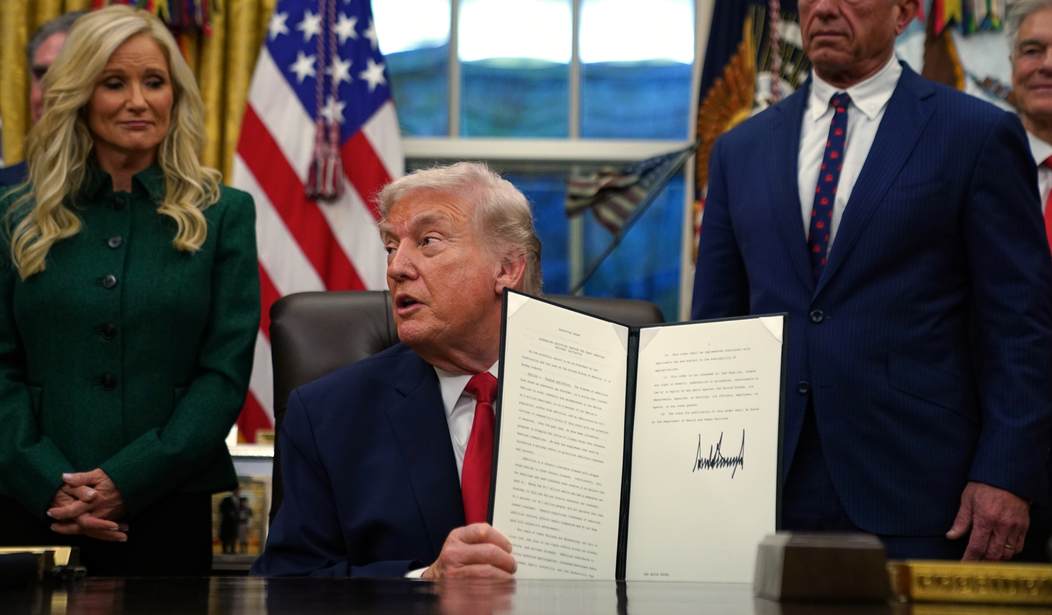
President Donald Trump signed an executive order Tuesday asking AI companies to let the federal government take a look at their most powerful models before releasing them to the public. No mandatory reviews. No licensing. No federal approval process. Just a request, with a 30-day window to act on it.
The order puts America's most advanced AI to work defending power grids, hospitals, and government networks before China or criminal actors find the holes first.
Trump wrote in the order that America leads the world in AI because his administration cut the regulatory dead weight the Biden White House piled onto developers and researchers.
"Advanced AI capabilities make our Nation stronger, but also introduce new national security considerations that require coordinated action across executive departments and agencies."
The order directs the Cybersecurity and Infrastructure Security Agency (CISA) to push AI-powered defensive tools out to federal agencies, state and local governments, rural hospitals, community banks, and local utilities: the systems that keep your lights on, process your mortgage, and staff your emergency room.
It also creates an AI cybersecurity clearinghouse under Treasury, with CISA and the National Security Agency (NSA) tasked with hunting vulnerabilities and pushing out patches.
The order introduces a category called "covered frontier models," which federal officials will identify through a classified benchmarking process measuring advanced cyber capabilities. Developers can then voluntarily give the government up to 30 days with those systems before a wider release.
The order draws a hard line:
"Nothing in this section shall be construed to authorize the creation of a mandatory governmental licensing, preclearance, or permitting requirement for the development, publication, release, or distribution of new AI models, including frontier models."
Tech companies and free-market conservatives had spent months warning that any "voluntary review" would become a federal permission slip the moment a bureaucrat decided it should be. The White House put it in writing.
Getting here took months of internal fighting. An earlier draft would have given the government 90 days to review new models before release. David Sacks, Elon Musk, and Mark Zuckerberg called the White House to kill it. Not Democrats. Not regulators. Trump pulled back from signing last month. Sacks eventually blessed a 30-day window, and the order moved forward.
Earlier this year, Anthropic unveiled Claude Mythos Preview, a model the company said could find software vulnerabilities well enough to trigger a cybersecurity "reckoning." That was enough to get Anthropic executives into direct meetings with Chief of Staff Susie Wiles and Treasury Secretary Scott Bessent. A private AI lab walked into the White House to explain what its own model could break.
Read More: White House AI Plan Signals Government No Longer Fully in Control of the Technology
The Pentagon Blacklisted Anthropic. Federal Agencies Are Using It Anyway
Steve Bannon and three dozen pastors had pushed for mandatory vetting. They did not get it, and a rally planned for Wednesday in Washington was going ahead regardless.
"We would rather see this be mandatory than voluntary," said Brendan Steinhauser of the Alliance for Secure AI Action.
The companies that lobbied against a 90-day review window got a 30-day one with no enforcement mechanism. The people pushing for harder requirements are still pushing. Trump directed the attorney general to prosecute anyone who uses AI to break into systems or steal data. The models keep shipping regardless.
Washington did not get ahead of this. It's almost caught up. For now.
Editor's Note: Do you enjoy RedState's conservative reporting that takes on the radical Left and woke media? Support our work so that we can continue to bring you the truth.
Join RedState VIP and use promo code FIGHT to receive 60% off your membership.

Join the Conversation
VIP members get the ability to comment on articles.