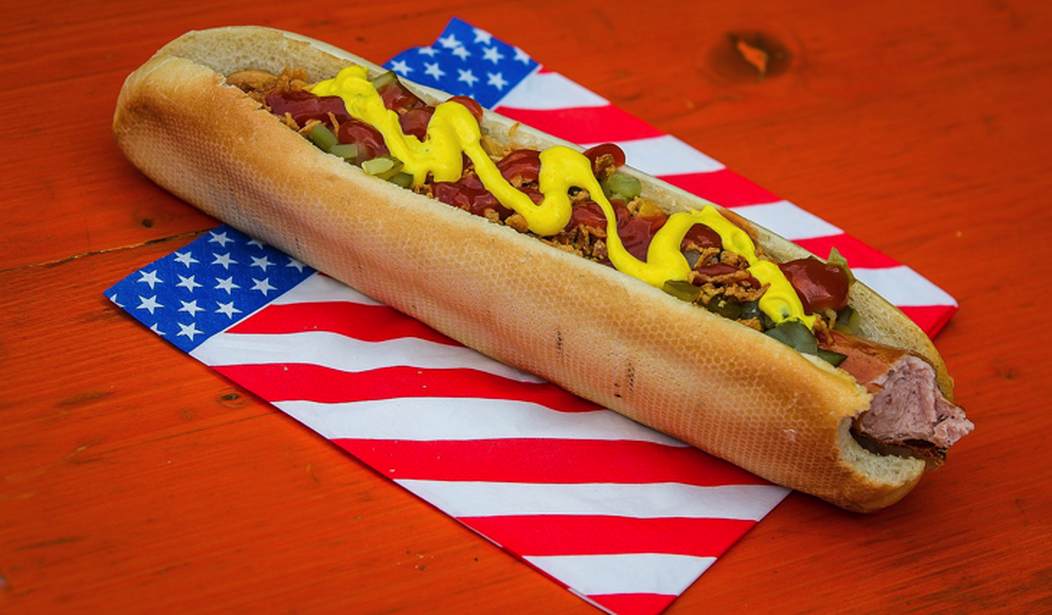

Hot dogs are really having a moment this summer. Of course, they always have a moment during the summer, when Americans get their grills out and enjoy the barbecue season to its fullest before the autumn breezes start to blow. And even when that happens, we just slap 'em on a stick and roast them over the fire pit.
It seems like things, hot dog-wise, have really ramped up this summer, probably in no small part to all of the America 250 celebrations. We're still a "baseball, hot dogs, apple pie, and Chevrolet" kind of country – despite the recent infestation of commies and socialists – and it shows.
I learned this summer that one of my newer friends is a hot dog freak. I discovered this when he gave, quite good-naturedly, every restaurant we went to a hard time if they didn't have hot dogs on the menu. Luckily, one of our friend group's favorite Happy Hour joints puts dogs on menu for all of July, and he was able to get his fill.
Summer means hot dogs to him, and who can argue with that?
According to the National Hot Dog and Sausage Council, Americans eat an estimated 20 billion hot dogs a year. That's roughly 70 per person annually by the council's calculation. We also buy about 350 million pounds – roughly 9 billion hot dogs – at retail locations, meaning restaurants, stadiums, fairs, street vendors, and other venues account for a huge chunk of total consumption. Hot dogs are apparently served in 95 percent of U.S. households.
We really like our wieners.
The National Restaurant Association (the *other* NRA) predicted at the end of last year that 2026 would be a year of "nostalgia" when it comes to food. Again, likely linked to the country turning 250 years old. The NRA said diners would be looking for cuisine that evoked "comfort and nostalgia—with a twist."
So, because there is nothing new under the sun – and everything old is new again – restaurants have been heeding customer demand for nostalgia with a twist and creating glammed up versions of the plain, old beef frank. There's reportedly even a version going for $100.
The humble frank has been experiencing a cultural glow-up.
— The Wall Street Journal (@WSJ) August 6, 2026
Some are reinventing the distinctly American fare with international flavors, while others are elevating it—sometimes quite literally—to a fine-dining level, with prices to match.
🌭 https://t.co/I24dpr3AfB pic.twitter.com/UpAD6L3Zkb
Here's the Wall Street Journal on the "rise" of the $100 hot dog.
Since its first appearance on the Coney Island boardwalk, the hot dog has been dogged by a lowbrow reputation—low nutrition, low quality, low price—maligned by public-health officials and persnickety parents alike.
Lately though, the humble frank has been experiencing a cultural glow-up. Some are reinventing the distinctly American fare with international flavors, while others are elevating it—sometimes quite literally—to a fine-dining level, with prices to match.
The WSJ found some, um, interesting examples.
There's now a $100 “Golden Glizzy” made with crème fraîche, mascarpone, 30 grams of Ossetra caviar, edible 24-karat gold, and a croissant-style bun. It became a hit at events like Miami's Formula One Grand Prix.
A $39 hot-dog duo is now a thing at the Museum of Modern Art's Bar Room, a $60 hot-dog tower can be yours in Breckenridge, and there's also a $29 tower to be found on tony Martha's Vineyard. Colorado's Coors Field has even sold a nearly two-foot-long, $45 “Glizzilla.”
Yes, my eyebrows are raised right along with yours.
If you're like me, you did not have hot dogs becoming high-brow on your 2026 bingo card. My mom will be thrilled to know, when she was trying to feed a family of 10 on a budget, she was decades ahead of the curve on the whole hot dog phenomenon.