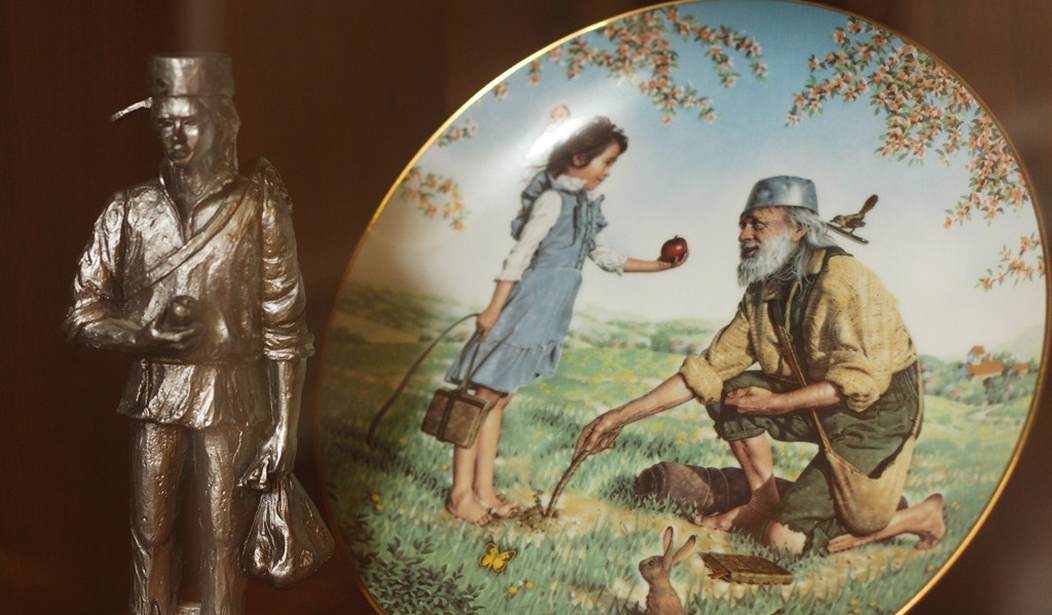

While we may have already celebrated our nation's 250th anniversary - whether you consider that officially happened on July 2 or 4 - that does not mean Americans need to end the party prematurely. And in my small way, I want to urge you all to learn more about our great American folk heroes over the next few weeks and months. I partly drew inspiration from this X user's post:
As part of the approaching American renaissance, we need to resurrect the memory of our folk heroes. Davy Crockett, Johnny Appleseed, John Henry, Paul Bunyan. These stories carry the true spirit of America and not enough kids know about them. pic.twitter.com/OCOnUW8nG0
— GODWIN 🪔 (@libraryofgodwin) November 19, 2024
The wellspring of ideas begins with Davy Crockett, Johnny Appleseed, John Henry, and Paul Bunyan. Other heroes suggested in the replies are also a mixture of real and folk tales: Daniel Boone, Pecos Bill, Casey Jones, and others.
As I thought about it more, I realized that some of the tales are well-known to people, including GenXers like me, because they were popularized in culture by some classic Disney cartoons - back when Disney was about quality and reflected our American values.
Let's get started with one of those: Johnny Appleseed
For many of us growing up, elementary school was the time and place we became acquainted with the folk hero, and as I said, through watching a cartoon about him. It turns out it was just one segment of a Disney animated film, "Melody Time," with the a string of stories (sort of like "Fantasia") told in verse and song:
On this day in 1948, the penultimate package feature Melody Time debuted. Package features were an economical way to present creative sequences that were too long to be considered "shorts." This film combined seven segments, including "Johnny Appleseed" and "Pecos Bill". pic.twitter.com/zpVpR8W1cy
— The Walt Disney Family Museum (@WDFMuseum) May 27, 2021
I bet the "Pecos Bill" segment is also one of many of us remember, too.
Here's actor/singer Dennis Day, the voice actor who played Johnny, with Walt Disney:
Today in 1948, the package feature Melody Time debuted. Pictured here is actor and singer Dennis Day, who voiced Johnny Appleseed, stands in character as Johnny Appleseed with Walt Disney. pic.twitter.com/LJwqklptkv
— The Walt Disney Family Museum (@WDFMuseum) May 27, 2022
And this is a musical scene from the segment:
The Legend of Johnny Appleseed segment of the 1948 animated classic, Melody Time pic.twitter.com/ocAQnVpLtC
— Old Media (@oldmedia) March 6, 2026
But the funny thing is that the cartoon character shown in the "Johnny Appleseed" cartoon had much different plan in mind when compared to the real-life man named John Chapman: (emphasis added)
Today, Chapman is known by another name—Johnny Appleseed—and his story has been imbued with the saccharine tint of a fairytale. If we think of Johnny Appleseed as a barefoot wanderer whose apples were uniform, crimson orbs, it's thanks in large part to the popularity a segment of the 1948 Disney feature, Melody Time, which depicts Johnny Appleseed in Cinderella fashion, surrounded by blue songbirds and a jolly guardian angel.
But this contemporary notion is flawed, tainted by our modern perception of the apple as a sweet, edible fruit. The apples that Chapman brought to the frontier were completely distinct from the apples available at any modern grocery store or farmers' market, and they weren't primarily used for eating—they were used to make America's beverage-of-choice at the time, hard apple cider.
I have a feeling my now-former colleague Brad Slager would appreciate the direction this is headed, although his last "Dipsology: Beyond the Basics" column covers the time before the American Revolution on our shores. Slager wrote:
The making of distilled spirits was not because intoxication was a desire, but because the product, and especially the alcohol, served a variety of purposes, even beyond consumption. There were medicinal applications, or it could be used as a food preservative, serve as a fuel source, as well as a cooking ingredient. It could even be employed in making crude perfumes. But drinking was also a need.
Water in that early era was a dicey challenge. Deep well water sources were not yet in play, and so potable water was not always a dependable product. Waterways could have questionable organism effects, and even after dependable sourcing was established, it was quickly corrupted by human waste, animal runoff, and standing water, which could feed the proliferation of insects, leading to more problems.
[...]
Soon enough, another crop in the New World served as a source for crafting spirits: apples.
With grapes not being a serviceable crop in that temperate zone, the easily fermentable apple crops were utilized. Hard cider was the first obvious product
READ MORE: The Lie-Able Sources Podcast: It’s Not the End of an Era, but It’s the End of Mine Here at RedState
Dipsology: Beyond the Basics - The Colonists' Success As a Result of Home Distilling
If you happened to miss any of his loquacious, yet charming stories on libations, catch up here, by all means.
Back to the real story. The way the Disney movie tells it, Johnny was spreading apples for eating and God's love along the Western frontier. While the latter may have been the case, he actually went ahead of the frontier folk - as part of a business venture, as Smithsonian magazine's story (linked above) continues:
...At the turn of the 19th century, speculators and private companies were buying up huge swathes of land in the Northwest Territory, waiting for settlers to arrive. Starting in 1792, the Ohio Company of Associates made a deal with potential settlers: anyone willing to form a permanent homestead on the wilderness beyond Ohio's first permanent settlement would be granted 100 acres of land. To prove their homesteads to be permanent, settlers were required to plant 50 apple trees and 20 peach trees in three years, since an average apple tree took roughly ten years to bear fruit.
Ever the savvy businessman, Chapman realized that if he could do the difficult work of planting these orchards, he could turn them around for profit to incoming frontiersmen. Wandering from Pennsylvania to Illinois, Chapman would advance just ahead of settlers, cultivating orchards that he would sell them when they arrived, and then head to more undeveloped land. Like the caricature that has survived to modern day, Chapman really did tote a bag full of apple seeds. As a member of the Swedenborgian Church, whose belief system explicitly forbade grafting (which they believed caused plants to suffer), Chapman planted all of his orchards from seed, meaning his apples were, for the most part, unfit for eating.
The White House recently reminded everyone - with a fun, supercuts X post - that America250 is all year long:
The 4th of July may be over, but we’re locked in all year. 🇺🇸🦅 pic.twitter.com/6O0G28Kq08
— The White House (@WhiteHouse) July 11, 2026
So let's keep it going.
You can listen to the full story of Johnny Appleseed (All the Songs from the Film) below or at YouTube: