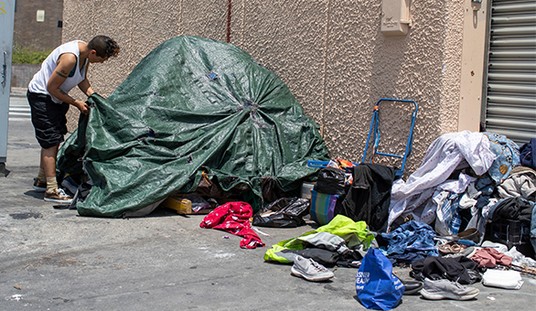

Seems like much of the lower 48 is still having a hot, hot autumn. A quick look at a weather map shows temperatures in the 80s and 90s in places like Los Angeles, Dallas, Miami, and even farther north. That is, to my thinking, way beyond operating specifications for this time of year.
Here in the Great Land, things are a little different. We’ve had several hard frosts. We have had a couple of snowfalls, although it’s still moderate enough that both snows melted away. The leaves on the poplars and birches have turned, and most of them are now on the ground instead of in the trees.
Now’s the time when the Alaskan countryside starts to smell of wood smoke.
I grew up from about age 13 on, in a house mainly heated by a fireplace. The house I grew up in, in Allamakee County, Iowa, had a foundation of native white Iowa limestone, every rock gathered, cut with a hammer and chisel, and mortared into place by my father, my brother, and me. The fireplace was massive, ten feet wide at the base and six feet deep from front to back. Dad once reckoned that there were 80 tons of stone in the foundation and the fireplace and chimney, with those last two items accounting for a third of that weight. Dad got the pattern for the fireplace from The Foxfire Book, and it drew perfectly. Once all that stone was warm, it radiated heat into the house, keeping things comfortable even in -20 degree cold.
The catch was, it took a lot of firewood. We started cutting, splitting, and stacking wood in the spring, and continued through until late fall. Most years, we used five to seven cords of firewood: White oak, red oak, maple, and hickory. Fireplaces are great, but they aren’t quite as efficient as a well-designed, well-installed wood stove. But chopping wood does a body good. The last winter my parents spent in that place, Dad cut, split, and stacked five cords of firewood in advance of the cold, by himself. He was 85, and one heck of a tough old man. When two years of bad floods and my mother’s declining health forced a move into town, Dad often complained that he didn’t have enough to do; I think he really missed the prideful task of laying up a winter’s firewood.
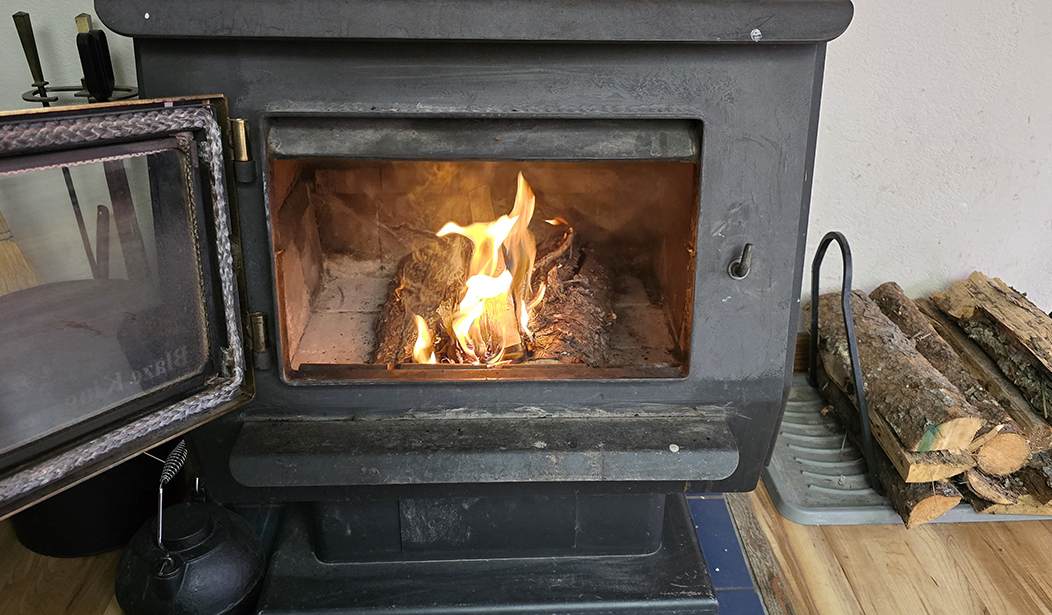
Now, here in Alaska, our house is heated by a Toyo oil burner, some strategically placed baseboard heaters that we try to keep to a minimum, and a wood stove. Our stove is quite different than Dad’s massive white limestone fireplace. It’s small, efficient, with a catalytic heat exchanger and a duct system that funnels some of the hot air into the cellar below the house, where it keeps a big stone heat sink warm, and that stays warm for a day after the fire goes out. And, in the depths of our Alaska winters, we try not to let the fire go out.
The downside: Unlike my childhood home on 60 acres of hardwood timber, our own property doesn’t have enough trees for us to rely on them. So, we buy firewood from our neighbors, a pair of twins who we first got to know as teenagers but who are now college graduates, who run a bed & breakfast and an Alaska arts and crafts shop on their property, and who still spend much of the summer cutting, splitting, and delivering firewood. When I described their activities to a buddy of mine, he commented that “…they must be a couple of tough young guys.”
I corrected him. “Tough young women, actually – and neither of them weighs a hundred pounds soaking wet.”
We grow them tough in Alaska.
Now it’s the time of year when, while on a drive or on a walk, you start to see woodsmoke coming out of stovepipes. Now it’s the time of year when I can look out the front window of our office and judge just how well our fire is doing by the woodsmoke coming out of our stovepipe. The countryside smells of woodsmoke, and despite the fact that we are mostly burning black spruce and birch instead of oak, maple, and hickory, that smell sometimes makes me a little homesick.
We are the only animals on the planet to have mastered fire. It’s at the basis of everything we do. It’s the thing that made us human; it was the very first technological leap our species ever made. It keeps us warm, it gives light in the darkness, and it cooks our food.
Winter’s coming. There are cold nights ahead, and cold nights in Alaska aren’t like cold nights in Tucson, although people from Minnesota, Montana, or upstate New York probably have a pretty good idea what it’s like. But while our oil burner is probably more efficient, and while the baseboard electrics are clean and odorless, there’s nothing quite like a good fire, looking through the stove’s door and seeing actual flames, giving a sensation of warmth that, for millennia, has been satisfying like nothing else.
I’m of the age now when, on a cold subarctic night, there’s nothing quite so satisfying as a good fire and a warm bed.