
Have you ever tried to use a paper straw to drink some water or a soft drink? They don't work very well. You might get one or two good sips before the straw softens and collapses. And then, once you've given up and finished your drink directly from the cup, you might go to a grocery store and discover they won't bag your groceries; if you don't have a reusable bag of your own, you will have to buy some paper bags for your purchases. Paper comes from trees, remember, and trees are basically machines for capturing atmospheric carbon — a big issue for the same people making you use paper straws and paper bags.
These are inconveniences, to be sure; it's not as though this is a threat to our livelihoods, just our tempers. The advocates for these measures, though, always give the same reasons for demanding we give up plastic straws and plastic bags: Plastic pollution, most notably in the world's oceans.
There's just one problem: While plastics in the world's oceans are indeed a concern, the developed world, including the United States and Europe, is contributing essentially nothing to this issue. The paper straws and grocery bags are virtue-signaling, nothing more, and do nothing to address this issue. Not one bit.
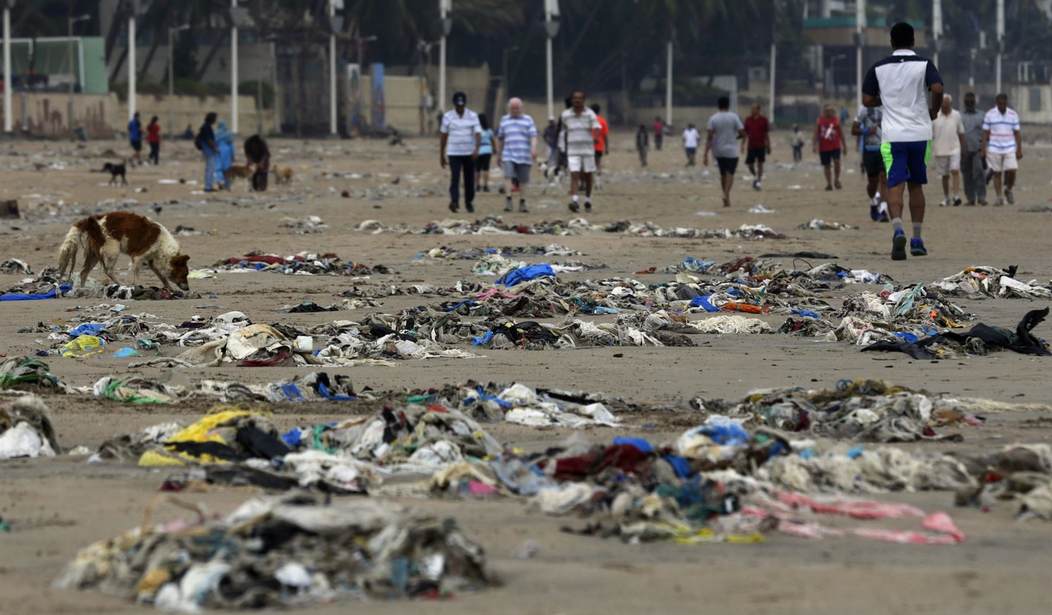
Why? Because almost all of the plastics in the oceans comes from Asia and South America, and the people in those places aren't about to stop using plastic straws.
Here's the breakdown. 70 to 80 percent of ocean plastics come from land sources, mostly via rivers, in places where the traditional way of disposing of waste is to chuck it in a nearby river. About 81 percent of the ocean plastics come from Southeast Asia, with the Philippines being a major contributor. In fact 10 rivers contribute from half to 90 percent of ocean plastics, depending on which study you look at. Those rivers are, in descending order of plastics sent to sea:
- The Pasig, in the Philippines, 62,592 metric tons per year.
- The Tullahan, in the Philippines, 13,450 metric tons per year.
- The Ulhas, in India, 13,433 metric tons per year.
- The Klang, in Malaysia, 12,816 metric tons per year.
- The Meycauayan, in the Philippines, 12,398 metric tons per year.
- The Pampanga, in the Philippines, 9,340 metric tons per year.
- The Libmanan, in the Philippines, 7,088 metric tons per year.
- The Ganges, in India/Bangladesh, 6,222 metric tons per year.
- The Rio Grande de Mindanao, in the Philippines, 5,256 metric tons per year.
- The Agno, in the Philippines, 4,637 metric tons per year.
You get the idea.
An interactive map of this issue can be viewed here, and it's illustrative. Each known source of ocean plastic pollution is marked with a red dot, and those red dots are heavily clustered in southeast Asia, the west coast of Africa, and some places in South America. The United States, Europe, and modern nations like Japan make up a tiny part of the total. The Ocean Cleanup Project, which publishes the interactive map, says this about the issue:
Rivers are a major source of plastic waste in the oceans. We estimate that 1000 rivers, represented by the red dots, are accountable for nearly 80% of global annual riverine plastic emissions, which range between 0.8 – 2.7 million metric tons per year, with small urban rivers amongst the most polluting. The remaining 20% of plastic emissions are distributed over 30,000 rivers, represented by smaller blue dots.
Our findings displayed in this map have been published in the journal Science Advances. The point file that contains the locations of the rivers and their modeled plastic emissions can be downloaded from figshare. The results can assist others in prioritizing, developing, and implementing mitigation measures and strategies.
So, there you have it. Yes, plastics in the ocean are a problem. No, the United States, Europe, the developed world in general, has essentially no part in it. Persuading the Philippines alone to stop dumping garbage in the rivers would solve a big part of the problem. Spread that to the rest of Southeast Asia and Africa, and you won't see any more heartbreaking commercials of sea turtles with their heads caught in plastic six-pack holders.
Now, here's where we come across an issue where the United Nations may actually be able to do some good - maybe. It seems like all they are doing is peddling "educational" programs, and admittedly that's about all they can do; they have a big uphill climb to change cultures that have, for thousands of years, just chucked their trash in the nearby river. Economic sanctions might help, but frankly, the international community has bigger financial fish to fry. No, the only way this issue will ever be resolved is with a major cultural change in the nations responsible. Something similar happened here in the United States, after all; in the 1960s and 1970s, when I was growing up, it wasn't at all unusual to see someone chuck a bag of trash or a couple of empty pop cans out a car window. Our cities were choked with smog, our rivers were polluted to the point where one caught fire, and our roadsides were littered with discarded trash. Now, most Americans would no sooner throw an empty pop bottle out of a car window than they would cut off one of their thumbs.
That kind of cultural shift, albeit a larger, more dramatic one, is what it will take, and frankly, it doesn't seem likely, not in the near future.
Meanwhile, though, environmental activists in the West still campaign against plastics that aren't part of the problem. The people of Europe and North America are the cleanest, lowest-polluting people in Earth's history; any efforts now are well into the realm of diminishing returns. Demanding we use paper straws and paper grocery bags is an utter waste of time and annoys us for no good reason. It's virtue signaling, and nothing but.