






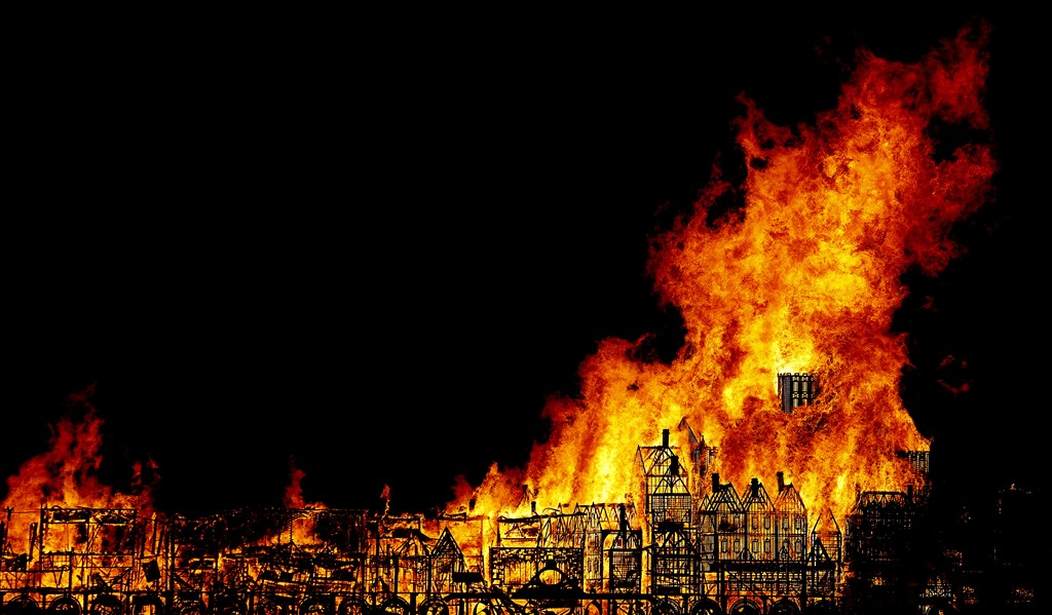
Three hundred sixty years ago, on September 2nd, 1666, an act of arson in a humble bakery almost completely destroyed what was then one of Western civilization's greatest cities. That event, which in the beginning was dismissed by the Lord Mayor of London, who said, "A woman could p**s it out," grew into a conflagration that was one of Europe's worst disasters.
And it all started in a bakery.
A fire started on September 2nd in the King’s bakery in Pudding Lane near London Bridge. Fires were quite a common occurrence in those days and were soon quelled. Indeed, when the Lord Mayor of London, Sir Thomas Bloodworth was woken up to be told about the fire, he replied “Pish! A woman might p**s it out!”. However that summer had been very hot and there had been no rain for weeks, so consequently the wooden houses and buildings were tinder dry.
The fire soon took hold: 300 houses quickly collapsed and the strong east wind spread the flames further, jumping from house to house. The fire swept through the warren of streets lined with houses, the upper stories of which almost touched across the narrow winding lanes. Efforts to bring the fire under control by using buckets quickly failed. Panic began to spread through the city.
As the fire raged on, people tried to leave the city and poured down to the River Thames in an attempt to escape by boat.
Bear in mind that in 17th-century cities, fire was an ever-present danger. People cooked with wood, charcoal or coal. Open fires were routine, in stoves and fire places. Buildings were wood, sometimes varnished, frequently kindling-dry. There were no fire departments to speak of. People dealt with structural fires with bucket brigades. And the summer of 1666 in London had been uncharacteristically warm and dry.
Absolute chaos reigned, as often happens today, as thousands of ‘sightseers’ from the villages came to view the disaster. Samuel Pepys and John Evelyn, the diarists, both gave dramatic, first-hand accounts of the next few days. Samuel Pepys, who was a clerk of the Privy Seal, hurried off to inform King Charles II. The King immediately ordered that all the houses in the path of the fire should be pulled down to create a ‘fire-break’. This was done with hooked poles, but to no avail as the fire outstripped them!
By the 4th September half of London was in flames. The King himself joined the fire fighters, passing buckets of water to them in an attempt to quell the flames, but the fire raged on.
As a last resort gunpowder was used to blow up houses that lay in the path of the fire, and so create an even bigger fire-break, but the sound of the explosions started rumours that a French invasion was taking place… even more panic!!
Thousands of refugees fled London and its environs. St. Paul's Cathedral went up in flames, its lead roof melted and flowed into the street. The Tower of London somehow survived, but almost all of London's government buildings were burned, along with about 13,000 private homes; the devastation was so complete that nobody knew for sure just how much was lost. When the fire was finally extinguished on September 4th, 80 percent of London was lost in the flames. Only six people were killed, in large part because everyone had abandoned their homes and businesses and fled the city. Over a hundred thousand people were homeless after the fire. Churches, civic buildings, homes, jails, marketplaces, inns, all destroyed. In some cases, burned-out shells remained; in others, nothing but ashes.
A French watchmaker, "Lucky" Hubert, confessed to starting the fire in the King's Bakery, and proved to be not so lucky, as he was hanged while the last embers still glowed.
The outcome of this wasn't all bad. In addition to the likely eradication of millions of rats, fleas and cockroaches (which probably were rapidly replaced) the rebuilt London was improved in almost every way. St. Paul's Cathedral was rebuilt, although it wasn't completed until 1711. Sir Christopher Wren was handed the task of rebuilding London, and it was from his efforts that the city we recognize today emerged.
All because of a disturbed Frenchman and a lack of organized fire controls in even the most modern of cities in the 17th century.
So, whenever you hear anyone longing for the good old days, remind them of the King's Bakery, and how a troubled Frenchman started a fire that got out of hand and destroyed a city, and how there was nothing the people could do to stop it.
Editor's Note: Do you enjoy RedState's conservative reporting that takes on the radical Left and woke media? Support our work so that we can continue to bring you the truth.
Join RedState VIP and use promo code FIGHT to receive 60% off your membership.



Join the Conversation
VIP members get the ability to comment on articles.