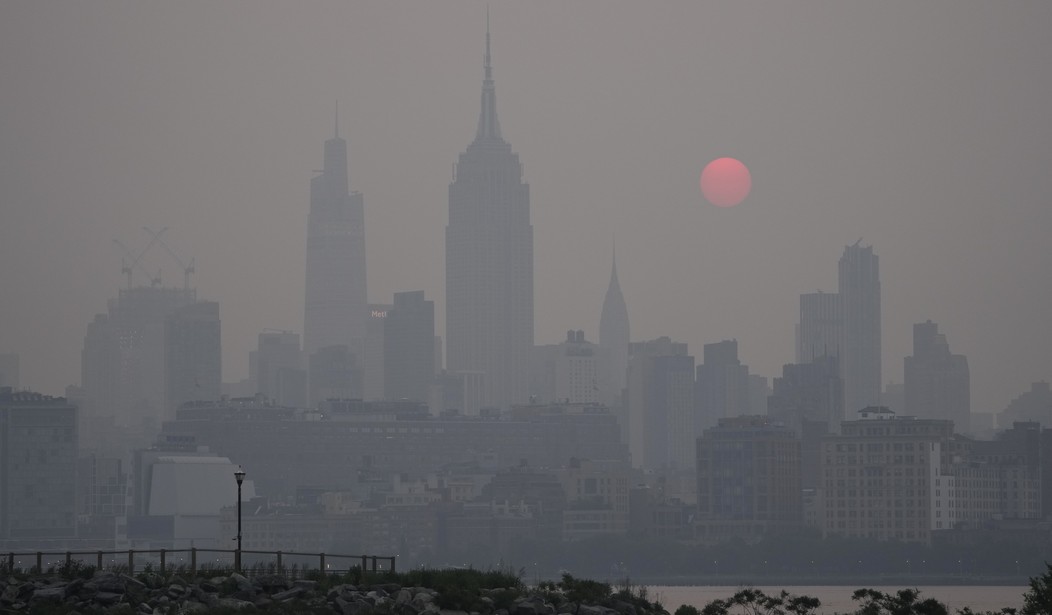

It's been hot over much of the contiguous 48 states lately. Hot weather in the summer. Who'd have thunk it? But even the northern tier of the United States has always been prone to summer heat waves. I grew up in northeast Iowa in the late 1960s and 1970s, and I can tell you that we had some hot, muggy summers. There were days when it was so hot, so muggy, and so still that you could actually hear the corn growing.
There have been some world-beaters, too. Heat waves, in fact, long precede human use of fossil fuels at anything like modern levels. But that doesn't stop activists from spreading climate panic.
A recent piece in the New York Times did just that, claiming that the current heat wave in the eastern USA would be "impossible" without climate change. There's just one problem with that claim: It's pure horse squeeze. Here's the claim, by a rather incurious journalist:
The New York Times (NYT) claims in “Without Climate Change, U.S. Heat Wave Called ‘Virtually Impossible’” that the recent Northeastern U.S. heat wave could not have occurred without human-caused climate change. This is false. The NYT bases its entire story on a model-driven analysis from a group whose sole purpose is to connect weather events to climate change, while ignoring the long observational record showing that severe heat waves have repeatedly struck the United States, including New York, for centuries.
“Heat and humidity as severe, prolonged and far-reaching as this week’s would have been ‘virtually impossible’ in the Northeast and eastern Canada before humans began warming the planet, a team of scientists said on Friday,” writes Raymond Zhong, a reporter for the NYT. “Emissions of carbon dioxide and other greenhouse gases from the burning of oil, gas and coal have trapped more of the sun’s heat at Earth’s surface, raising temperatures worldwide for more than a century.
“Summer hot spells are nothing new, but because of the excess heat around the planet caused by global warming, they can produce higher temperatures today than they once did,” Zhong continued.
Do they, though? That's the question Mr. Zhong never asks, nor does he question the source of the claim, a climate activist group that substitutes working backwards from a conclusion for actual analysis.
Unlike a good journalist, Zhong never questioned the premise, never examined the historical record, never interviewed anyone outside the climate attribution community, and never asked whether the group they cite, World Weather Attribution (WWA), has conclusions that might be influenced by the organization’s very reason for existing. Instead, Zhong presented readers with exactly one narrative: climate change is causing the present heat wave.
WWA exists for one purpose, to determine how much climate change has influenced weather events. That is its mission. Asking WWA whether climate change caused a heat wave is like asking the National Football League whether football is important or Greenpeace whether they think oil spills are harmful. What exactly did the NYT expect them to conclude? That climate change had nothing to do with it?
Of course not. This is not journalism, rather it’s a reporter using a narrative autopen.
That's bad science and bad journalism.
Read More: Normalized Data Debunks Europe's 'Soaring Climate Damage' Story
Why Computer Simulations Aren’t Evidence of Coming Heat Apocalypse
Here's the thing: The worst heat waves, by actual measurement, have not happened in the last couple of decades, when the climate scolds were wagging their fingers at us over fossil fuel use. No, the worst heat waves in the United States happened in the 1930s, during the Dust Bowl era, and it's not even close. As Climate Realism notes, there have been consistently bad heat waves since modern measuring techniques first came into use in the 1890s. In 1901, a heat wave in the eastern USA killed over 9,000 people. In 1911, much of New England was plunged into a triple-digit heat wave, setting the record high temperature in Boston at 104, a record which still stands. And then, the heat waves of 1934-1936 set records all over the central United States that, again, still stand. I remember my father talking of the heat waves in the mid-1930s, when he and his brother would walk miles to spend the day splashing in the Wapsipinicon River in eastern Iowa.
Even the Founders experienced severe heat waves. One of the more famous battles of the Revolution was the Battle of Monmouth, New Jersey, in 1778; that battle was fought in the middle of a heat wave that produced temperatures estimated, by contemporary accounts, to have been over 100 degrees.
And I remember the great heat wave of 1980, which is claimed to have produced heat-related fatalities numbering around 10,000, along with crop failures that may have cost as much as $20 billion.
Even setting the history aside, the New York Times story disregards another factor in urban heat waves: The urban heat island effect. Note that the current heat wave seems to be affecting urban areas the most, and that is because those (unnatural, if you ask me) environments are covered with pavement, which soaks up heat during the day and releases it at night, resulting in an overall higher temperature trendline, not because of daytime highs, but because of increased overnight lows.
The New York Times, once the "paper of record," should be ashamed of this bit of biased and misleading reporting. But then, this is nothing new for the legacy media these days.
This seems appropriate.