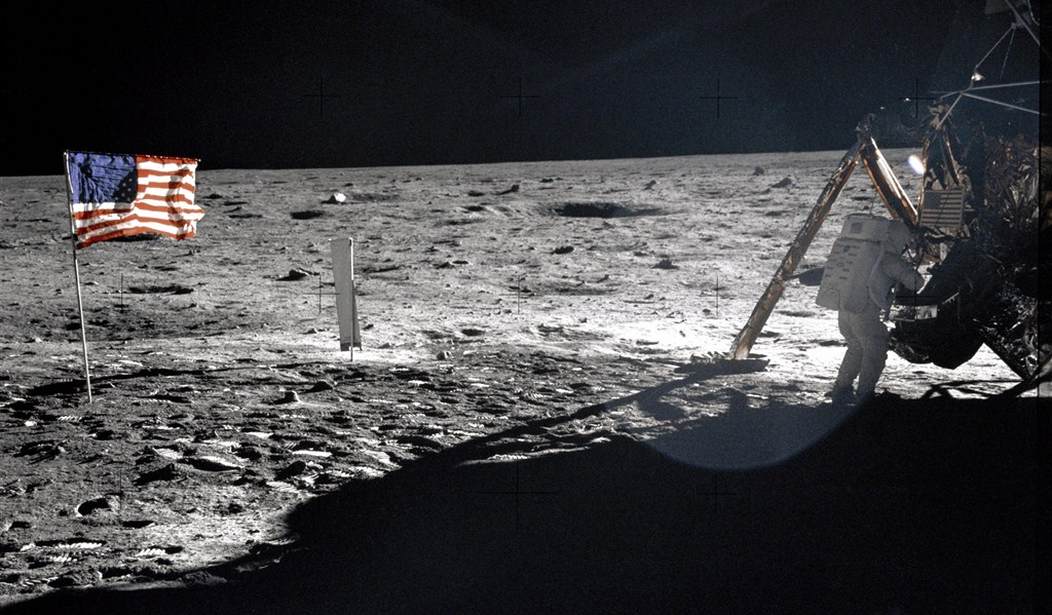

Most of us Baby Boomers remember heady events like the Apollo moon missions. Back in those days, the National Aeronautics and Space Administration (NASA) was riding pretty tall in the saddle, and justifiably so. It broke a lot of new ground in technology and space travel, and a lot of that technology, from Velcro to Tang, found its way into the hands of the American public. They put men on the moon, not once but several times, and brought them safely home, all with 1960s technology.
Imagine flying to the moon in a 1969 Rambler. That is, more or less, what those brave men did.
July 29th, 2026, the day this is written, is the 68th anniversary of the founding of NASA, and there's still a pretty substantial "cool" factor there. And, we shouldn't be surprised that it was a Cold War thing.
The U.S. Congress passes legislation establishing the National Aeronautics and Space Administration (NASA), a civilian agency responsible for coordinating America’s activities in space, on July 29, 1958. NASA has since sponsored space expeditions, both human and mechanical, that have yielded vital information about the solar system and universe. It has also launched numerous earth-orbiting satellites that have been instrumental in everything from weather forecasting to navigation to global communications.
NASA was created in response to the Soviet Union’s October 4, 1957 launch of its first satellite, Sputnik I. The 183-pound, basketball-sized satellite orbited the earth in 98 minutes. The Sputnik launch caught Americans by surprise and sparked fears that the Soviets might also be capable of sending missiles with nuclear weapons from Europe to America. The United States prided itself on being at the forefront of technology, and, embarrassed, immediately began developing a response, signaling the start of the U.S.-Soviet space race.
I'm not quite old enough to remember Sputnik, but my father was, and he described it as quite a surprise; to hear him tell, nobody much thought the Soviets capable of such a thing. We caught up, though.
On November 3, 1957, the Soviets launched Sputnik II, which carried a dog named Laika. In December, America attempted to launch a satellite of its own, called Vanguard, but it exploded shortly after takeoff. On January 31, 1958, things went better with Explorer I, the first U.S. satellite to successfully orbit the earth. In July of that year, Congress passed legislation officially establishing NASA from the National Advisory Committee for Aeronautics and other government agencies, and confirming the country’s commitment to winning the space race. In May 1961, President John F. Kennedy declared that America should put a man on the moon by the end of the decade. On July 20, 1969, NASA’s Apollo 11 mission achieved that goal and made history when astronaut Neil Armstrong became the first person to set foot on the moon, famously declaring “That’s one small step for man, one giant leap for mankind."
12 years. 12 years from forming NASA out of a cobbled-together group of other agencies, to putting men on the moon. That's remarkable.
Read More: THE ESSEX FILES: NASA Actually Doing Things Right
America Has Its Artemis III Crew - The Race Back to the Moon Is On
NASA's space program began with the Mercury orbiters, each of which put one man in orbit around Earth, to gather data how space flight could affect humans. Astronaut Alan Shepard became the first American in space, while John Glenn became the first American to orbit Earth.
Then came the Gemini missions, two-man excursions that tested technologies and practices for extended space flights. In the Gemini program, American astronauts learned how to do spacewalks, and how best to dock one spacecraft with another.
Then, in 1968, Apollo 8 became the first crewed spaceship to orbit the Moon - that was crowned on July 20th, 1969, when Neil Armstrong and Buzz Aldrin became the first humans to set foot on the Moon. No country in all the years since has managed to do that.
NASA's workload makes an impressive list. There have been mishaps; the two shuttle disasters not least among them. But there have also been successes: The Voyager probes, the first human constructs to leave the solar system for interstellar space, the Viking landers that set down safely on Mars, the Mars rovers which gave us a wealth of information on the Red Planet. And, of course, the Hubble Space Telescope, which gave us fascinating views of distant objects in space - allowing us, in effect, to look back in time at the cosmos.
And now, the Artemis program is aimed at returning humans to the Moon. Again, no other country has achieved that. Not in 1969, not at any time since.
NASA is still operating. It have, under other administrations, dabbled in things well outside their original mission, like pushing anthropogenic climate change panic-mongering. But now they seem focused again, and that's a good thing.
The real cutting edge, though, is now in the private sector. What Elon Musk's SpaceX is achieving now would have been unimaginable in 1969, but it is reminiscent of those early days, when NASA rockets blasted off every few months, carrying men who had the right stuff into the unknown. The private sector may be taking over space now, and that's for the best; but on this day, we might remember that 68 years ago, the United States decided that we were going to be the most advanced nation in space travel, and NASA made sure we achieve that.
It's a good legacy for SpaceX and Blue Origin to build on.