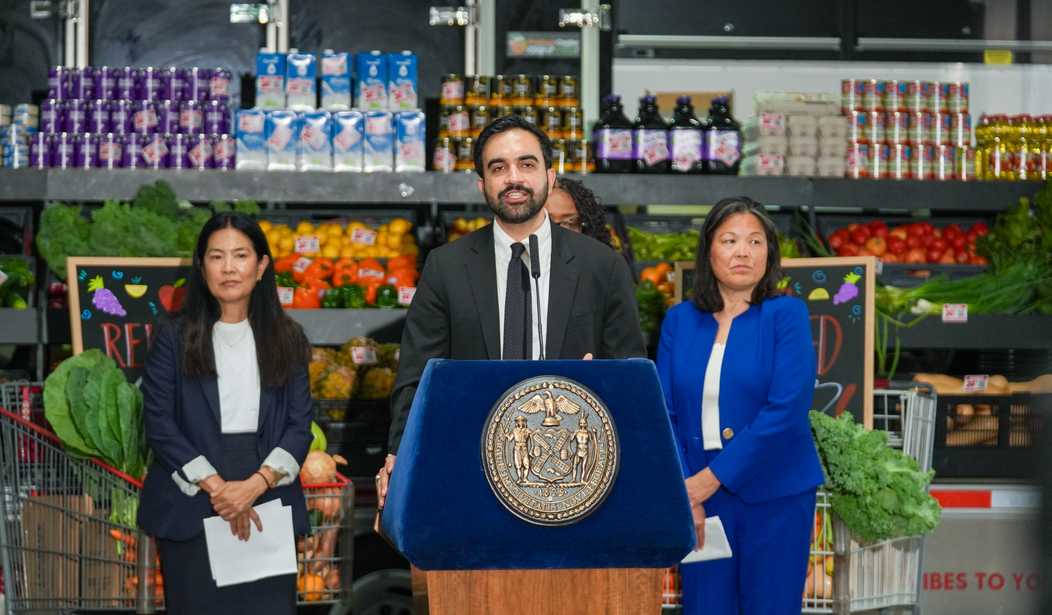

"Democratic socialists" may be nuts, they may be economically illiterate, they may be ignorant of business practices and trade to the nth degree, but that doesn't necessarily mean they lack some canniness. We've seen these people, who we may as well honestly call communists, try again and again to convince us that all the manifest failures of socialism won't be repeated, how that "wasn't real socialism," and that they can make it work if they just have the right Top Men in charge - by which, they mean, themselves.
Trouble is, that never works. But as we are seeing right now, in one of our nation's once-great cities, the loony left, in the form of Mayor Zohran Mamdani, they're trying yet again. This time, though, there's a slightly new twist. Namely, Mayor Mamdani is pushing for his socialist grocery stores. In other words, instead of stealing the means of production, he's stealing the means of distribution.
There are a number of problems with that notion. City Journal's Seth Barron notes a few of them:
Despite all its experimenting with solutions to poverty and hunger, the federal government never appears to have considered going into the retail grocery business. Selling food is infrastructure-heavy, logistically complex, and notoriously low-margin. The grocery industry, while unglamorous, is nevertheless more complicated than most bother to consider. The average hardware store carries about 20,000 Stock Keeping Units (SKUs), a code that storekeepers use to designate every product, in every size or color. A typical bookstore might have 15,000 SKUs, while a good-sized furniture store could offer 5,000 different items, many of which would have to be ordered off-site. A standard supermarket carries about 30,000 SKUs, at an extremely high rate of inventory turnover, and much of its stock is perishable.
Mamdani and his commie minions neither know nor care about this. But it's always like this with these people; in this case, a spoiled brat from Uganda, with no education and no experience in business, along with this cadre of similarly-ignorant myrmidons, are going to attempt to horn in on a complex and difficult industry. There's no way in the world they won't make an utter hash out of it.
So, why are they trying to step in to a system that's already well-established?
Given that a network of grocery stores already exists, our social-welfare planners must have concluded that they should give consumers themselves either chits or cash to buy the food they need from their local supermarket. They did not see the need to build a parallel, competitive system. Grocery stores aren’t analogous to rural electrification, where the government had to step in to fill a gap that the private sector hadn’t covered. The stores, especially in a dense city like New York, are all up and running.
Why, then, did the Mamdani administration overlook the obvious solution to the unaffordability of food—namely, to issue coupons to supplement SNAP benefits—and choose instead to build a complicated, expensive new system, one mandated to undercut existing taxpaying businesses? It seems preposterous, in fact, for the mayor to wage war against neighborhood enterprises while he simultaneously promises to help small businesses thrive.
Well, I have some thoughts.
Read More: Mamdani: Nah, No IDs at City Grocery Stores — Illegals Welcome to Shop on the Taxpayer Dime
Priceless: Immigrant-Led Business Group Delivers Brutal Message to Mamdani Over His Grocery Games
First: If it was poverty and hunger that the Mamdani administration was concerned with, and I'd point out that there is little or no abject poverty anywhere in the United States, only relative poverty, there are far more efficient ways to get food to hungry people. But this, I suspect, is a feature, not a bug.
Second: Lots of Americans are accustomed to the notion of big-box, corporate grocery store chains. Here, it's a big Fred Meyer store that we go to for our monthly trading, and most Americans do likewise. But the heavily urbanized neighborhoods in New York still depend on small, family-owned, street-side markets for their groceries. These are precisely the people that any harebrained scheme such as government-run grocery stores will squeeze out of business. Again, I ask: Feature or bug? Is Mayor Mamdani looking to pre-empt another generation of what he sees as kulaks?
Third and finally: Mamdani, or perhaps someone who is advising him, isn't completely dim. With this move they are, in effect, back-dooring communism, by stealing the means of distribution. They are not trying to seize the means of production; where food is concerned, that's simply impossible for them. Almost no food is grown within the city. But they can gain control over the distribution of food, and if they can get total control over food distribution, they gain control over everything everyone does anywhere in the city.
And I don't think for one moment that someone in the New York municipal government, perhaps Mayor Mamdani himself, hasn't thought of that.
We'll be keeping an eye on this sure-to-fail mess, and as for the Mamdani administration and the whole "democrat socialist" movement in general, I can only say this: If I ever meet a "democratic socialist" who knows anything, anything at all, about economics or business, I'll shake his hand and buy him an Arturo Fuente Opus cigar.