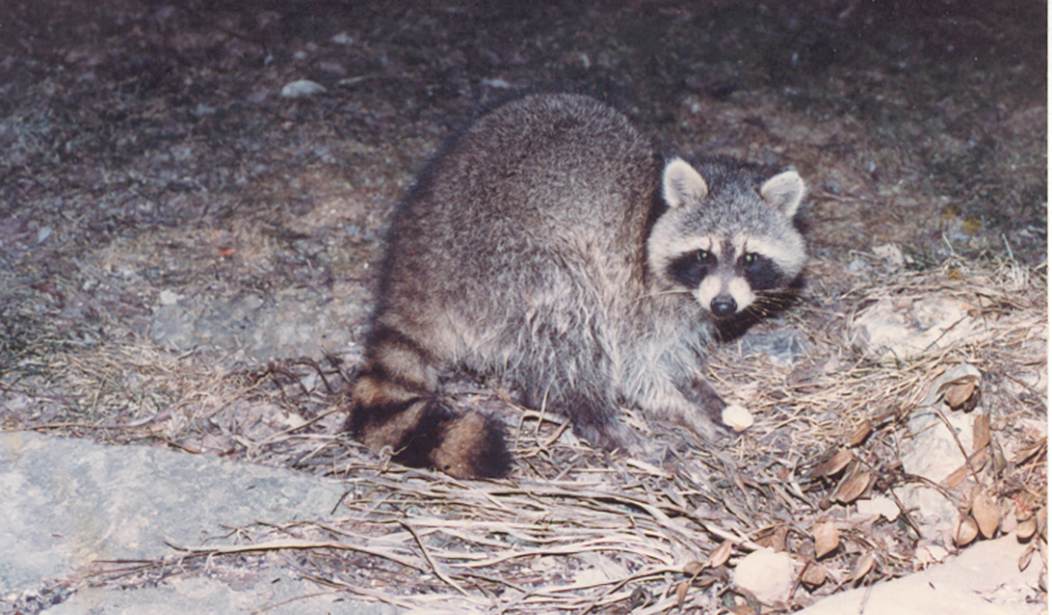

Summer's coming on us soon, and with that, a lot of folks will be outdoors. When you are enjoying those times, though, be aware of any critters acting strangely; rabies is still a very real threat in North America. Rabies is a nasty infection. It's a syndrome caused by the infection of a mammal with the virus, Lyssavirus rabies, and it can cause symptoms including nausea, vomiting, violent movements, uncontrolled excitement, fear of water, an inability to move parts of the body, confusion, and/or loss of consciousness. In animals, it can also cause extreme aggression and strange behavior, like seeing normally nocturnal animals moving around in daylight.
Back in the days of my youth in Allamakee County, Iowa, the Old Man had a strict policy: Any animal, including especially skunks and raccoons, that showed any signs of odd behavior would be shot immediately. We killed a few raccoons and skunks that we were pretty certain had rabies, and in those days, as today, both species were known to be major rabies vectors.
Sometimes, though, in dealing with a problem like this, even the government can sometimes have a sudden rush of brains to the head. Since 1995, the USDA's Animal and Plant Health Inspection Service (APHIS) and specifically, APHIS's Wildlife Services program, have been doing some good work in reducing the threat of rabies, with an oral vaccine delivered in a bait that looks a lot like... ravioli.
Since 1995, APHIS' Wildlife Services (WS) program has been working cooperatively with local, State, and Federal governments, universities, and other partners to reduce rabies in wildlife. ORV baits are distributed to wildlife in targeted areas. This edible bait consists of a sachet, or plastic packet, containing the RABORAL V-RG® rabies vaccine. To make the bait attractive to wildlife, the sachets containing the vaccine are sprinkled with fishmeal coating or encased inside hard fishmeal-polymer blocks about the size of a matchbox. Each year, WS and cooperators distribute about 6.5 million baits in selected States to create a zone where raccoon rabies can be contained. This program is critical to national rabies prevention as raccoon populations are present in all 48 States. While raccoon vaccination is the largest of WS' efforts, the program has also been involved in a cooperative ORV operation in Texas that targets canine rabies in coyotes and a unique variant of the disease in gray foxes.
Note that it's not just raccoons being targeted.
What's a little less clear is just how the oral vaccine works. While we normally vaccinate our pets against rabies, that vaccination is a shot. If a human is exposed to rabies, normally through an animal bite, the treatment is, again, a series of injections. The mechanism of this vaccine being delivered by being eaten? That's not explained. But works it does, and that's an unalloyed good.
Read More: So, a Seal Walks Into a Bar...
Clever Critter Outfoxes Immigration Authorities
This program really grew legs, it seems, in Ohio, where a new strain of the rabies virus started showing up in the raccoon population.
In 1996, a new strain of rabies in wild raccoons was introduced into northeastern Ohio from Pennsylvania. To protect Ohioans and their domestic animals, the Ohio Department of Health (ODH) and other state and local agencies partnered with the United States Department of Agriculture (USDA) Animal and Plant Health Inspection Service Wildlife Services to implement a program to immunize wild raccoons for rabies using an oral rabies vaccine (ORV).
This effort created a barrier of immune animals that reduced animal cases and prevented the spread of raccoon rabies into the rest of Ohio. The vaccine-laden baits are dropped by fixed wing aircraft in rural areas and by low-flying helicopters and ground vehicles in urban and suburban neighborhoods.
USDA has a list of the economic benefits so far of putting this check on rabies in wildlife:
- An economic evaluation of rabies prevention data indicates that for every dollar spent on a coyote ORV program in Texas, between $4 and $13 are saved.
- The domestic dog-coyote variant of rabies was successfully eliminated from the United States in 2008 as a result of an ORV baiting program in Texas, proving that ORV of wildlife can successfully eliminate terrestrial rabies.
- A gray fox ORV program in the southwest United States stopped the expansion of a rabies outbreak and reduced the original treatment zone by 50 percent.
- A raccoon ORV program in the eastern United States has created a barrier against the westward spread of raccoon rabies into naïve raccoon populations beyond the Appalachian Mountains and across the western United States.
Rabies isn't anything to play around with. I still have vivid memories from when I was about 14 or so, of running to grab my .22 rifle to deal with an old boar raccoon who was clearly and obviously infected. Dad wasn't around, Mom was in her garden, and I had to protect my Mom, of course. That raccoon became an ex-raccoon, which was an act of mercy if there ever was one, and he got burned on a brush pile.
For many years, that's how we dealt with rabies. We vaccinated our pets, we shot any wildlife that showed symptoms, and we burned their corpses, or buried them very, very deep. But a few years ago, science came up with a new tool to deal with rabies in wildlife, and it's working. It's been working for thirty years now, and we're seeing results every summer.
Still: Pay attention to your surroundings this summer. If any critter is acting strangely, give them a wide berth. And if you see anything odd lying on the ground that looks a little bit like a funny-shaped ravioli, leave it for the raccoons. That's who it's meant for.