








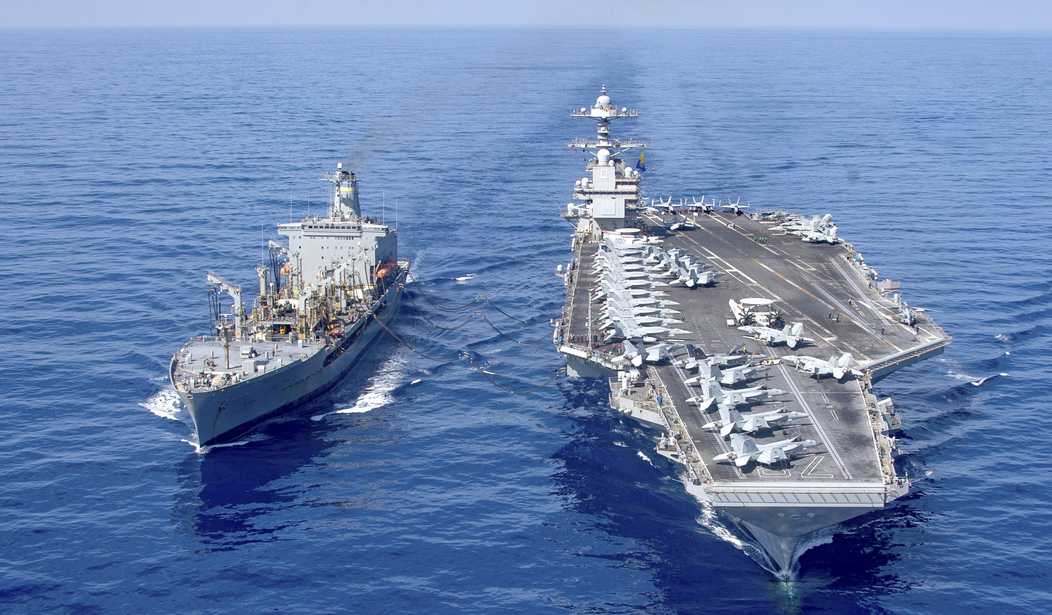
Parking a warship off of someone's coast has been an international intimidation tactic since Grog and Yook first loaded up a raft with rocks and floated it downstream to the clan of the guy who stole a reindeer pelt, to convince him to give it back. Time was when we'd send a battleship, so whoever was getting froggy could look out and see those 16-inch guns pointed their way. Now it's an aircraft carrier task group, but the effect is much the same. In all these cases, we're showing bad guys what the "or else" looks like.
Iran doesn't seem to have been too impressed by President Trump's sending one aircraft carrier to their region of the world. So now he's thinking of sending another one.
President Donald Trump is weighing deploying a second aircraft carrier to the Middle East as the U.S. continues talks with Iran over its nuclear program.
Trump commented during an interview with Axios Tuesday, saying he would consider the move if the talks with the Islamic Republic fail.
The president is set to meet with Israeli Prime Minister Benjamin Netanyahu Wednesday at the White House, marking their seventh meeting since Trump took office over a year ago.
Two carriers? Well, we've got more. But here's the question: One of our carrier task groups contains more destructive power than Iran ever had. One didn't seem to sway them much. So now, the threat has doubled, but doubling down on an already overwhelming advantage may not be that much of a persuader.
Talks between the U.S. and Iran have been ongoing in Oman since late last week, with tensions between the two nations growing.
Israel is reportedly concerned with not only Iran rebuilding its nuclear program, but also ballistic missiles and support for proxy groups, such as Hamas and Hezbollah.
While Trump won’t commit to whether the U.S. will strike Iran for the second time in less than a year, he continues to hurl threats at the Iranian regime, citing a large armada of American naval ships in the region, which has been growing.
That has a familiar ring to it, considering that was the pattern before we snatched Venezuelan dictator Nicolás Maduro and dropped him into an American jail cell. That's not likely to be the fate of Iran's mullahs, though.
Read More: Iran Snaps Back: US Bases, Carriers Now in Crosshairs
Trump's Armada Advances: Iran Now on Notice for Nuclear Deal
The difference here is that Iran is a tough nut to crack for any kind of ground assault. The capital is far inland, away from any easy approach. There are mountains between the sea and Tehran. We can own the skies, we can drop bombs until the cows come home, but we cannot easily put boots on the ground. And, honestly, we shouldn't be contemplating that move. When it comes down to storming the barricade, it is the people of Iran who will have to take that on.
That doesn't mean there isn't value in showing Iran the big stick. Iran's air force is a non-entity. In 1991, Iraq had a larger, more capable air force, and as one F-16 driver told me at the time, by about Day 2 of the air war, Iraqi pilots were looking at their planes and seeing coffins. We could have a net of total air superiority over Iran within hours, which could prove a big help to the people on the ground - especially if we were identifying any regime-loyal military forces and reducing them to flying spare parts.
It may remain to be seen whether a second carrier would have any effect on the mullahs. But hey, we have plenty more.
Editor's Note: Thanks to President Trump and Defense Secretary Pete Hegseth's leadership, the warrior ethos is coming back to America's military.
Help us report on Trump and Hegesth's successes as they make our military great again. Join RedState VIP and use promo code FIGHT to get 60% off your membership.

Join the Conversation
VIP members get the ability to comment on articles.