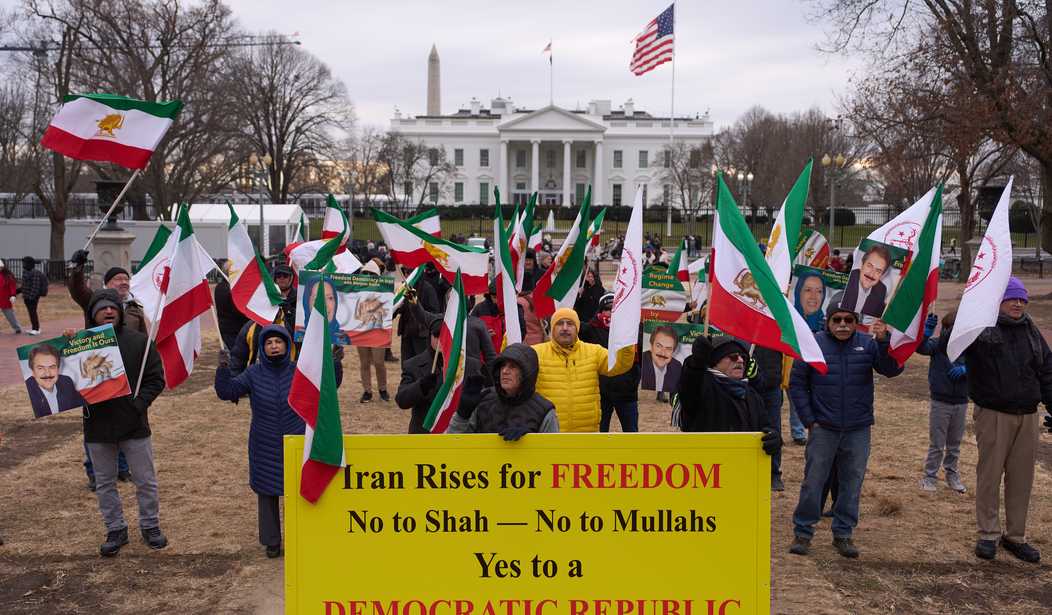

What will become of Iran? At this juncture, that's very much up for debate. The regime, those vicious barbarians that control the Islamic Republic's terrorist-supporting, theocratic government, has cracked down brutally on the thousands of Iranian people who have had enough. These brave people have taken to the streets demanding that Iran join, at least, the 20th century; even that would be a big step forward for a land ruled by the medieval mullahs.
The mullahs have clamped down on internet access and, indeed, any news coming out of Iran. But news is coming out nonetheless, and it's painting a picture of some of the most brutal repression that we have seen since the Cold War.
A recent piece from the Free Press's Amy Kellogg has some of those details, and they are horrifying.
The shots from the Basij came as the crowd was already scattering. As he ran, Ali thought, Why are you shooting at us as we are running away? But there was no time to think about it then; he just needed to escape home.
The man who told me this has just left Iran. I have known him for two years, but for his own and his family’s safety he can’t be identified, so I am calling him Ali. He and his wife are in a neighboring country for now, where they fled last week, after the protests in Iran were crushed by Ali Khameini’s regime in a violent crackdown that has taken at least 6,000 lives—a number that after all the injured and missing are accounted for could climb to over 20,000. Both are young professionals who intend to return home to Iran, but they need the internet, still cut off in Iran, to do their jobs. And they need to breathe.
6,000 dead, many shot in the back as they are fleeing. Note that many of the protestors so dispersed are unaccounted for. Are they prisoners? Or were they summarily executed, an atrocity that we are near-certain the regime is undertaking?
Note also the consequences of the mullah's cutting off communications. This was done to clamp down on the protestors, as well as to attempt to hide the regime's brutality from the world. There's just one problem: The world is already painfully aware of Iran's penchant for brutality, and word of their vicious reprisals on their own people will always get out, one way or another. Now, many young Iranian professionals, who rely on the internet for their livelihoods, are unable to earn a living in an economy that was already collapsing before all this started.
Young professionals, many of them educated in Europe, Canada, or the United States, are precisely the demographic the mullahs fear. They have the most to gain from turning a vicious, theocratic Iran into a renewed, democratic, prosperous Persia - and thanks to the regime's actions, they are finding themselves in the position of having nothing left to lose.
There is nothing so dangerous as a man with nothing left to lose.
Ali first joined the protests on January 8. By then, they had grown to a million people. He and his wife, whom I’ll call Roya, live in one of Iran’s bigger cities, and were not activists or dissidents. “I had never been to a protest before,” Ali told me. But he felt a responsibility to take a stand. And, for the first time in Ali’s life, the prospects for a change in the regime appeared hopeful.
“After the 12-day war with Israel, the regime seemed weak. They didn’t feel as scary,” Ali said. “We are okay materially—not like some people in Iran. But we wanted change and wanted to be a part of making it happen.”
And that is precisely how change in Iran must happen.
Read More: Iran Snaps Back: US Bases, Carriers Now in Crosshairs
Trump's Armada Advances: Iran Now on Notice for Nuclear Deal
Consider the iron courage of these young people who have taken to the streets in Tehran, in Qom, in other Iranian cities and towns. Unarmed, they face the soldiers of the regime, one of the most vicious, repressive governments on the planet. Unarmed, they have taken to the streets to demand what much of the world takes for granted: Self-determination, and an end to a vicious, Bronze-Age theocracy that has ruled Iran with an iron fist since 1979, before many of these protestors were born. As I've pointed out for years, many of these young people were educated in the United States, Europe, and other countries of the modern, developed world. They've seen how good life can be. They've seen how modern societies can work, and no matter how dysfunctional the nations of Europe are right now, they are light-years above Iran. Now these protestors are demanding that for Iran.
They are right to demand. They are right to take to the streets. And they are facing the regime with uncommon courage.
President Trump has sent American forces to the region, but we are limited in what we can do. We can own the skies over Iran; against the air power of one American carrier group, Iran can do nothing. It would be much like the air war in Desert Storm, wherein an F-16 driver told me that by day two, the Iraqi pilots were "looking at their airplanes and seeing coffins." We can conduct targeted strikes. We can hit their military headquarters. We can strike the centers of the government. We can help, but we can't do it for them.
In the end, this will be up to those young people in the streets. We can plow the road. We can help them by clearing some obstacles. But this won't end until the protestors who are shouting for a free, modern Iran march into the centers of power in Tehran and rip the mullahs and their minions away from the levers of power.