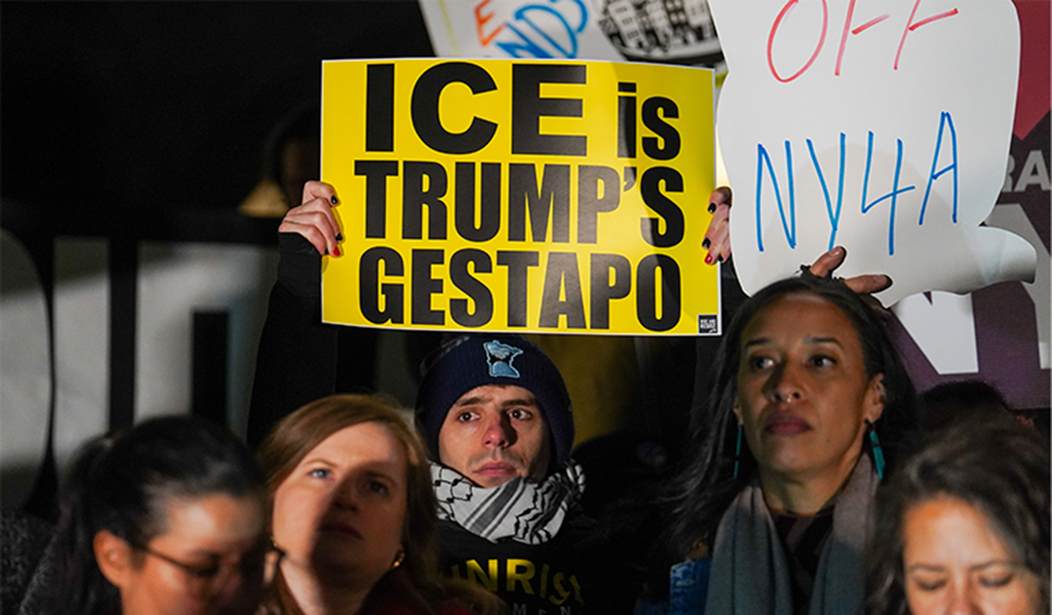

The situation in Minnesota is growing more tense, it seems, by the moment. In a recent, disconcerting development, Minnesota's Democratic Governor Tim Walz has threatened to call out the state's National Guard — potentially against federal law enforcement — stating that a warning order has already been issued to the Guard, in effect telling them to get their web-footed fowl arranged in a linear fashion and be ready for more orders.
On Thursday, some GOP lawmakers were already calling on President Trump to invoke one serious tool with a long history of use in the United States: The Insurrection Act.
Republican lawmakers are urging President Donald Trump to invoke the Insurrection Act against Minnesota Gov. Tim Walz after the Democrat warned he could deploy the National Guard in response to federal immigration enforcement actions in his state.
"Invoke the Insurrection Act. Arrest Tim Walz," Rep. Mary Miller, R-Ill., said in a post to X on Wednesday evening.
Miller’s calls to apply the law, which gives the president powers to arrest suspects obstructing federal law enforcement, follow Walz’s suggestion that he might deploy the National Guard to push back on President Donald Trump’s use of Immigration and Customs Enforcement (ICE).
Arresting a sitting governor is a serious step, but so is threatening (even implicitly) to set the state's National Guard on federal officers who are conducting their legal duties, namely, enforcing immigration law.
"We do not need any further help from the federal government. To Donald Trump and Kristi Noem, you’ve done enough. I’ve issued a warning order to prepare the Minnesota National Guard," Walz said in a press event.
This has the potential to become another Fort Sumter. With that in mind, we should understand just what the Insurrection Act states, and when it has been invoked in the past.
Read More: Tim Walz Is Willing to Risk Lives to Salvage a Narrative No One’s Buying
JD Vance Absolutely Levels the Left Over Minneapolis Shooting – 'The Gaslighting Is Off the Charts!'
The Insurrection Act is now found in Title 10 of the United States Code. The Act states:
Whenever there is an insurrection in any State against its government, the President may, upon the request of its legislature or of its governor if the legislature cannot be convened, call into Federal service such of the militia of the other States, in the number requested by that State, and use such of the armed forces, as he considers necessary to suppress the insurrection.
Whenever the President considers that unlawful obstructions, combinations, or assemblages, or rebellion against the authority of the United States, make it impracticable to enforce the laws of the United States in any State by the ordinary course of judicial proceedings, he may call into Federal service such of the militia of any State, and use such of the armed forces, as he considers necessary to enforce those laws or to suppress the rebellion.
The President, by using the militia or the armed forces, or both, or by any other means, shall take such measures as he considers necessary to suppress, in a State, any insurrection, domestic violence, unlawful combination, or conspiracy, if it—
(1) so hinders the execution of the laws of that State, and of the United States within the State, that any part or class of its people is deprived of a right, privilege, immunity, or protection named in the Constitution and secured by law, and the constituted authorities of that State are unable, fail, or refuse to protect that right, privilege, or immunity, or to give that protection; or (2) opposes or obstructs the execution of the laws of the United States or impedes the course of justice under those laws.
The Insurrection Act has been invoked by presidents 30 times since its passage. The most recent invocation was in 1992, when President George H.W. Bush invoked the Act to suppress the Los Angeles Rodney King riots. The first President Bush also invoked the Act in 1989 to tamp down riots and looting in the U.S. Virgin Islands after Hurricane Hugo. The Act was also invoked once by President Reagan, in 1987, when the announcement of the upcoming deportation of Cuban prisoners led to the takeover of a federal penitentiary in Atlanta, Georgia.
Perhaps the most serious recent (for some of us, at any rate) use of the Act was in 1963; bear with me, because aspects of this may look familiar indeed. In that year, at the height of the civil rights movement, the Alabama National Guard was activated by the state to prevent black students from entering all-white schools. President John F. Kennedy invoked the Act to federalize the Alabama National Guard and order them to stand down. You may read his entire proclamation here.
The Act has not been invoked since 1992. So why are Republican lawmakers calling on President Trump to invoke it now?
Arguably, hordes of rioters impeding federal law enforcement constitute an "unlawful obstruction, combination, or assemblage, or rebellion against the authority of the United States." They are making it difficult, if not entirely impracticable, to enforce the laws of the United States. And that, indeed, strikes at the very heart of the matter: The protestors and rioters in Minneapolis, Chicago, and Los Angeles, and anywhere else where Immigration and Customs Enforcement (ICE) agents are trying to do their jobs, are deliberately and with malice aforethought attempting just such an unlawful obstruction. That seems remarkably clear.
As for Governor Walz threatening ICE and Homeland Security with the Minnesota National Guard, President John F. Kennedy has already established the blueprint; as noted above, in Alabama, he used the Insurrection Act to federalize the Alabama Guard, then legally ordered them to stand down. In the unlikely event the Minnesota National Guard took to the street to oppose the United States - color me very skeptical on that score - the president could resolve that in the same way.
In simple terms, if Governor Walz tries to activate the Minnesota National Guard and set them to impede federal law enforcement, it's not going to work. As for actually arresting a sitting governor, in that you can also color me very skeptical. I doubt that's a step that the Trump administration is willing to take. But what the president would be authorized to do under the Act is to use the "militia or the armed forces" to suppress the rebellion, just as George H.W. Bush did in 1992. The Insurrection Act provides something of an end-run around the Posse Comitatus Act, and the result, should the rioters push things that far, may result in them facing the 101st Airborne — or the Marines.
So far, the Trump administration has only used the regular federal military forces to provide logistical support for law enforcement and to guard federal buildings. Invoking the Insurrection Act opens up a whole new kettle of fish, and with that, things in our major cities could get very spicy indeed.