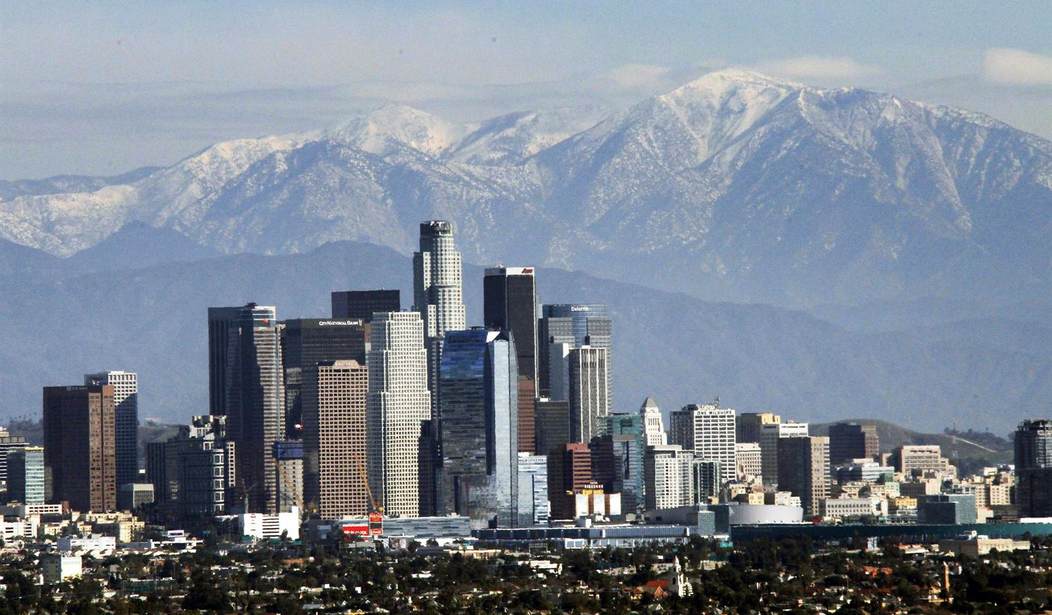

California is an expensive place to live. In fact, much of California, especially those lands along the coast, has never been what you'd call a cheap place to live. Back in the day, it was a land that attracted people. The beaches, the scenery, the mountains, and the salubrious climate all attracted people in the millions. It's easy enough to see why; it's a beautiful place.
Speaking of that climate, though, there are scolds out there who are claiming that climate change is making California not just expensive, but prohibitively expensive. Not some of the highest taxes in the nation, not the highest energy costs in the nation, not the constant effort to run any productive people out of the state, but climate change. Specifically, anthropogenic climate change, caused by human activity.
There's just one problem with that claim: It's hot garbage.
Linnea Lueken is a Research Fellow with the Arthur B. Robinson Center on Climate and Environmental Policy, and she has laid out some facts in a response to an LAist story that busts the climate scolds' arguments right in the chops.
First: Fires.
LAist blames these fires on “an unusual lack of rain, a condition blamed on climate change,” and then backed this assertion up by referencing attribution studies: “Using weather data collected since 1950, scientists ran simulations showing the conditions that dried out the foothills were 35% more likely because of global warming.”
This is nonsense. Not only are attribution studies junk science, as discussed by previous Climate Realism articles here, here, and here, but the conditions that led to the dryness that contributed to the Eaton fire and others at the same time were not due to climate change.
Much of California is and has been a hot, dry place, prone to fires. It wasn't always like that; during the last glacial maximum, the Los Angeles area was a mild, wet temperate forest interspersed with grassland. But when the glaciers receded, the LA area became what it is: A hot, dry place. And the attribution studies cited by LAist are indeed a mess.
Attribution studies aim to determine the extent to which claimed human-induced climate change influences specific weather events. These studies often utilize climate models to compare real-world scenarios with hypothetical situations devoid of the models (modelers) assumed estimates of human impact. The reliability of these models is unverifiable and to the extent their outputs have been tested against real world data and historical events and trends, they have failed.
That's not data-gathering. That's guesswork.
Next, the Santa Ana winds.
Santa Ana winds are most common during the winter months, and cause vegetation to dry out rapidly, even if there was enough rain beforehand. In fact, there was a lot of burnable vegetation in the area at the time, a high fuel load, because the previous winter seasons had been wetter, and contributed to more plant growth. This means that when the winds came, they dried out a lot of fuel for fires when they were started by arson, in the case of the nearby Palisades fire.
Data does not indicate that the Santa Ana winds are getting more severe or common due to climate change, though there are some studies suggesting they could get weaker, but that has not appeared in data yet.
I've felt those winds while working in the Los Angeles area. Yes, they are warm, and they are dry. But the evidence doesn't support the winds' growing any warmer or drier; in fact, the opposite may be true.
The LA wildfires were associated with very strong (up to 100 mph) and dry Santa Ana winds, which were generally from the northeast.
There is an extensive peer-reviewed science literature indicating that global warming will reduce the strength, intensity, and frequency of such Santa Ana winds.
Let's note, once again, that it's not the slight warming of the northern hemisphere that we take issue with; it is the extent to which humans are involved, and how much of our modern lifestyles we would have to surrender to mitigate that effect. The earth has been warming, slowly and slightly, since that last glacial maximum, and will continue to do so. There have been some spikes and dips, like the Little Ice Age, but the trend is there, and has been since before the Industrial Revolution.
Read More: Are Men 'Climate Deniers' Because They're Insecure in Their Masculinity?
Hybrid Killers: New Research Shows You're 3X More Likely to Die in a Hybrid Auto
Finally, despite claims, the number of hot days in California is not increasing. Most, perhaps all, of the increasing daytime highs in the Los Angeles area are due to the ever-growing urban heat island effect.
Data from the National Oceanic and Atmospheric Administration (NOAA) do not show that California’s number of extremely hot days is increasing beyond what earlier parts of the 20th century saw, particularly the 1930s. (See figure below)
Here's the figure:
— Ward Clark (@TheGreatLander) December 31, 2025
The black line running horizontally across the chart is a trendline. Note that it's flat.
California's cost of living has many progenitors, and most of them work in Sacramento. The once-Golden State will continue to be an expensive place to live, probably more so as long as the Democrat-dominated state legislature remains in place. High taxes, high regulations, idiotic forest management, idiotic land-use and water storage practices, have made the state more expensive and more prone to fires. Housing costs are driven up by excessive regulations on builders and restrictive zoning laws. And having the most expensive gasoline prices in the country isn't helping.
It's not the environmental climate that makes California so costly. It's the political climate.
If you're so inclined, you can read the entire LAist piece here.