
Here's an exercise: Go out to an oil-drilling rig and take a good look at the men - it's always men - working on the rig. Go out to where there's a pipeline being laid, and do the same. Then again, in a coal mine.
You'll notice one thing that all those dudes have in common: They are all pretty secure in their masculinity. None of them is too worried about not appearing masculine. Most of them couldn't look feminine if they tried. And the other thing you'll notice is that they aren't too worried about climate change.
So when someone accuses them of being insecure in their masculinity, because they doubt the questionable "consensus" about anthropogenic climate change being a threat, you know the proper response: Laugh in their face.
New research provides evidence that men who are concerned about maintaining a traditional masculine image may be less likely to express concern about climate change. The findings suggest that acknowledging environmental problems is psychologically linked to traits such as warmth and compassion. These traits are stereotypically associated with femininity in many cultures. Consequently, men who feel pressure to prove their manhood may avoid environmentalist attitudes to protect their gender identity. The study was published in the Journal of Environmental Psychology.
Scientific consensus indicates that climate change is occurring and poses significant risks to global stability. Despite this evidence, public opinion remains divided. Surveys consistently reveal a gender gap regarding environmental attitudes. Men typically express less concern about climate change than women do. Michael P. Haselhuhn, a researcher at the University of California, Riverside, sought to understand the psychological drivers behind this disparity.
Sadly, the original study described here is paywalled. Nevertheless, I have some questions.
First: How did they determine that any of the men examined felt any "pressure to prove their manhood?" There's a long linkage of assumptions here that leads into the stuff you'll find behind the south end of a northbound horse here. The findings suggest - not really an issue, science is tentative, but here's where they go off course - that acknowledging environmental problems is linked to warmth and compassion. How was this determined? In what cultures is this linked to femininity? I've known plenty of strong, capable, and masculine men who were warm and compassionate when events called for it, while still being strong, capable, and masculine; my father, to name just one.
Second: Can we dispense with the "scientific consensus" horse squeeze? Science doesn't work by consensus. Science works by examining facts, and when new facts are uncovered, hypotheses change. No consensus is required; only evidence.
But there may be a more compelling reason that men are less likely to become all a-flutter over climate change, and while it is one associated with Western civilization, it's not at all what the proponents of this claim are saying.
Read More: Primary Energy Fallacy: The Flawed Math Behind Green Hype
In the Face of Facts, Climate Scolds Now Double Down on Lies
Instead, it may have to do with education and the culture that has grown up around higher education in the Western world. Watts Up With That's Eric Worrell has a few thoughts on that.
The question then is, why do women appear more likely to believe irrational climate warnings?
Before anyone suggests the problem is women are irrational, there is a much simpler explanation.
Women in Western culture are far less likely to have a science / engineering background. Knowledge of science provides the mental toolkit to challenge wild climate claims. Having the skill to analyse and question climate claims does not automatically make someone a climate skeptic, but it provides more a path for someone to become a climate skeptics.
It is completely understandable if men or women who lack scientific knowledge defer to authority figures instead of forming their own conclusions.
How many of the sampled “insecure” men had a STEM background? Did the study author even bother to check?
So, did the study normalize the data for educational background, as Mr. Worrell asks? I'd bet you my indoor-outdoor thermometer, which at the moment registers a very non-global-warming temperature of -15 outside the office, that the answer is "no." Here would be a better research project: Forget sex, forget any nebulous claims about men being secure or insecure in their masculinity, and just check people with STEM backgrounds against people without STEM backgrounds. That will produce a much more relevant result: Examine people who have been taught to think critically, to examine evidence, to rely on mathematics and logic. As a control, survey the people, male, female, and whatever else, who are the products of any major university's Department of Ethnic Underwater Dog-Polishing Studies.
Guess which group will be more likely to be consumed with climate panic.
Remember that little thought experiment above? About taking a look at men working on an oil rig or a gas pipeline?
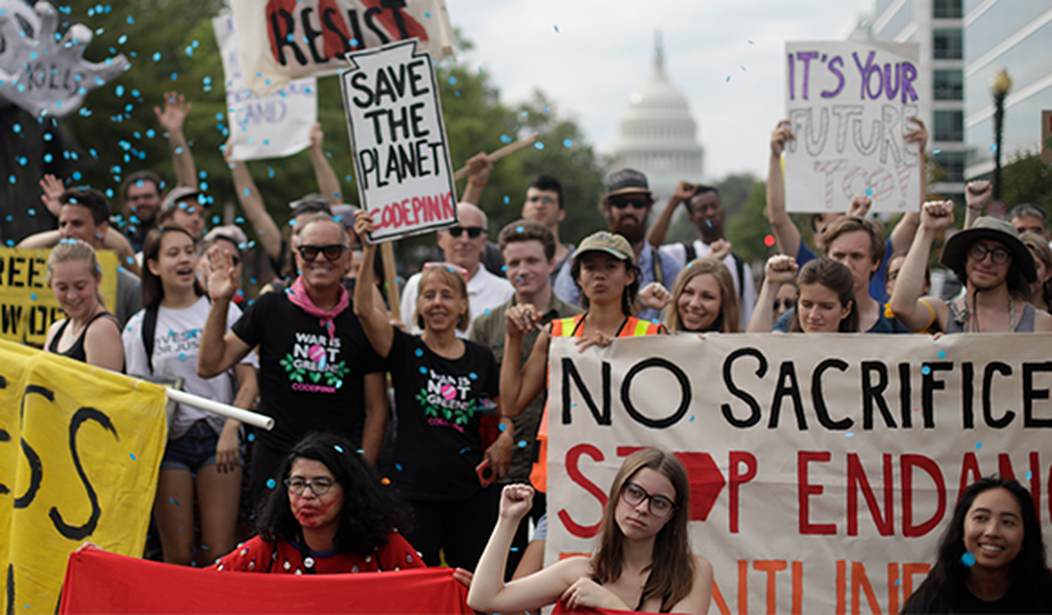
Now look at any of the men - and I use the term "men" in the broadest possible sense - at a climate protest. Ask yourself how secure those guys are in their masculinity.
I don't think I need to say any more.