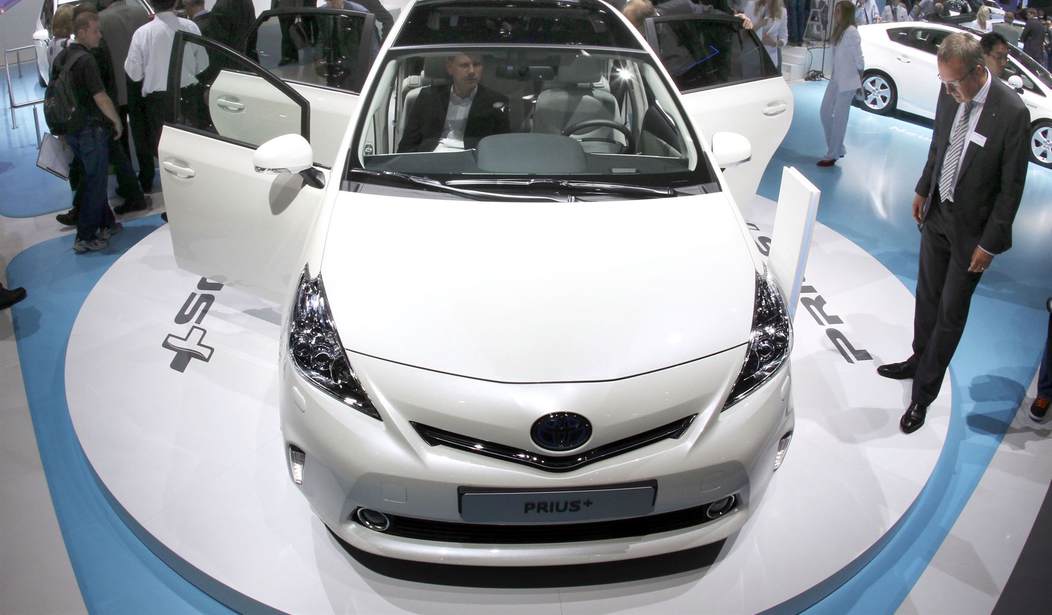

Hybrid cars and trucks have been ballyhooed by climate scolds, environmental activists, and "green energy" advocates alike as one of the big new things in clean transport. Of course, just like a purely electric vehicle, the "electric" side of the hybrid car isn't saving any energy; the same amount of chemical energy, turned into electricity, turned into kinetic energy is required to move a vehicle of a certain weight a certain distance at a certain speed. That's thermodynamics, and I seem to remember there are a few fundamental laws involved. An EV or a hybrid running on its battery is just moving the first part, the conversion of chemical (or nuclear) energy to electricity, back to another location.
Life's full of choices. Some people choose hybrid vehicles or EVs for one reason or another, and that's their business. But it's important to know all the variables before making a decision like this, including the safety inherent in these vehicles. So, when a new report out of the United Kingdom arises showing a driver or passenger is three times as likely to die in an accident in a hybrid vehicle than in a traditional gas (or, as the Brits call it, petrol) vehicle, that's concerning.
Road safety experts were calling for an inquiry on Saturday night as it was revealed motorists are three times more likely to die in hybrids than in petrol cars.
A total of 122 people died in hybrid car crashes last year, compared with 777 in accidents involving petrol cars, according to Department for Transport figures analysed by The Mail on Sunday.
But as hybrids are outnumbered by almost 20 to 1 on Britain's roads by petrol models, that means hybrids are three times more likely to be involved in a fatal crash.
Note that the study doesn't appear to encompass purely electric vehicles; it seems that it's not just the battery and the electric motors that cause the problems. It's the combination of those items with a gasoline tank that causes dangerous fires. These battery and electrical fires are, mind you, fires that burn at very high temperatures and require special equipment to put out.
Experts believe the higher death rates could be explained by hybrids' combination of petrol engines and batteries and electric motors, which can be harder to control and more prone to fires.
The RAC Foundation, a transport research organisation, called for a 'dedicated investigation branch' to look into the trend. 'It's high time we had a specialist resource to address road safety risk', director Steve Gooding said.
The cars' batteries may also be to blame. They can be damaged by the heat of the engine, which burns at extremely hot temperatures, making them more liable to set ablaze.
The high electric current running through the car also increases the risks for passengers involved in crashes. First responders need special training and equipment due to the different nature of hybrid fires, and the potential for toxic gas to be released.
Taken as a whole, this looks a lot like a technology that's not ready for prime time.
Read More: The Federal EV Credit Is Gone - What Happens Now?
Ford Now Dropping All-Electric F-150 Lightning Amid $13B EV Losses
Traditional car fires can be sudden and nasty. Then again, they aren't always so. Many years ago, while driving through South Chicago in the winter, I witnessed a car pulled off the interstate highway with the hood up and the engine compartment in flames; a man, I presume the driver, stood calmly in front of the car, warming his hands over the fire. Now, that's not a prudent thing to do, but with an electrical/battery fire in an EV, he wouldn't be able to get near the broken-down vehicle, and from the looks of this new report, it seems his chances of even escaping the vehicle would have been lower.
We all have to make choices when we buy a vehicle. The general attributes of an EV or hybrid vehicle may make them very attractive to urban/suburban commuters. But, again, it's important to know all the variables, and this research, this revelation that a crash in a hybrid places drivers and passengers in considerably more danger than a traditional benzene-burner; that should be part of the purchase decision.
This is why it's important to know things.
Watts Up With That's Eric Worrell has a personal experience to relate:
I once survived a gasoline vehicle fire, it was nasty, but I had a good minute to escape the vehicle – I had time to pull over, safely get out of the vehicle through the passenger door, and stroll a hundred yards from the vehicle before the fire reached an intensity which would have been life threatening. After the fire was put out by the fire crew, I even managed to recover and salvage my plastic laptop computer. It was scorched and the battery was destroyed, but after a month of drying out it actually booted and survived enough for me to recover my files.
Battery fires are a little more spectacular.
He also presents this as evidence:
One of our daughters has a hybrid Ford Fusion. She likes it; it's her second Fusion, and she's a fan of the platform. But now, much as a father already worries about his daughters, I've got another thing to worry about.