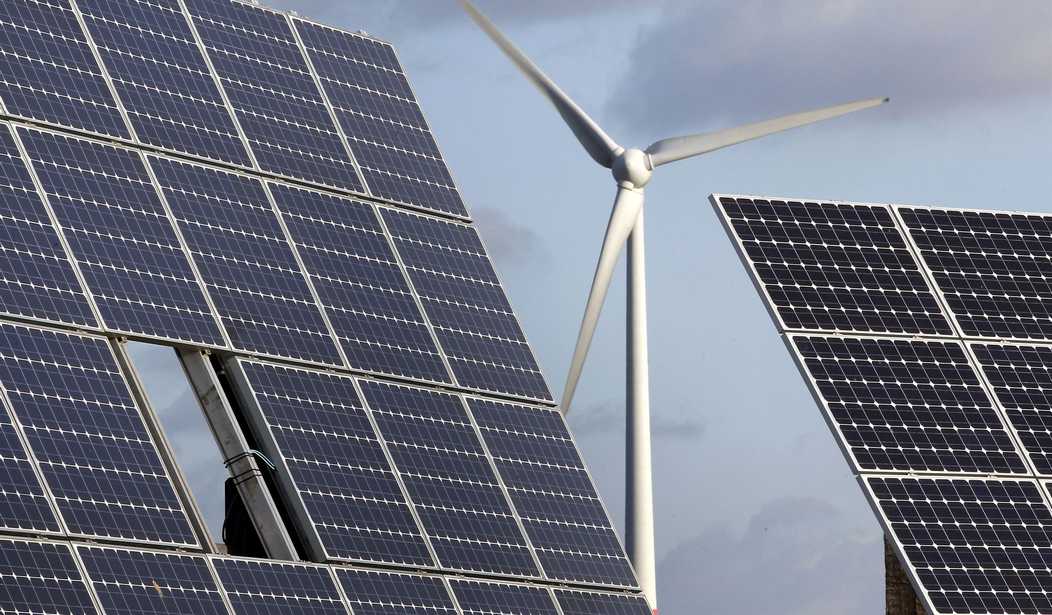

The more we see of the various "renewable" and "green energy" schemes, the worse they look. The problems, as I've been saying and writing for years, are legion when it comes to their basic function: Producing electricity. Low energy density, intermittent supply, the horrible amounts of landscape they take up; one could go on for many pages. I should know - I have.
But, by all means, let's keep piling on. Another problem with these "renewable" boondoggles is cost, not only the costs of building out the installations, but the cost of the electricity produced. Now, a new study has looked at some state-by-state data, comparing states (let's be honest, red states) that depend on traditional fuels to states (let's be honest, blue states) that have gone all-in for renewables.
The results, as The Manhattan Contrarian's Francis Menton informs us, are telling. First, the underlying problem:
I have been writing here for about a decade that wind and solar would inevitably prove to be far more expensive for producing useful electricity than other methods like fossil fuels, nuclear, or hydro. The reasons are not difficult to understand. Wind and solar, due to intermittency, are not capable of powering a full-time electrical grid on their own. To make the grid capable of fulfilling customer demand 24/7/365, wind and solar require large amounts of additional capital infrastructure — dispatchable back-up generation, energy storage, additional transmission capacity, and more. If wind and solar prove insufficient to eliminate dispatchable back-up generation, then you find yourself running (and paying for) two duplicative systems, when you could have had only one. Energy storage as a potential solution to intermittency turns out to be impossibly expensive. If the only back-up generation you can find that works is powered by fossil fuels, then you haven’t even succeeded in achieving zero carbon emissions in the electricity sector.
In a sane world, these things alone would be enough, one would think, to doom these methods. But that state-by-state data is where things really get fun.
Earlier this week a think tank called the Institute for Energy Research came out with a Report titled “BLUE STATES, HIGH RATES ELECTRICITY PRICES: ELECTIONS HAVE CONSEQUENCES.” The Report takes a deep look at five states in particular — California, Florida, Louisiana, Kentucky and New York. Two of those — California and New York — have sought to make themselves the “climate leaders” and have raced to increase use of the renewables and reduce the use of fossil fuels. The other three — Florida, Louisiana and Kentucky — have stuck with fossil fuels. Over time, the prices for electricity as between these two groups of states have diverged dramatically.
You can probably see where this is going. From the report:
According to Lawrence Berkeley National Labs, each of the top five most expensive states for electricity have mandates requiring 100% of their power to come from renewable or carbon-free sources, making their electricity unnecessarily more expensive. These, and other mandates, such as net metering requirements, are driving up prices across America.
In contrast, eight out of 10 states with the lowest electricity prices are reliably red, and seven of these states have no 100% carbon-free mandates. Additionally, 20 of 25 states with the lowest electricity prices are Red states; only four are blue, and one is purple.
That's a pretty stark contrast, and a built-in campaign talking point for 2026 and 2028.
Read More: Primary Energy Fallacy: The Flawed Math Behind Green Hype
Scale Up Now: 100+ New Reactors to Cut Costs and Replace Aging Fleet
Despite the claims of green energy advocates, climate scolds, and Democrats - but I repeat myself thrice-fold - these energy schemes don't save money. The results of the blue states, California and New York, going in for renewables have been higher electricity costs, to go along with their higher costs for gasoline, diesel, home heating oil, natural gas, and, well, just about everything.
Here's the 50-state map mentioned in the report:
— Ward Clark (@TheGreatLander) December 16, 2025
It's not a perfect red-blue correspondence, but it's pretty close; the states of the liberal northeast and California, in particular, are hurting when it comes to electricity costs.
Now, there's more to it than just the methods of generation, as there usually is. For example, our own Alaska has pretty high electrical rates, but Alaska is something of a unique case. Despite having more than ample gas and oil reserves, much of our refined fuels has to come from the lower 48, due to a dearth of refineries in the Great Land. Also, infrastructure in a place as vast and as sparsely populated as Alaska adds to the cost.
New York can't make those claims. Nor can California. And we should also note that taxation and onerous regulation also drive up energy costs in those blue states, with California coming in among the very worst - this is, remember, presumed Democrat 2028 presidential candidate Gavin Newsom's California.
And, indeed, this is where Republicans should focus any discussion on energy policy in the 2026 and 2028 campaign cycles. Focus on the increase in exploration and development, and the concomitant decrease in energy prices, yes, by all means; that's important. But focus also, not just on the uglifying effect that the various renewable energy schemes have on the environment, but also the uglifying effect they have on electricity costs. Our modern society is utterly dependent on reliable, affordable electricity. Without it, we are immediately projected back into the mid-19th century, and our current population cannot be sustained with mid-19th century technology. When electricity costs are high, when electricity is unreliable, we all suffer; every aspect of the economy suffers. The opposite pertains when energy costs are low. The more we look at the data, the more studies unfold, the more information comes to light, the more we see that it is traditional methods of electrical generation - gas, oil, nuclear, and, yes, coal- that are economically viable.
Republicans, are you listening? This is a built-in campaign debate point, one you can win on.