






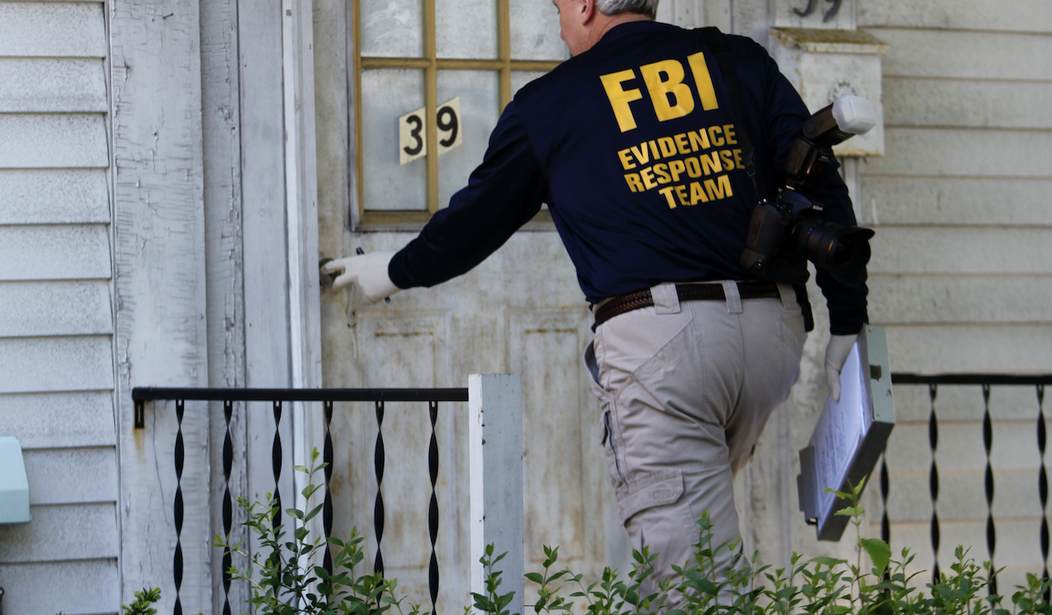
Well, this is awkward.
A federal appeals court has ruled that the United States cannot be held liable for an FBI SWAT team’s raid on the wrong home because the operation involved protected government “discretion.” But the agent who led the raid can potentially be held personally liable because a jury could find his conduct amounted to “plain incompetence.”
If that sounds contradictory, the judges of the 11th Circuit noticed, too.
The case arose from an October 2017 operation targeting alleged gang members in Georgia. FBI agents had arrest and search warrants associated with a home at 3741 Landau Lane.
Instead, at approximately 5 AM, a SWAT team descended on a family living at 3756 Denville Trace. An astute reader might notice those are two distinct addresses. Nevertheless, the agents broke down the door on Denville Trace, detonated a flash-bang grenade, stormed the bedroom carrying rifles, dragged homeowner Hilliard Cliatt from a closet, and handcuffed him. Curtrina Martin was also in the home, as was her 7-year-old son, who was awake and terrified by the raid.
The correct house was three homes away, on a different street and across an intervening intersection. Now, thankfully, it appears that no one in the home wrongly raided was physically injured (or worse). Still, what a terrifying experience.
The SWAT team leader, FBI Agent Lawrence Guerra, blamed his personal Garmin GPS for the mistake. He later threw the device away and, according to the 11th Circuit, has never explained why.
The family sued both the United States under the Federal Tort Claims Act (FTCA) and Guerra individually for violating their Fourth Amendment rights. The case previously reached the Supreme Court, which rejected one defense invoked by the government but sent it back to the 11th Circuit to consider other issues.
On Wednesday, the appeals court delivered a decidedly mixed result.
The unanimous three-judge panel held that the federal government remains protected by sovereign immunity. Under binding 11th Circuit precedent, decisions about planning and executing a raid — including how agents locate and identify the correct home — fall under the FTCA’s “discretionary-function exception.”
In other words, the government generally cannot be sued over those judgment calls, even if they were exercised negligently.
The panel made clear that it was “reluctantly” applying that precedent.
Agent Guerra, however, fared considerably worse. The court reversed the decision granting him qualified immunity, finding that the evidence — viewed in the family’s favor at this stage — could support a finding that he failed to make reasonable efforts to verify the address.
There were ample warning signs. The two homes differed in color, windows, landscaping, and roofline. Street signs and mailbox numbers were visible. Guerra had access to GPS information, Google Maps, photographs of the correct house, and location updates connected to the suspect’s phone.
Evidence also called into question whether Guerra conducted the site survey and morning drive-by he claimed to have completed. Cellphone data from key periods was missing, and the car he used as a reference point — a black Chevrolet Camaro — did not match the suspect’s white Nissan Maxima.
A jury, the court concluded, could find that Guerra violated the family’s clearly established Fourth Amendment rights.
Judge Adalberto Jordan — joined by the other two panel members — then wrote separately to call the 11th Circuit’s interpretation of the discretionary-function exception “a mess.” He questioned how failing to check a street sign, mailbox, or GPS address could qualify as protected policy judgment.
“Must a government agency memorialize such a rudimentary requirement to raid the correct house?” Jordan asked.
Jordan urged the full 11th Circuit to reconsider its precedent, calling this an “exceptionally important” case for doing so.
For now, the federal government is out of the case, but the family’s constitutional claim against Guerra returns to the district court. The plaintiffs may ask the full 11th Circuit to rehear the case and revisit the precedent that shields the government; Guerra could likewise seek further review of the qualified-immunity ruling. If the court declines — or if its eventual en banc decision leaves either side dissatisfied — the case could make its way back to the Supreme Court.
As it stands, though, the law has produced a difficult result: The government cannot be held responsible because the raid involved official discretion, while the agent may be held responsible because the manner in which he exercised that discretion allegedly crossed the line into plain incompetence. For a family whose door was broken down, home stormed, and child terrified because federal agents failed to verify an address, that distinction may not feel like much of a remedy at all.
Editor's Note: Do you enjoy RedState's conservative reporting that takes on the radical Left and woke media? Support our work so that we can continue to bring you the truth.
Join RedState VIP and use promo code FIGHT to receive 60% off your membership.



Join the Conversation
VIP members get the ability to comment on articles.